The art of Jo Whaley

whaley1.jpg

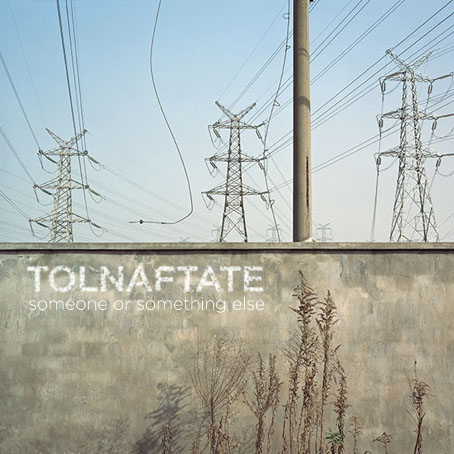
Papilio ulysses (2000).

Best. Insect Art. Ever. From a series entitled The Theater of Insects, also the name of a book devoted to Ms Whaley’s photographs which will appear from Chronicle Books later this year.

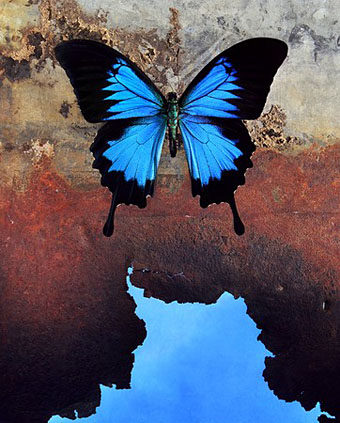
The photographs in this book are fantastic field illustrations. While the insects in these images are real, the backgrounds are imaginary altered habitats of my devising. Inspired by the old dioramas found in natural history museums, the pinned insects are arranged in constructed environments. The studio where I create the images is as much a theatrical scene shop as it is a photography studio. The prop room looks like an eighteenth-century cabinet of curiosities, in that it is filled with specimens of natural history and visual oddities of manufacture. I use free association and intuition to make decisions about arranging the insect with a particular backdrop. Looking at color, shape, and form, I move the elements about until the magic of the image appears. Lighting the scene is challenging as the sets are only about five by seven inches across with a depth of about an inch and a half. Yet the studio lighting is key to breathing a spirit into these pinned specimens and unifying the disparate elements within the mise-en-scène Finally, the performance of the image is concluded with a single click of the camera’s shutter. (More.)
whaley2.jpg

Coleoptera (2003).

Via Fabulon.

Previously on { feuilleton }
Endangered insects postage stamps
Robert Lang’s origami insects
Lalique’s dragonflies
Lucien Gaillard
Wesley Fleming’s glass insects
Insect Lab

The recurrent pose 17

lynnes1.jpg

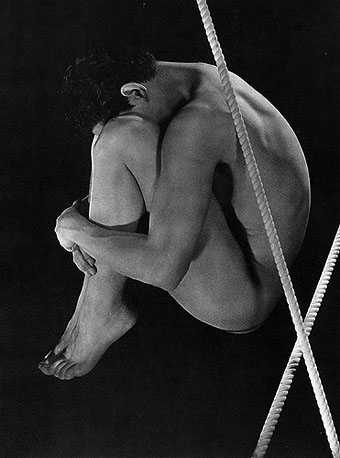
The Flandrin pose again, this time in a photograph by George Platt Lynes (1907–1955). This is from a Flickr set of Lynes’ work which was a nice find since many of the web collections are small and tend to repeat the same material.

lynnes3.jpg

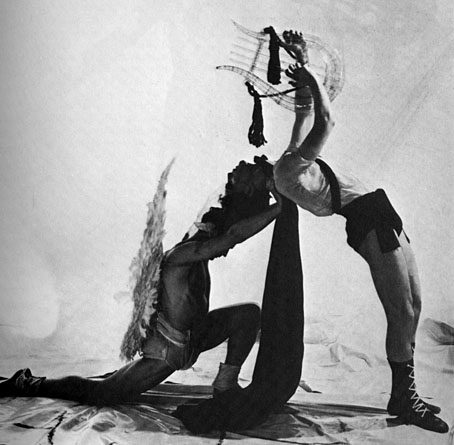
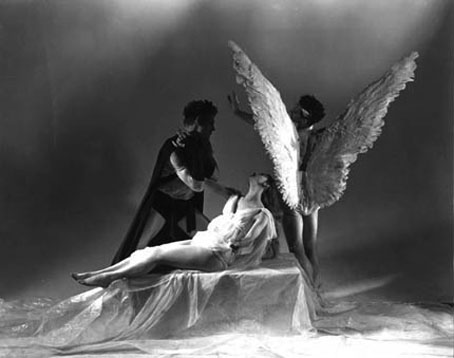
The picture above isn’t from the Flickr set, it’s a scan from Philip Core’s essential Camp: The Lie that Tells the Truth (1984), and a photograph that long fascinated me for completely unwholesome and inartistic reasons. Core credits it only as depicting dancers from Balanchine’s Icarus but I’d suspected for some time it was a Lynes picture, Lynes having photographed Balanchine’s dancers on several occasions, notably in some nude stagings of Orpheus. The Flickr picture below confirms the Lynes origin although it adds a new layer of mystery by crediting it to Balanchine’s Die Fledermaus. Given the very Classical look of the dancers’ costumes I suspect Core has the correct attribution but the confusion is also an excuse to keep searching.

lynnes2.jpg

Elsewhere on { feuilleton }
The recurrent pose archive

Previously on { feuilleton }
Philip Core and George Quaintance
George Platt Lynes

Take Your Time: Olafur Eliasson

eliasson.jpg

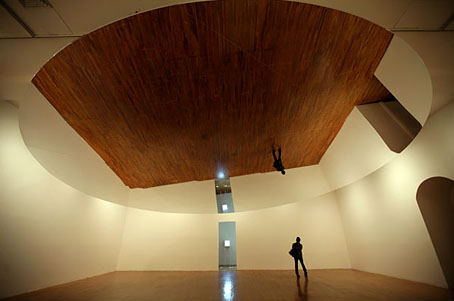
New work by Danish artist Olafur Eliasson is always welcome here and the above is exactly that, a large rotating mirror installed at the P.S. 1 Contemporary Art Center, New York, along with other pieces comprising a major survey of his work.

Take Your Time a new piece at P.S. 1, made for the show, consists of a huge, tilted, disc-shaped mirror suspended horizontally from a gallery ceiling. What strikes you at first is the omniscient, bird’s-eye reflection of the room below, with you standing in the middle of it. Then you notice that the mirror is rotating very slowly, and with a subtly undulating motion that causes the room itself feel warped and unstable. You experience this as much with your sense of balance as with your eyes.

The New York Times takes a critical look at Eliasson’s work and complains about his not being radical enough, an objection which seems curiously old-fashioned as well as being the kind of issue that only plagues art critics, other artforms getting on perfectly well without concerning themselves with being avant garde and challenging above all else. Better to ignore the redundant polemic and look at the slide show of his works.

Take your time: Olafur Eliasson runs until June 30, 2008.

Previously on { feuilleton }
Olafur Eliasson’s BMW
Olafur Eliasson’s Serpentine Pavilion
New Olafur Eliasson

The CD cover meme

Okay, here’s a web meme I can really get behind…. I’ve never been tempted to try one of those long list affairs filled with questions such as “what was your favourite breakfast cereal when you were a child?” The CD cover meme is more my kind of thing and it goes like this:

1. http://en.wikipedia.org/wiki/Special:Random
The first article title on the page is the name of your band.

2. www.quotationspage.com/random.php3
The last four words of the very last quote is the title of your album.

3. www.flickr.com/explore/interesting/7days/
The third picture, no matter what it is, will be your album cover.

4: Combine all three elements in your photo editing software.

5: Share

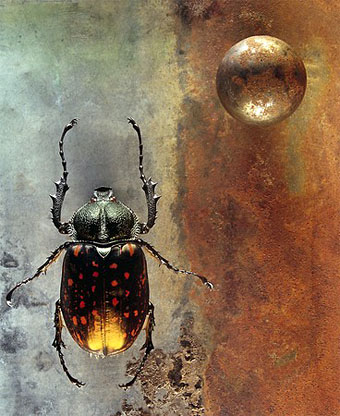
Et voila! Without further ado I give Someone or Something Else by Tolnaftate, that well-known Berlin Techno outfit.

tolnaftate.jpg

Someone or Something Else by Tolnaftate, Feuilleton Records, 2008.

For the record (as it were), Tolnaftate is “a synthetic over-the-counter anti-fungal agent. It may come as a cream, powder, spray, or liquid aerosol, and is used to treat jock itch, athlete’s foot and ringworm”, and the quote, I’m pleased to say, was from HL Mencken, “All successful newspapers are ceaselessly querulous and bellicose. They never defend anyone or anything if they can help it; if the job is forced on them, they tackle it by denouncing someone or something else.” The pylons were unwittingly supplied by this Flickr user. Flickr has a pool devoted to this meme and they encourage you to add your own creations.

Via Sleevage which features some choice examples.

Elsewhere on { feuilleton }
The album covers archive