Babobilicons by Daina Krumins

krumins.jpg

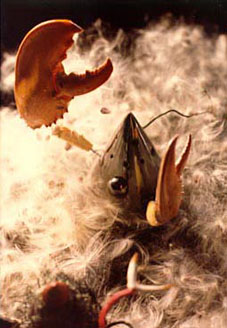
A Babobilicon.

Daina Krumins’ Babobilicons is a truly surrealist work in terms of both its process and product. Krumins takes time to make her films. It took her nine years to create this remarkable animated short, yet her method is in line with the surrealist affinity for chance operation. She cultivated slime molds on Quaker five-minute oats in her basement, planted hundreds of phallic stinkhorn mushrooms, and put her mother behind the camera to film them growing. The results are sexual and bizarre. She combined ordinary objects—wallsockets, candles, and peeling paint—to get unnerving, dreamlike images. Porcelain fish jump through waves; mushroom erections rise and fall. Her Babobilicons—robotlike characters that resemble coffee pots with lobster claws—move through all this with mysterious determination. Anyone who order 10,000 ladybugs from a pest control company to film them crawling over a model drawing room definite possesses a sense of the surreal. Renee Shafransky, The Village Voice

So now tell me you’re not intrigued…. I’ve seen Daina Krumins’ earlier film, The Divine Miracle (1973), a strange procession of religious imagery inspired in part by the kitsch of Christian postcard art. I haven’t seen Babobilicons (1982) unfortunately, but if the singular atmosphere conjured by the earlier work is anything to go by it should be quite something. There’s also a later Krumins’ film which seems equally surreal, Summer Light (2001), about which this NYT appraisal says “Giant milkweeds float about the landscape, babies play with fiery leaves and deer antlers jump out of water like salmon.”

Read more about the films here and here, including details of how to buy them on VHS. Surely a DVD release is overdue?

Previously on { feuilleton }
Mushrooms on the Moon
Impressions de la Haute Mongolie

Books for Bloomsday

bloomsday.jpg

Ulysses is a book to own, a book to live with. To borrow it is probably worse than useless, for the sense of urgency imposed by a time-limit for reading it fights against the book’s slow pace, a leisurely music that requires an unhurried ear and yields little to the cursory, newspaper-nurtured eye. Most of our reading is, in fact, eye-reading—the swallowing whole of the cliché, the skipping of what seems insignificant, the tearing out of the sense from the form. Ulysses is, like Paradise Lost, an auditory work, and the sounds carry the sense. Similarly, the form carries the content, and if we try to ignore the word-play, the parodies and pastiches, in order to find out what happens next, we are dooming ourselves to disappointment.

Thus spake Anthony Burgess in 1965. This year as Bloomsday rolls around again I find myself actually reading Ulysses on the day itself. I decided recently that enough time had elapsed since my last Joycean excursion and this time did something else I’d not tried before, reading Dubliners, A Portrait of the Artist as a Young Man and Ulysses in sequence. The story of Leopold Bloom’s walk around the city was originally intended as a shorter piece for the Dubliners collection and many characters from Dubliners and Portrait turn up again in the later novel.

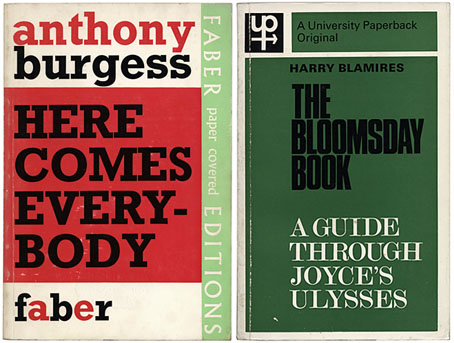
I first encountered Ulysses when I was about 17 and despite having read a fair amount of experimental or challenging fiction by that time still found it difficult and frequently nonsensical. A lack of context was the problem; one of the failings of the book—if we have to look for failings—is that it really does help to know something about Joyce’s intentions which otherwise remain opaque to an uninformed reader. So my first proper reading of the novel was helped considerably by the discovery in a library of Harry Blamires’ Bloomsday Book (1966) which goes through the entire novel virtually page by page, examining the symbolism and correspondences layered into the text.

Joyce’s alter-ego in Portrait and Ulysses was Stephen Dedalus, named after the mythological Daedalus who built the labyrinth for the minotaur. Anthony Burgess in Here Comes Everybody: An introduction to James Joyce for the ordinary reader (1965) describes Ulysses as Joyce’s labyrinth and both the Blamires and Burgess books are excellent guides to its literary maze. Blamires examines the minutiae (and occasionally overdoes the reading of religious symbolism) while Burgess takes a superb tour through the entire corpus, often bringing to Ulysses a quality of understanding which Blamires lacks. Here Comes Everybody is an ideal introduction for those curious about Joyce’s work and reputation but who feel intimidated when they pick up the books. It’s a shame that Burgess’s title—a phrase of Joyce’s lifted from Finnegans Wake—has been hijacked recently by a book about internet culture. Burgess’s book also appears to be out of print so anyone looking for a copy is advised to try Abebooks.com. Blamires’ book is still in print in a revised edition and for another notable writer’s view there’s Nabokov’s lucid exposition in his Lectures on Literature. And if all that doesn’t satisfy, there’s always The Brazen Head.

Previously on { feuilleton }
Finnegan begin again
T&H: At the Sign of the Dolphin

Stamps of horror

hammer_stamps.jpg

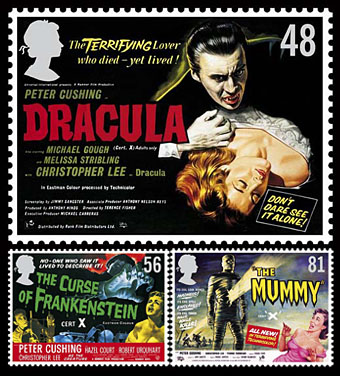
The Royal Mail continues to rifle popular culture for suitable anniversary subjects, this week following its series of James Bond postage stamps with stamp sets celebrating the 50th anniversaries of Hammer’s first run of horror films and the Carry On series. I don’t think I’d use the word “celebration” in the case of the latter, I seem to be in the minority in always having regarded the Carry On films with considerable loathing, despite the best efforts of Kenneth Williams (who hated them) and company; give me some wit, please, not the laboured double entrendres of Talbot Rothwell.

Grievances aside, it’s gratifying to see the original posters used for these stamp designs, the Dracula one is especially good, suitably so seeing as it’s the best film of the lot. “Politicians, ugly buildings, and whores all get respectable if they last long enough,” says Noah Cross in Chinatown; based on this evidence the same could also be said of cheap cinema.

Previously on { feuilleton }
Horror comics
Endangered insects postage stamps
James Bond postage stamps
Please Mr. Postman
Hail, horrors! hail, infernal world!

Happy birthday Henry

tuke1.jpg

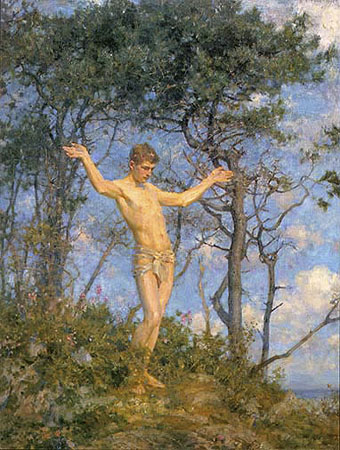
The Sunworshipper (To the Morning Sun) (1904).

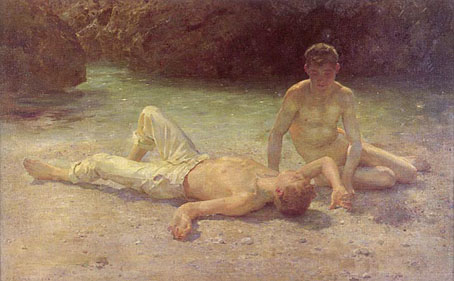
Thanks to Mr Jahsonic for noting the 150th anniversary of the birth of Henry Scott Tuke (1858–1929). The current exhibition of his paintings at the art gallery in Falmouth, where he lived and worked, labels him a British Impressionist, avoiding mention of his status as principal painter among the loose collection of Victorian and Edwardian artists and writers known as the Uranians. Tuke’s beach scenes present a hazy vision of sun-drenched adolescent homoeroticism with a quality rarely seen in gay art today. This site has the best online selection of his pictures.

tuke2.jpg

Noonday Heat (1902).

Elsewhere on { feuilleton }
The gay artists archive