The art of Michael Dotson

dotson.jpg

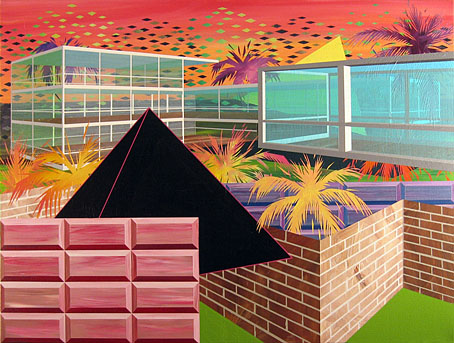
Dream House #3 (2009).

Many of Michael Dotson‘s vivid acrylic paintings would make good illustrations for JG Ballard books or for some of his more hallucinatory short stories. Not all of these stylised urban landscapes and empty sports arenas have the requisite latent menace to be truly Ballardian but the anomalous black pyramid in Dream House #3 carries a weight of sinister implication. Pseunami (2005), meanwhile, depicts a vibrantly abstracted catastrophe.

Via Core 77.

Previously on { feuilleton }
Ballard and the painters
AVAF at Mao Mag

Le Phallus phénoménal

denon.jpg

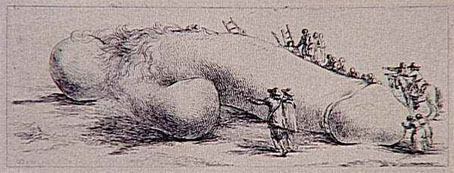
Le Phallus phénoménal (1793–1794).

This blurred and discoloured picture arrives following a discussion with Paul Rumsey in the comments for an earlier post about engravings of monstrous whales. The pictures there were by engraver Hieronymus Cock whose surname gives us an additional resonance when discussing Moby Dick and sperm whales. The picture I posted of Jan Saenredam’s stranded whale showed the dead creature’s considerable penis (another engraving does the same) which led Paul to alert me to Dominique Vivant’s mischievous play on these pictures, where the artist exchanges the whale for a Brobdingnagian phallus. Or perhaps it’s merely a Gulliverian phallus and those people are Lilliputians… Whatever the case, I then mentioned to Paul JG Ballard’s story ‘The Drowned Giant’ from Ballard’s Terminal Beach collection which concerns the body of an enormous human found washed on a beach and subject to similar scrutiny by townspeople as in the stranded whale pictures. The body is eventually dissected and sold off. Paul reminded me of the end of the piece where Ballard writes:

As for the immense pizzle, this ends its days in the freak museum of a circus which travels up and down the north-west. This monumental apparatus, stunning in its proportions and sometime potency, occupies a complete booth to itself. The irony is that it is wrongly identified as that of a whale…

…which brings us full circle. Perhaps fittingly, Ballard’s story was published in Playboy magazine in 1965 under the title ‘Souvenir’.

As for Dominique Vivant (1747–1825), aka the Baron de Denon, his prestigious career besides engraving included, among other things, the directorship of the Louvre. We’re told he also wrote an erotic novel, Point de lendemain, and produced a selection of pornographic etchings, of which Le Phallus phénoménal would seem to be a part. Let no one accuse the French of being prudes; the picture above is from a site where you can order framed prints should you have a sudden urge to hang a phenomenal phallus on your wall.

Elsewhere on { feuilleton }
The etching and engraving archive

Previously on { feuilleton }
Of the Monstrous Pictures of Whales
Jan Saenredam’s whale
The Whale again
Rockwell Kent’s Moby Dick
Phallic bibelots
Phallic worship
The art of ejaculation

L’Androgyne

seon.jpg

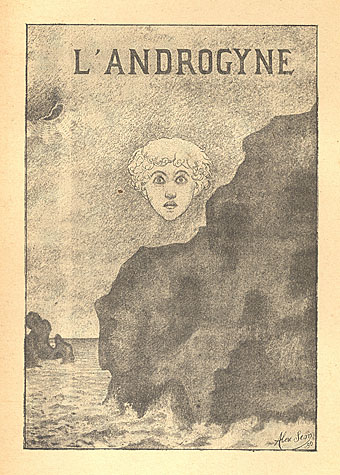
L’Androgyne by Alexandre Séon (1890).

Related to yesterday’s post, I’ve been re-reading various books this week for details of the most curious character associated with the French Symbolist movement, novelist and occultist Joséphin Péladan (1859–1918), also known as Sâr Peladan, a Babylonian title he bestowed upon himself as more befitting his adopted role as Rosicrucian mystic. Péladan’s writings and occult art theories spurred many of the painters who banded together as part of his Salon de la Rose+Croix, a kind of anti-salon intended to stand in opposition to what the Sâr saw as the drab realism of the Impressionists and the staid historicism of academic painters. One gets the impression reading about Péladan that he was probably a rather preposterous figure—his obsession with androgyny caused him to change his forename from Joseph to Joséphin yet he kept his length of bristling beard. But, like Oscar Wilde in London, his presence in the pool of fin de siècle art creates considerable ripples. Alexandre Séon, whose frontispiece above was created for Péladan’s semi-autobiographical essay, L’Androgyne, was particularly devoted to him, as was Carlos Schwabe. Séon’s picture depicts “the androgyne Samas, stupefied by the sexual enigma”, a character with whom Péladan fully identified as he describes his youth and its apparent state of androgynous grace.

mitchenko.jpg

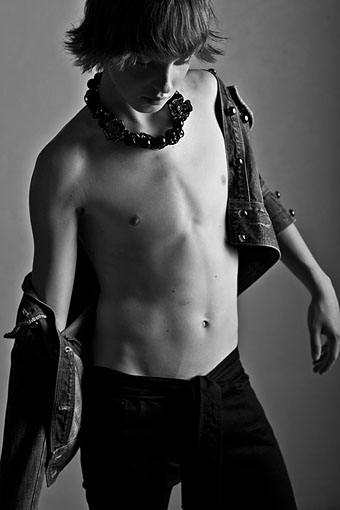
One doesn’t need a Rosicrucian salon today for examples of creative androgyny, of course, all you have to do is go to Flickr where you’ll find creatures such as the boy above from Roman Mitchenko’s photostream. The photos there are at the fashion end of the spectrum; for more of an amateur or semi-professional perspective there are groups like the Androgyny pool, and the Mommy, I want to be androgynous! pool, the latter featuring many striking boyish girls and girlish boys.

Previously on { feuilleton }
Arthur Tress’s Hermaphrodite
Carlos Schwabe’s Fleurs du Mal
Czanara’s Hermaphrodite Angel

Delville, Scriabin and Prometheus

delville1.jpg

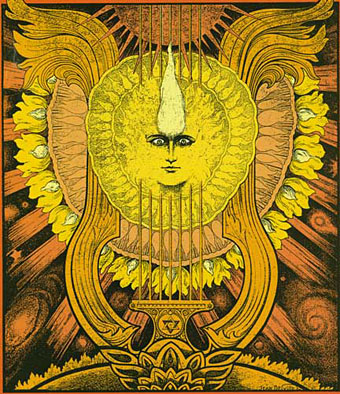
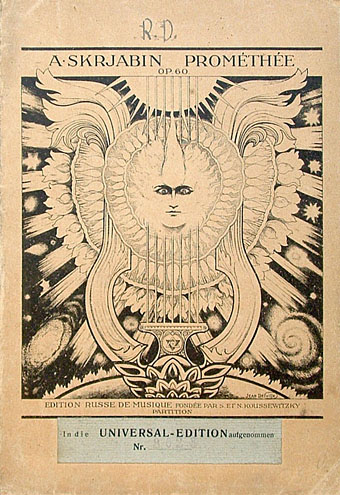
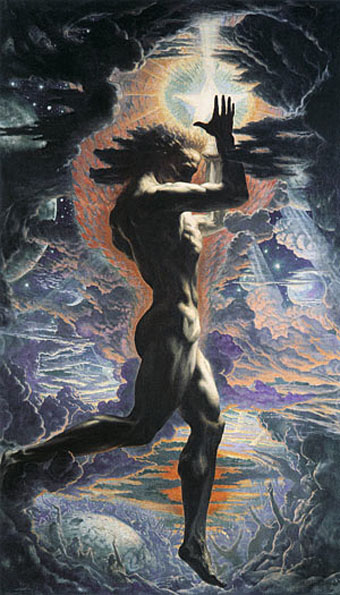
Another striking design found by chance. Symbolist artist Jean Delville (1867–1953) created this sheet music title page for Promethée by Scriabin in 1912, and the pair are well-matched given their shared predilection for mysticism (Theosophy in Delville’s case). Delville had also dealt with Prometheus in a typically dramatic, if sexless, picture a few years earlier (below). Once again it’s unfortunate that one of the really great artists of the Symbolist period is so poorly-served by the web that one has to discover his work by accident. There’s a dedicated site here but the gallery pages are only harvesting what’s already scattered around. Delville had a long and consistently high-quality career; he deserves better.

delville2.jpg

delville3.jpg

Prometheus (1907).

Update: Dave C reminds us of another Delville site with a better selection of pictures including a photo of the artist at work.

Previously on { feuilleton }
The faces of Parsifal
Masonic fonts and the designer’s dark materials
Angels 4: Fallen angels