
Mirror, mirror | Simon Callow on The Picture of Dorian Gray.
Echoes of the Cities
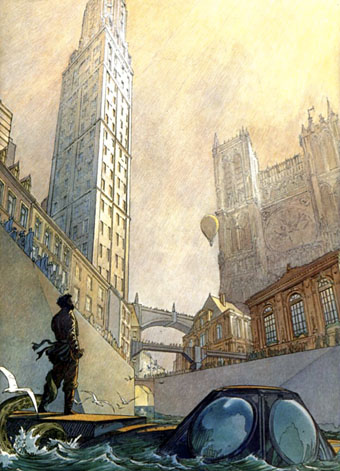
Mysterieux retour du Capitaine Nemo.
This week has been incredibly hectic work-wise but I’ve managed to keep these posts going, so here’s the last one devoted to an appreciation of the Cités Obscures of François Schuiten and Benoît Peeters. A week of posts barely scratches the surface of their vast and involved creation of alternate worlds, fantasy design and architecture, and Borges-like metaphysical speculation. When I try to explain my disaffection with the popular end of American comics, it’s works such as these which I offer as an alternative. The problem, of course, is that only a handful of the books have been translated into English, a detail which tells you all you need to know about English-speaking comics publishers and—since demand fuels the market—their readers.
This final set of pictures is a selection from Schuiten and Peeters’ L’Echo des Cités (1993), a facsimile edition of the main newspaper which serves the cities of the Obscure World. Unfortunately, this remains untranslated but the bulk of the book is full-page illustrations, many of which are among Schuiten’s best. A number of these were later reprinted as limited lithograph prints.
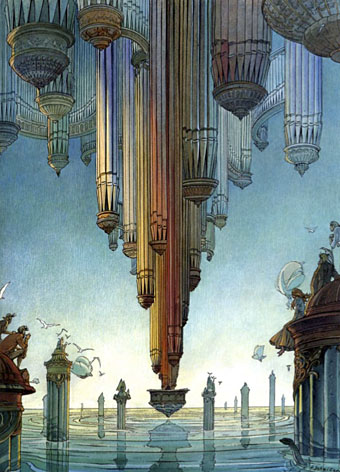
Les rêves engloutis d’Oscar Frobelius.
Further tales from the Obscure World
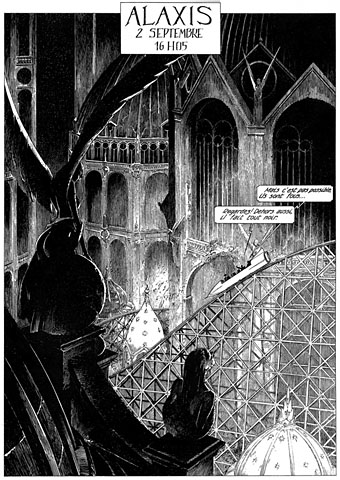
L’enfant penchée.
We’re at the penultimate post in this week-long tribute to the Cités Obscures series of François Schuiten and Benoît Peeters, and there isn’t enough space left to cover some of the more recent volumes in detail. What follows is a quick skate through three more major works.
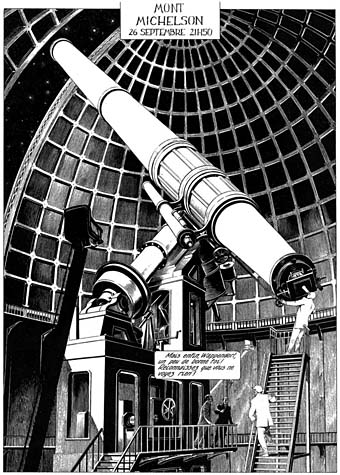
L’enfant penchée.
L’enfant penchée (1996), or The Leaning Child, is an expanded version of a 1995 children’s story by Schuiten and Peeters, Mary la penchée. Mary is the young daughter of wealthy industrialists from Mylos struck down one day by some cosmic calamity which shifts her centre of gravity, causing her to permanently lean at an apparently impossible angle. When she’s bullied at school she runs away and joins a circus. A meeting with scientists and astronomers leads to a resolving of her affliction, and the repairing of her ruined life. This is a fascinating story for a number of reasons, not least the existence of a parallel narrative taking place in our world which is conveyed using photographs, and which unveils some of the metaphysical aspects of the Obscure World. The story of Mary is also flawlessly drawn. Schuiten uses a black-and-white style modelled on the work of old magazine illustrators like Franklin Booth, and there are further references to Winsor McCay and Jules Verne.
Brüsel by Schuiten & Peeters
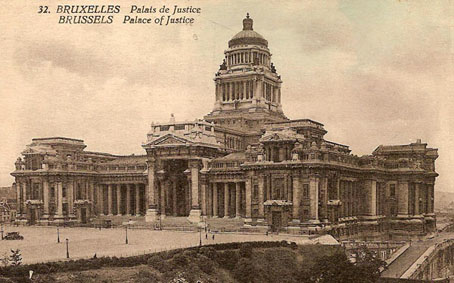
The Palace of Justice, Brussels.
Brüsel (1992) by François Schuiten and Benoît Peeters follows La route d’Armilia as the next major work concerning the Cités Obscures. As with La Tour, this is a longer story where it isn’t immediately apparent that we’re in the Obscure World at all, although Brüsel is clearly an alternate version of our Brussels. The unfinished Palace of the Three Powers in the city centre is modelled on the Palace of Justice in Brussels, and both buildings share architects by the name of Joseph Poelaert.
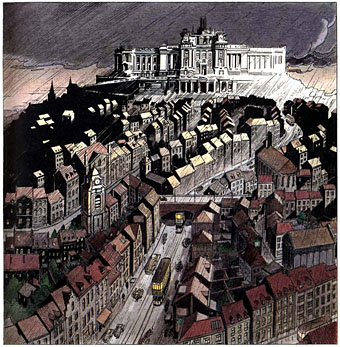
The Palace of the Three Powers, Brüsel.
Brüsel is a “small man” tale of Constant Abeels, a would-be shopkeeper preparing to launch a business selling a new and modern innovation: plastic flowers. Abeels suffers from a persistent cough, and it’s a combination of his health problems and business problems—the water for the shop is disconnected—that causes him to become enmeshed in schemings to radically transform the city, and the resistance to those plans. The tale is also a satire on the overly-optimistic march of progress of the late 19th and early 20th century, with all the problems of trying to impose sudden architectural change on a change-averse community. Inhabitants of Brussels have a long history of sudden architectural change, the huge Palace of Justice being constructed only after residents of the area had been forcibly evicted. In the 1950s and 60s, the flattening of old quarters in order to build New York-style office blocks was so destructive that the French coined the term “Brusselisation” to describe a brutal remodelling of a city against the wishes of its citizens.
La route d’Armilia by Schuiten & Peeters
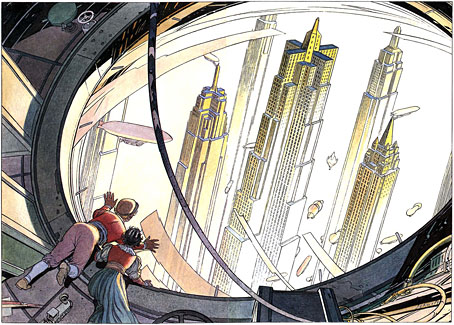
Ferdinand and Hella look down on the skyscrapers of Brüsel.
La route d’Armilia (1988) by François Schuiten and Benoît Peeters is the next substantial story in the Cités Obscures series after La Tour; there was also a book about transportation in the Obscure World, L’Encyclopédie des transports présents et à venir, published the same year. La route d’Armilia is the book where Schuiten and Peeters’ Jules Verne influence comes to the fore, with the story of a young boy whose name is derived from Verne characters, Ferdinand Robur Hatteras, undertaking an airship journey to Armilia at the Obscure World’s northern pole. As with the earlier L’archivist, this is mainly an excuse for Schuiten to demonstrate his prodigious architectural invention and draughtsmanship, although the story this time is more of a piece. The journey takes us from the city of Mylos—a dismal place of factories, chimneys and smoke, like one of the polluted cities of the early Industrial Revolution—over the cities of Porrentruy, Mukha, Brüsel, Bayreuth, Calvani, Genova and København. Each city is substantially different from the last, and one of the pleasures is seeing what the next stop along the way will be like.
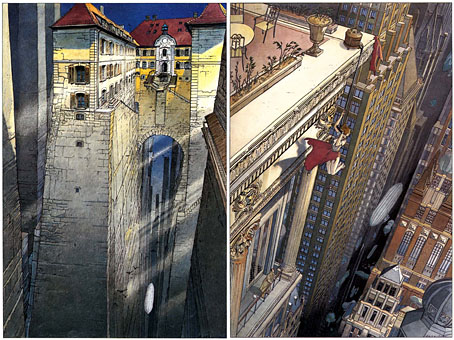
left: the airship passes through the canyon streets of Porrentruy; right: in Brüsel a woman hangs perilously from a ledge. Acrobatics or accident, we never discover which.