Through the Wonderwall

wonderwall1.jpg

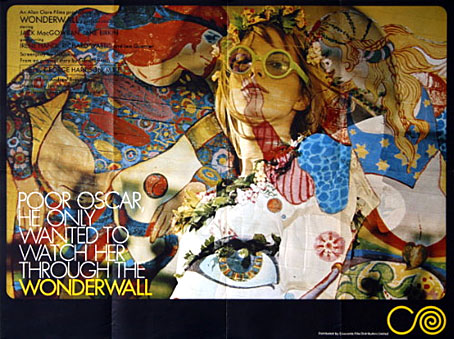
It’s taken me years but the recent obsession with UK psychedelia led me to finally watch Joe Massot’s piece of cinematic fluff from 1968, Wonderwall, a film distinguished primarily for its score by George Harrison (with Ringo Starr and Eric Clapton playing pseudonymously), and its title which was swiped years later by a bunch of Rutles-imitators from Manchester. The story is so slight it would have barely sustained an hour-long TV film: absent-minded scientist (Jack MacGowran) becomes intrigued by his glamorous neighbour (Jane Birkin playing “Penny Lane”; yeah, right…) and knocks holes in the walls of his flat in order to scrutinise her modelling, partying and frequent undressing. Unlike Blow Up (1966, and also featuring Jane Birkin) and the later Performance (1970), both of which attempted to accurately pin down some of the modish aspects of the period, this is a very kitsch piece. That wouldn’t be so bad if it was entertaining kitsch like, say, Smashing Time (1967), but Massott has to resort to scenes of limp comedy and some rather dull dream sequences in order to pad the thing out. Between the handful of actual dialogue scenes there’s a lot of gloating over Ms Birkin’s flesh which no doubt satisfied one half of the audience but by today’s standards is hardly thrilling. Iain Quarrier plays Penny’s duplicitous boyfriend (with a fake Liverpool accent) in his last screen role before he quit acting. Quarrier and MacGowran had appeared together in two of Roman Polanski’s British films, Cul-de-sac (1966) and Dance of the Vampires (1967). In the latter, MacGowran again plays an absent-minded scientist while Quarrier is cinema’s first (?) gay vampire.
wonderwall2.jpg

An interjection from The Fool.

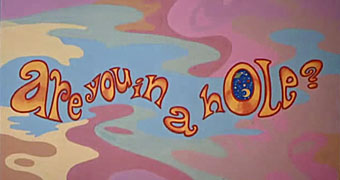
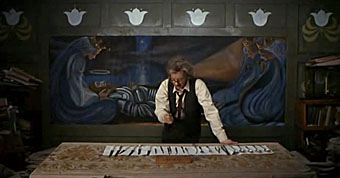
Of chief interest for me in Wonderwall was the decor and title card decorations by Dutch psychedelic collective, The Fool (who also appear in the party scene), famous for their earlier Beatles associations including the inner sleeve for Sgt Pepper and designs for the short-lived Apple Boutique in London’s Baker Street. I was also curious about the distinctive decor of MacGowran’s flat which contrasts with the psychedelia next door, all dark green walls embellished with Victorian murals and a Tennyson poem—very fittingly a piece called The Daydream—which circles the room.
wonderwall4.jpg

The professor prepares to attack the wall.

This was particularly interesting in that it made another connection between the psychedelic era and Victorian arts movements, especially from the Aesthetic/Arts & Crafts end of things, but it wasn’t at all obvious whether the connection was an intentional part of the film’s production design or an accident of location and budgetary convenience. Aside from the old-fashioned appearance of MacGowran’s rooms there seemed no reason why his otherwise cultureless character would have any interest in decorating his living space in this way.
wonderwall3.jpg

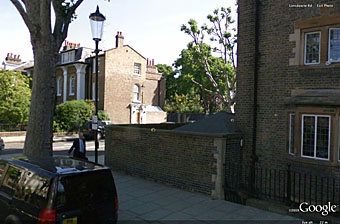
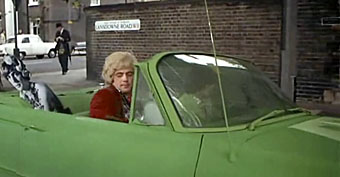
The street corner then…

google1.jpg

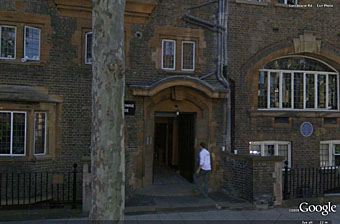
…and now.

google2.jpg

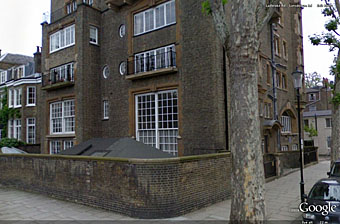
The building itself is equally distinctive and an exterior shot conveniently shows a street sign placing the location in Lansdowne House, a Victorian apartment block on the corner of Lansdowne Road and Ladbroke Road in the Notting Hill/Holland Park area of London.
google3.jpg

Lansdowne House.

What did the building look like today, I wondered? Google Earth proves indispensable at times like this and it was easy to find, in a street which looks more cramped than it does in the film. The presence of a blue plaque on the wall proved intriguing, a sign that the place once had famous residents. Googling for that revealed this photo which was a real surprise: Lansdowne House at one time contained studios for artists who included Charles Ricketts and Charles Shannon, a gay couple and leading lights of London’s fin de siècle art scene (also friends of Oscar Wilde), and another artist, James Pryde, who with William Nicholson worked as The Beggarstaffs. So my suspicion about the Arts & Crafts decor was correct, which means that MacGowran’s flat may have been decorated that way originally and remained untouched since the 1890s. I haven’t seen Rhino’s special edition of Wonderwall which contained additional information about the making of the film, so have no idea whether the history of the building is mentioned there. If anyone does know, please leave a comment. For now I’m quite happy to have stumbled upon another minor link between two of my favourite art decades.

For more visuals, this page has a host of screen grabs from the film as well as some gif animations, all of which manage to make Wonderwall seem more interesting than it is when you’re watching it.

Previously on { feuilleton }
Charles Ricketts’ Hero and Leander
Images by Robert Altman

Booklife by Jeff VanderMeer

booklife.jpg

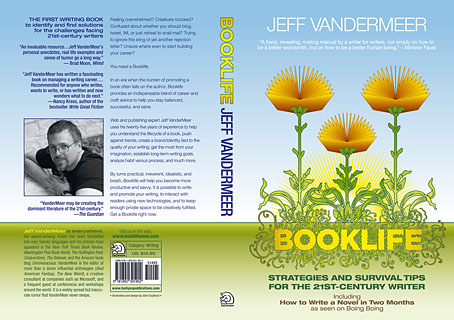
Yet another of the titles I’ve been working on this year—yes, it’s been a very busy time—Booklife took several months of back and forth on the part of author, editor and designer before we had something that everyone was happy with.

Offering timely advice in an era when the burden of production and publicity frequently falls on authors, this essential reference reflects on methods for being focused, productive, and savvy in the craft of writing. Discussing a wide range of essential topics for self-promoting authors, this important guide explores questions such as How can authors use social media and the internet? How does the new online paradigm affect authors, readers, and the book industry? How can authors find the time to both create and promote their work? and What should never be done? Through good-humored encouragement, practical tips of the trade culled from 25 years of experience as a writer, reviewer, editor, publisher, agent, and blogger are shared. Including topics such as personal space versus public space, deadlines, and networking, the benefits of interacting with readers through new technologies is revealed.

After all the work it’s been good to see the book receiving such a positive reception this week, with a feature spot on Boing Boing and a high placing in Amazon’s book listing. Back in February I wrote a lengthy post about the evolution of the cover design, and that post has been reproduced at the Booklifenow site which serves as an online extension of the book itself. Web designer Luís Rodrigues did a great job of matching the site design to the cover.

Update: The cover at unaccountably large size on Wired.com

Previously on { feuilleton }
Designing Booklife

Eyecandy

eyecandy.jpg

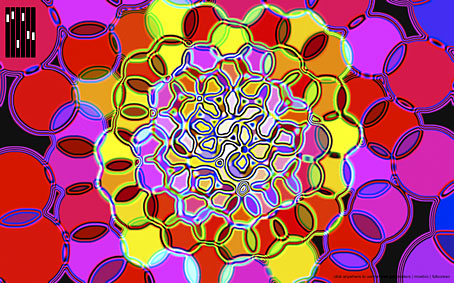
Continuing a rather psychedelic week, Eyecandy is another of those groovy web toys, this time putting you inside a kaleidoscopic sphere of coloured circles whose parameters you can change with sliding controls. Fun to mess with when the right music is playing.

And while we’re on the subject, my new calendar has been selling very well thanks to some generous linkage from Arthur Magazine, Jeff VanderMeer, Boing Boing, Trendhunter, and others. Thanks to everyone who’s bought one, I’ll definitely be following this with something similar, not least a set of illustrations for Through the Looking-Glass. And Jabberwocky, yes, have to do something special for that…

Previously on { feuilleton }
The Kaleidoplex
Colorscreen

The art of Robert Sherer

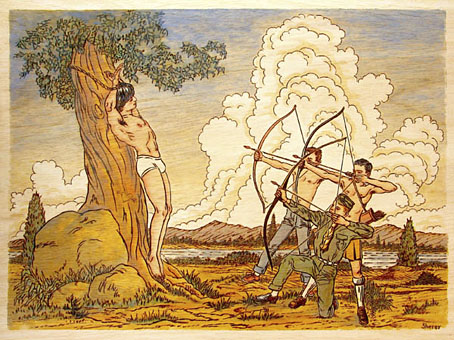
sherer1.jpg

American Martyr.

The Sebastian-esque piece above is a pyrograph by American artist Robert Sherer. Pyrographs—pictures burned onto wood—aren’t very common here but are a fixture of craft classes at US summer camps. Sherer adopts the medium to subvert the wholesome orthodoxies of American life, that side of America which persistently stigmatises minorities as “other”, and to resurrect and explore his memories of youthful feelings for other boys.

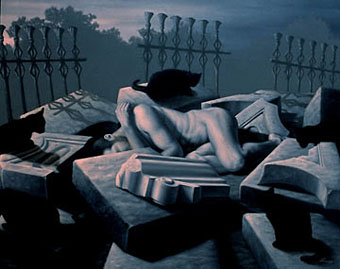
sherer2.jpg

Newborn.

“Stigma” is an apt word when discussing Sherer’s work. His paintings in the Male Nudes series, of which Newborn (above) is a part, have suffered censorship at the hands of those who found their representations of men in the postures of traditional female nudes to be bizarrely unacceptable. (The tribulations are detailed here.) Then there’s his Blood Works series of symbolic botanical illustrations—some of which are entitled Stigmata—which use HIV+ blood as a medium to explore “the complexities of romantic life and sexual attraction in the HIV era.” The challenge of these works to the viewer makes a considerable change from the usual parade of undressed men which comprise the majority of work by male artists dealing with gay themes.

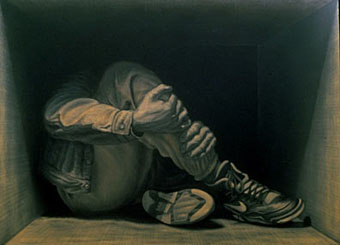
sherer3.jpg

Condo.

Robert Sherer slideshow at GLBTQ
Robert Sherer at Lyman-Eyer

Elsewhere on { feuilleton }
The gay artists archive

Haeckel fractals

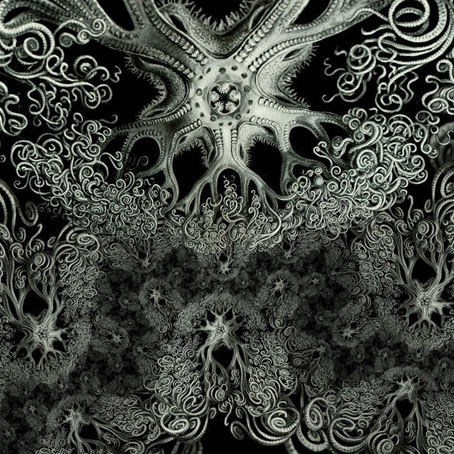
haeckel.jpg

In which Ernst Haeckel’s Art Forms in Nature are given the Mandelbrot treatment. The example above is one of a number of variations created using the splendid Gorgon-headed Starfish, a creature I’ve messed with myself a couple of times.

These fractal images have been created by the Subblue people using their Fractal Explorer plug-in for Adobe’s Pixel Bender Toolkit, both of which are free downloads. I’ve not had chance to play around properly with Pixel Bender but the results here make it seem worth spending time getting to grips with its rather primitive interface.

Previously on { feuilleton }
Ernst Haeckel, Christmas card artist