Flamboyant excess: the art of Steven Arnold

arnold1.jpg

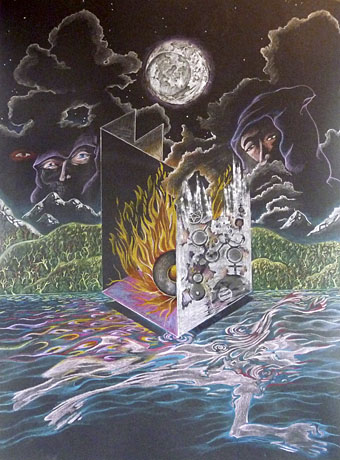
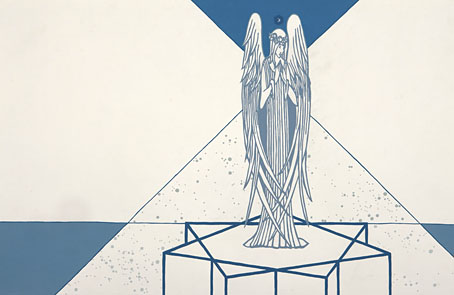
Invitation to Yin and Yang by Steven Arnold.

“Less is NOT more, MORE is more, less is less.”

Steven Arnold

Thanks to Monsieur Thombeau for pointing the way to The Steven Arnold Archive, a respository of biographical and career detail about Steven Arnold (1943–1994):

…a California-based multi-media artist, spiritualist, gender bender, and protégée of Salvador Dalí. His work consisted of drawings, paintings, rock and film posters, makeup design, costume design, set design, photography, and film.

Arnold’s work with outrageous performance troupe The Cockettes seems to receive more attention today than his other creations so it’s good to see the balance being redressed. It was a surprise, for instance, to find he’d drawn a poster in 1967 for The Matrix club, San Francisco. Similar works are mentioned but the site doesn’t have any examples and I’ve yet to see any elsewhere.

arnold2.jpg

arnold3.jpg

And I haven’t seen the Cockettes film, Luminous Procuress (1971) either. Salvador Dalí unsurprisingly responded with enthusiasm to its atmosphere of androgynous weirdness:

Luminous Procuress is an altogether extraordinary, individualistic phantasmagoria. It was filmed entirely in San Francisco over a two-year period, and describes the adventures of two wandering youths in San Francisco who visit the home of a mysterious woman, the Procuress. She is an elegant emblem of sorcery, her vivid features glowing under bizarre, striking maquillage, and one is not certain who she is or where she intends to lead the protagonists. Although the language she speaks is vaguely Russian, it appears that the Procuress has psychic powers. She discerns a sympathetic response to her on the part of the youths, and by magical means, conducts them through fantastic rooms, on a psychic journey… (more)

Definitely one for the future viewing list. Meanwhile, one of Arnold’s tableaux photos, The Advantages of Modern Marriage, is currently on display in Cruising the Archive: Queer Art and Culture in Los Angeles, 1945–1980 at the ONE National Gay & Lesbian Archives, Los Angeles. The exhibition runs to April 1st, 2012.

Previously on { feuilleton }
James Bidgood

Milton Glaser album covers

glaser01.jpg

Music For Space Squirrels (1958) by Al Caiola’s Magic Guitars.

Having sought out Saul Bass’s album cover designs recently, curiosity impelled me to see what fellow New York designer Milton Glaser had been doing during the same period. I already knew some of Glaser’s covers for the Tomato label in the 1970s but Discogs has many more, including a handful in the Pop/psychedelic style he used most famously for his Bob Dylan poster. Not all of these are to my taste—illustration-wise I prefer Bob Pepper’s art—but Glaser was nothing if not versatile. I’ve no idea what Music for Space Squirrels sounds like although it’s probably less interesting than the promise of those floating rodents.

glaser02.jpg

Medium (1968) by The Mandrake Memorial.

glaser03.jpg

Grieg’s Greatest Hits (1969).

Continue reading “Milton Glaser album covers”

Europe and the Spirit World

schongauer.jpg

The Temptation of St Anthony (c. 1470) by Martin Schongauer.

From one lot of devils to another, and also another art exhibition with an occult theme. Are curators running out of ideas or becoming more adventurous? The answer probably lies somewhere in between. Europe and the Spirit World, or the Fascination with the Occult, 1750-1950 is currently showing at the Museum of Modern and Contemporary Art of Strasbourg, France, and the art on display ranges from early pieces like Schongauer’s famous engraving to more recent works by artists such as Victor Brauner, one of whose Chimeras is featured. The website is sparse but there is a 450-page catalogue for those interested. The exhibition runs until February 12th, 2012.

Ken Russell, 1927–2011

thedevils.jpg

May–September 1970, Ladbroke Grove: Ken asked me what would most upset an English audience. Louis XIII dining al fresco, carelessly shooting peacocks on the lawn between courses. “Impossible,” said Ken. “How would you do that?”

“Make some dummies, stand them on the lawn and detonate them.”

“No, you’d have to shoot real peacocks. It wouldn’t work otherwise.”

Derek Jarman, Dancing Ledge (1984)

It hardly seems worth adding to the Russell eulogies when The Guardian over the past few hours has been so profligate with their stories you might think they’d offed the director in order to boost their readership. For my part I’ll keep it brief and say I used to be guilty of taking Ken Russell for granted, he seemed so ubiquitous when his feature films were turning up all the time on British television. He was fortunate to make the most of that brief moment when American studios were nurturing a handful of world-class talents in the UK. A shame it didn’t last. Derek Jarman, after working on The Devils and Savage Messiah, designed a production of Stravinsky’s The Rake Progress that Russell directed in 1982. Discussing that period in Dancing Ledge he says: “Ken is deeply disillusioned with the cinema, the end of a love affair. Whenever the subject comes up there is sadness, tales of betrayal and hopes dashed.” About British cinema in general, Jarman had this to say:

The English film world is mesmerized by Oscars, and almost any project has to pass the Hollywood test. All indigenous work has to be historic and “quaint” – Brideshead or Chariots of Fire, a dull and overrated TV film, fit the bill. All the rest take their chances.

The BFI is finally releasing The Devils on DVD in March 2012. Unlike The King’s Speech it never won any Oscars. No need to guess which one I’d rather watch.

Guardian obituary | Ken Russell: a career in clips
• The Independent: Farewell to the wild man of cinema
Telegraph obituary
Fuck Yeah Ken Russell

Previously on { feuilleton }
Salome’s Last Dance

Los Bikers by Dënver

losbikers1.jpg

What’s going on here then? An epigraph from Yukio Mishima…an Air-like song…a pair of boys stripping down to their underwear to play bondage games…gorgeous dancers in white briefs performing amid statuary… Yes, it gets my vote.

Dënver are from Chile, and the song is Los Bikers from their 2010 album Música, Gramática, Gimnasia. I’d tell you who directed the video but they’re not very clear about that themselves. There’s more video and music on the inevitable Dënver Myspace page. Via Homotography.

losbikers2.jpg

Previously on { feuilleton }
The Lady Is Dead and The Irrepressibles
Forbidden Colours
Mishima’s Rite of Love and Death