The Kingdom of the Gods

quail01.jpg

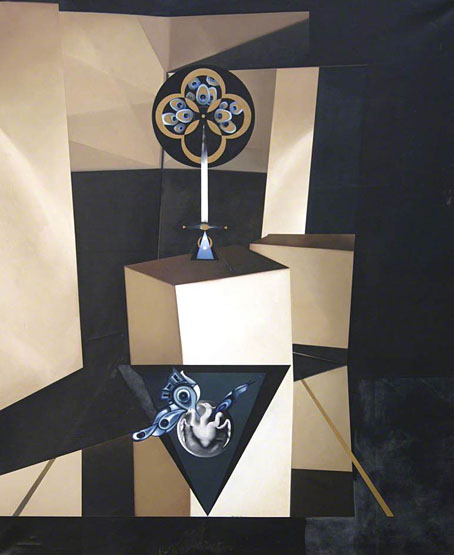
Looking for more Theosophist art turned up The Kingdom of the Gods (1952), a book by Geoffrey Hodson with illustrations by Ethelwynne M. Quail. Hodson was a Theosophist scholar with a predilection for the clairvoyant visualising of transcendent beings. Several of his books are descriptions of encounters made on his travels, commencing at a modest level in 1925 with Fairies at Work and Play. Fairies are a somewhat trivial subject for Theosophical students, which may explain why Hodson’s later books move on to accounts of angels in their various forms, before arriving at descriptions of fully-fledged gods, a type of divine life which in Hodson’s telling is more populous than we realise. A note at the beginning of The Kingdom of the Gods states that Ethelwynne Quail’s paintings were made originally for slide projections which Hodson used in his lectures.

quail02.jpg

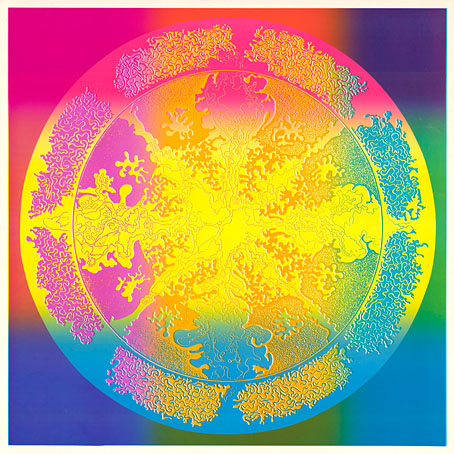
Most of Hodson’s gods are lower-order beings of a kind that the Romans termed genius loci, the spirit of a place, while their depictions are nebulous, bird-like renderings like some of the “thought-forms” depicted in the 1905 book of that name by Charles Webster Leadbeater and Annie Besant. The determination of the Theosophists to make the invisible manifest on paper or canvas may explain the attraction of the religion for so many artists. One of the illustrations in Thought-Forms shows Gounod’s music forming over a cathedral tower like a polychrome mushroom cloud; a decade later, the Theosophy-inspired Luigi Russolo was doing something similar with his Futurist painting, La Musica. Geoffrey Hodson would have been delighted by the mystical artists of the 1970s, especially Gilbert Williams and Robert Venosa. Some of Ethelwynne Quail’s spirits might be sketches for Venosa paintings, his early works in particular, which have the same sweeping lines but rendered in a meticulous, crystalline manner.

quail03.jpg

quail04.jpg

quail05.jpg

Continue reading “The Kingdom of the Gods”

Christian Waller’s The Great Breath

waller09.jpg

In last week’s anniversary post I threw some barbs at social media to which this piece might act as a riposte; the poisoned waterholes still have their uses. A link on Bluesky to a book by James Hume-Cook, Australian Fairy Tales (1925), had me looking for more information about the book’s illustrator, Christian Yandell (1894–1954), an Australian artist whose illustrations are as good as those being produced in Britain or America at the height of the boom in illustrated books. Ms Yandell is better known today under her married name, Christian Waller. In addition to working as an illustrator she was a printmaker and stained-glass artist. She was also another early 20th-century artist whose work reflects an interest in Theosophy, most notably in a print series from 1932 which she titled The Great Breath.

The production of The Great Breath was entirely undertaken by Waller; all aspects from the cutting and printing of the linoblocks to the manufacture of the distinctive gold-painted emerald green cover was done by hand. She printed the blocks on her 1849 hand-press in her studio at Ivanhoe, each book taking about four days to make, hand-bound with green cord. Although it was intended to produce an edition of 150, it seems only about 30 were made, with some unbound impressions extant, usually untrimmed. Each consisted of a title page, colophon, contents page and seven linocut designs. The images were printed in solid black on white translucent tracing paper, trimmed and tipped onto the cream pages. The books were not numbered sequentially, but rather in relation to the numerology of the buyer.

waller08.jpg

The bound collection comprises seven prints plus an eighth plate presenting vague clues about the meaning of the series and some of the symbolism in the imagery. The prints themselves are in a bolder style than Waller’s storybook illustrations, resembling templates for stained-glass designs. What “The Great Breath” refers to isn’t explained at all, I’d guess you had to be a reader of Madame Blavatsky’s magnum opus, The Secret Doctrine, to be sufficiently enlightened. The explanatory plate features Blavatsky-derived concepts such as “Root Races” and “the World Cycle”, along with references to Atlantis, Hyperborea and Lemuria. The Secret Doctrine incorporates the alleged histories of these lost continents into its collage of myth, religion and mysticism, as a result of which Madame Blavatsky is almost solely responsible for the legend of Atlantis migrating from books of archaeological speculation and pseudo-history to the more rarified realms of occultism. You can trace a thread of Atlantis references from Theosophy to The Golden Dawn, and on into the 20th century, through weird fiction to the crank shelves, where the submerged continent may be found among all the flying saucers, pyramidology and “ancient astronauts”. Since Theosophy has few adherents today it might be said that the elevation of Atlantis to a mystical plane was Blavatsky’s most substantial legacy, if it wasn’t for all the artists who fed off the soup of borrowed ideas in The Secret Doctrine to elevate work of their own. I continue to believe, semi-mischievously, that Theosophy ought to be recognised as the primary force behind the development of abstract art, so many important artists (Hilma af Klint, Kandinsky, Mondrian) were inspired by Blavatsky’s writings. “Inspire” is apt in this context, being derived from Latin and Greek words meaning “to breathe”. Maybe the significance of Waller’s title isn’t so hard to divine after all.

waller01.jpg

Continue reading “Christian Waller’s The Great Breath”

Weekend links 817

paolozzi.jpg

The Silken World of Michelangelo (1967) by Eduardo Paolozzi.

• “By the late 19th century, representing time as a line was not just widespread—it was natural. Like today, it would have been hard to imagine how else we could represent time. And this affected how people understood the world.” Emily Thomas on the evolution of our thinking about the nature of time.

• At Green Arrow Radio: Bill Laswell and the Cosmic Trip, in which the indefatigable performer/producer talks about his career and Cosmic Trip, a new album by saxophonist Sam Morrison.

• At Public Domain Review: Snail Homes, Bog Bodies, and Mechanical Flies: Robert Testard’s Illustrations for Les secretz de l’histoire naturelle (ca. 1485).

• Among the new titles at Standard Ebooks, the home of free, high-quality, public-domain texts: Continental Op Stories by Dashiell Hammett.

• The winter catalogue of lots for the After Dark: Gay Art and Culture online auction. Homoerotic art, photos, historic porn, etc.

• New music: The Third Mind. A Sonic Tribute to the Dreamachine by Various Artists.

• Mix of the week: DreamScenes – February 2026 at Ambientblog.

A Conversation with Tarotplane by AJ Kaufmann.

• RIP Bud Cort.

Timewhys (1971) by Tonto’s Expanding Head Band | Time Be Time (1990) by Ginger Baker | Time Scale (2009) by Belbury Poly

Twenty

devries.jpg

Numeral designs from 1904 by Reinier Willem Petrus de Vries.

Monsieur Chat, the tutelary deity of the place with the lower-case French name in affected curly brackets, makes a rare appearance with the news that { feuilleton } is 20 years old today. The blog (a term I’ve always used with reluctance) was launched on the 13th of February, 2006, self-described as “A journal…cataloguing interests, obsessions and passing enthusiasms.” The launch date was a random one, being the day that my new website went live, while the decision to start a blog was made not so much on a whim but out of a vague impulse that it might be something worth playing with for a while. Little did I realise… Since these anniversary posts usually involve some degree of stock-taking it’s worth noting how much the media landscape has changed over the past two decades.

monsieurchat.jpg

Monsieur Chat, for it is he. Graffiti by Thoma Vuille.

In February 2006 MySpace was the biggest social media site, with Facebook climbing fast behind it. YouTube was little more than a year old (and yet to be bought by Google), while the iPhone and the ensuing smartphone era was still a year away. A month after I pressed “Publish” on my first post a new social-media service named Twittr [sic] was launched to little fanfare; no need to recount how that turned out. All of these things contributed in some way to the eventual collapse of blogging as a widespread pursuit, social media in particular, which is another way of saying that I probably chose the wrong moment to embark on such a venture myself. Not that this has ever worried me. I’m cautious about anything that’s liable to eat into time that might be spent doing other things, and it took me a while to see that non-diaristic blogging was a worthwhile endeavour. It’s been a curious thing planting a flag on a hill then remaining there while the rest of the world chases after the latest outlet for their opinions and their pet photos. The micro-blogging format of social media killed the blogs because it co-opted the diaristic impulse behind many of the writing sites of the early 2000s. Social media also provided something that long-form blogs can’t give you: instant gratification, endlessly repeated.

blog.jpg

The oldest page at the Internet Archive is from May, 2006, although the header I was using at the time hasn’t been preserved. The Piranesi header has been pasted in from a later page.

The complaints about social media are all very familiar today (it’s a drug, it’s a form of mental poison, etc), and all true to some degree. Recent suggestions that we can improve the internet by a return to blogging strike me as unrealistic. This is an unusual form of activity, one best suited to writers (or to those who enjoy writing), to creative types rather than mere diarists, and to people who don’t suffer inordinately when they throw something into a public arena then receive little or no feedback as a result. Starting something like this today without being part of a connected community like Substack would require resilience to cope with the isolation. And yet… The blogging format still provides opportunities that can’t easily be satisfied elsewhere. Chief among these is long-form writing, so too the static nature of the blog post which resists the relentless churn of today’s internet. I still enjoy being able to set down a few thoughts on a niche subject then have those thoughts (or links or pictures or whatever) easily available online. And the thoughts don’t always have to be delivered in words; one of the attractions of the format was being able to post a list or group a collection of disparate items under a single heading with only a minimum of explanation. The weekend links do this while also serving as a searchable archive of bookmarks. And if you’re running the place the way I do then previous posts are still relatively easy to find, even if the post is a very old one.

linotype.jpg

The closest you’ll get to a portrait of the author.

In the end, I do all this because I enjoy it, not because it’s another form of work or (perish the thought) “productivity”. Things I’ve enjoyed over the past 20 years would include making and reporting on new discoveries; the feedback from my consistently smart and informative readers; honing my writing skills, then being asked to write paid-for articles as a result. The latter was something I never expected at all. Most of all I value having a small space of my own on the internet, a not-so-temporary autonomous zone. I may be sceptical about a mass return to blogging but I prefer the options to remain open for people sick of the billionaires who regard them as another resource to be manipulated and exploited. Places like this may be regarded as anomalies or hangovers from an older era but the internet remains a malleable environment. The tools to create your own alternative to corporate control are still out there and freely available, all that’s required is the determination to use them.

My thanks, as always, to my readers, especially those who dropped some money in the Ko-fi jar. This site will always be paywall-free but every little helps. And so, as the bouncing cat might say, “En avant et vers le haut!”

John x

Turris Babel, a film by Jan Mimra

babel1.jpg

Another short animation, a collage film from 1989 which concerns everyone’s favourite Biblical megastructure, the Tower of Babel. Jan Mimra’s film doesn’t recount the creation of the building but uses the tower as a symbol for the human world, its history and its culture. The building itself is a hybrid structure made of architectural elements from the whole of human history, with a pyramid at the base and a platform at the summit supporting a collection of modern tower blocks.

babel2.jpg

The narrative purpose of Mimra’s tower is never very clear; to judge by the soundtrack the fragmentation of a universal language has already occurred, even though the Biblical story has this taking place only after the tower has been destroyed. There’s further confusion in a flood which threatens the tower and its inhabitants, something which may be another Biblical reference but could equally be a metaphor for modern warfare (the sinister planes suggest as much) or even climate change. Mimra’s film was made at the Jiří Trnka Studio in Prague, and includes a reference to another Czech collage animator, Karel Zeman, in a brief glimpse of Jules Verne piloting the paddling submarine from Zeman’s The Invention for Destruction.

Previously on { feuilleton }
Babel details
Athanasius Kircher’s Tower of Babel
La Tour by Schuiten & Peeters