MCMLXX

data70.jpg

Data 70, a typeface by Bob Newman.

The presence of electronic artists Data 70 in the Spatial mix at the weekend had me thinking about the preponderance of cultural items that were given “70” as a suffix in the 1960s or in the year 1970. The air of futuristic optimism in the 60s drew attention to the birth of a new decade in a manner that hadn’t really happened before, and certainly didn’t happen for 1980 by which time the optimism had been sunk by a decade of political and fuel crises, and the end of the space race.

Data 70 take their name from the “futuristic” computer-like typeface designed by Bob Newman in 1970. Newman’s typeface wasn’t the first of the Space Age designs—Colin Brignall’s Countdown appeared in 1965—but Data 70 was everywhere in the 1970s. Data 70 (the group) dedicated a piece of music to Newman.

A few more 70s follow. These are only the ones I’ve been able to remember or stumble across so I’m sure there are more. And note: to qualify for this micro-category something has to be named “70” only where the suffix signifies modernity or the future, no Expo 70 (the world’s fair in Osaka) or anything annual that happened to be labelled 70 as part of a series.

boccaccio.jpg

Boccaccio 70 (1962).

The label might imply the future but the predominant tone of these entries is sex. Boccaccio 70 set things in motion by updating the Decameron to modern Italy. Despite the claims of the poster, anthology films are nothing new, and this one has four stories directed by Vittorio De Sica, Federico Fellini, Mario Monicelli and Luchino Visconti. Italo Calvino was one of the writers.

Continue reading “MCMLXX”

Maximiliana oder die widerrechtliche Ausübung der Astronomie

ernst1.jpg

The title of this 10-minute film translates as Maximiliana or the Illegal Practice of Astronomy which is also the name of an art book created by Max Ernst in 1964. The film was a collaboration between Ernst and filmmaker Peter Schamoni, the subject being German astronomer and lithographer Ernst Wilhelm Leberecht Tempel (1821–1889). Tempel’s astronomy was “illegal” because he was regarded as an amateur by other astronomers which meant he was denied permission to name his discoveries. Maximiliana was the name Tempel and physicist Carl August von Steinheil decided on for an asteroid that Tempel discovered in 1861. This was deemed unacceptable so the asteriod was given the name Cybele instead (now 65 Cybele).

ernst2.jpg

Some of this is related in Schamoni’s film but you’ll need an understanding of German to appreciate the detail. The film is worth a look for other reasons, notably some shots of Ernst filling sheets of paper with the curious hieroglyphs that cover the surfaces of some of his later paintings. These hieroglyphs also feature in the Tempel book, and one of them appears in the film as an animated figure. Peter Schamoni made a number of art films including an excellent feature-length documentary about Max Ernst in 1991. That’s also on YouTube but untranslated so you’ll need some good German (and French) to appreciate it.

Previously on { feuilleton }
Max and Dorothea
Dreams That Money Can Buy
La femme 100 têtes by Eric Duvivier

Fog Line, a film by Larry Gottheim

fogline.jpg

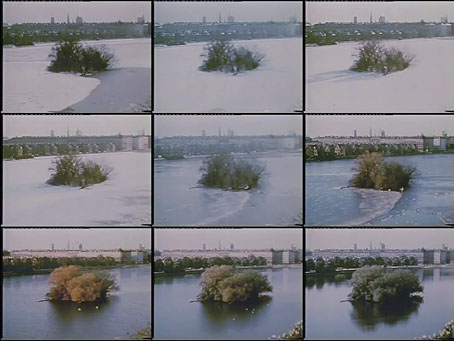
As a piece of minimalist cinema, Fog Line (1970) makes Michael Snow’s Wavelength seem hyperactive. In a static 11-minute shot, trees and fields emerge from drifting fog; no sound or music, just the trees, a few suspended wires and the fog. Immerse yourself here.

fog.jpg

Gottheim’s film reminded me of the photos I took in 2005 one damp and chilly November afternoon on the banks of the River Mersey. The river snakes through south Manchester on its way to Liverpool, and is a pleasant place to walk when the ground isn’t as sodden as it was on this occasion. There’s a few more photos from that session here.

Previously on { feuilleton }
Wavelength
La Région Centrale

7362, a film by Pat O’Neill

7362.jpg

This week is a psychedelic one for Londoners: on Monday Britain’s first Psychedelic Society was launched at Conway Hall (the Society uses my Psychedelic Alice artwork in some of its graphics); today (the 4th) there’s an evening of short psychedelic films at BFI Southbank: Jet Propelled Cinema: How Psychedelia Infected Hollywood Sci-Fi. A couple of these—James Whitney’s Yantra and Scott Bartlett’s OffOn—have featured here already but Pat O’Neill’s 7362 (1967) was one I’d not seen before. O’Neill’s film is a 10-minute exploration of vertical symmetry, solarisation and rapid strobing of a kind that no doubt carries an epilepsy warning when it’s screened in public. An electronic soundtrack by Joseph Byrd and Michael Moore connects the film to the psychedelic music scene via Joe Byrd whose cult band The United States of America recorded one of the best albums of the period a year later. 7362 is currently available on DVD together with 25 other shorts in Treasures IV: American Avant-Garde Film, 1947–1986.

Elsewhere on { feuilleton }
The abstract cinema archive

Jon Hassell, live 1989

hassell.jpg

Jon Hassell’s 1990 album City: Works Of Fiction was reissued by All Saints recently in a smartly packaged three-CD/double-vinyl set. The highlight of the additional material was an hour-long concert by Hassell and his ensemble—Gregg Arreguin, Jeff Rona, Adam Rudolph and Daniel Schwartz—recorded at the Winter Garden of the World Financial Center in New York City on 17th September, 1989. It’s a great performance that sees the group running through some of the pieces that would later be recorded for the City album. Brian Eno was offstage mixing the sounds of rain forest creatures into the music.

Having listened to this concert regularly since the summer it’s been a surprise to find a video recording of what appears to be the very same performance. The tape has the date as the 16th but the music is an exact match for the CD; according to the NYT the group played three nights in all. The reduced lighting makes for gloomy visuals, and the musicians are much more concerned with playing than leaping around the stage. For me the attraction is simply seeing Hassell and company working their magic with such authority; some of Hassell’s pauses show his use of digital loops, something that’s never been so obvious on record. These performances, and the album that followed, saw a shift in the evolution of the “fourth world” concept, Hassell’s term for a “coffee-coloured classical music of the future” that would blend the first world and the third world, the past and the future, into new hybrids. The sleeve-notes for the City album began: “Spirit: not only in the forest but in the carwash, too.” Bringing palm trees and jungle sounds into the heart of Manhattan develops that idea. Hassell talked to The Wire about the album in 1990.

Previously on { feuilleton }
Power Spot by Michael Scroggins