Bridget Riley Flashback

riley.jpg

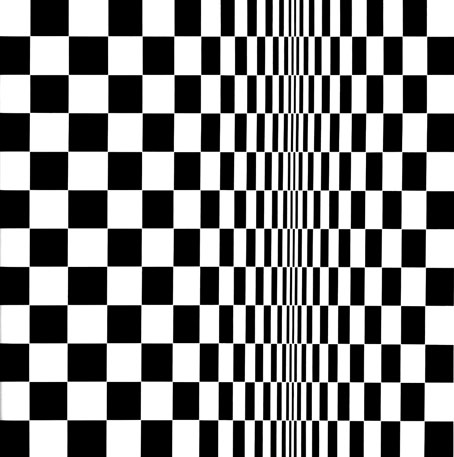
Movement in Squares (1961).

Continuing the Sixties theme, the Walker Art Gallery in Liverpool has an exhibition running whose title, Bridget Riley Flashback, alludes to the connection between Riley’s vibrant Op Art and the psychotropic concerns of the decade which brought her to the world’s attention. Riley’s works nearly always look very clean and mechanical in reproduction which can tend to defeat their purpose as paintings. The actual pictures are paint on canvas, with each square or line carefully applied by hand (not always by herself it should be noted; she had assistants), and present a deliberate contradiction in their rigid formalism and hand-crafted production. Their large size also gives them substantially greater visual impact.

A seminal work in the show is ‘Movement in Squares’, which was purchased by the Arts Council collection in 1962, the year after it was made. Consistently exhibited in retrospectives of her work, she credits the work as the beginning of her breakthrough into abstraction. This shows an insight into the role of the Arts Council collection in supporting British artists and collecting the art treasures of the future.

Bridget Riley Flashback runs until December 13, 2009.

Previously on { feuilleton }
Design as virus #4: Metamorphoses
New Bridget Riley

The recurrent pose 29

slimane.jpg

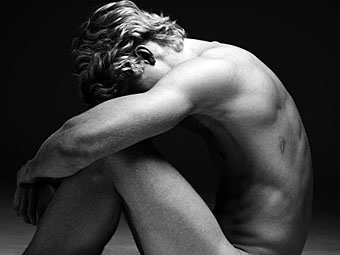
Taner photographed by Hedi Slimane.

No, I don’t go looking for these deliberately, they just keep turning up. This latest manifestation of the Flandrin pose is from a photo shoot by Hedi Slimane. I was going to write a bit more on this subject but haven’t had the opportunity today since the webhost has been having problems and the site was down for a few hours. Something for later. Meanwhile, a commenter recently pointed out this similar example by John Jude Palencar, a Flandrinesque painting for a book cover.

Elsewhere on { feuilleton }
The recurrent pose archive

Angels of Anarchy: Women Artists and Surrealism

fini.jpg

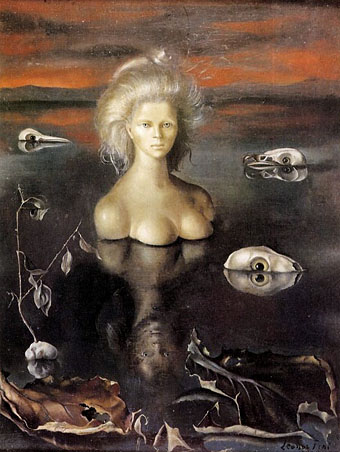
Le Bout du monde by Leonor Fini (1948).

Yes, I’ll definitely be going to see this one.

The first major exhibition of women artists and Surrealism to be held in Europe, Angels of Anarchy, opens this autumn at Manchester Art Gallery.

Featuring over 150 artworks by 32 women artists, the exhibition is a celebration of the crucial, but at the time not fully recognised, role that women artists have played within Surrealism. Paintings, prints, photographs, surreal objects and sculptures by well-known international artists including Frida Kahlo, Meret Oppenheim, Leonora Carrington and Lee Miller will be exhibited alongside works by artists less well-known in the UK, such as Emila Medková, Jane Graverol, Mimi Parent, Kay Sage and Francesca Woodman. Manchester Art Gallery is the only venue for this exhibition, making it a once-in-a-lifetime opportunity to see the works of so many significant women artists displayed together, with many of the works on loan from international public and private collections.

Angels of Anarchy runs from 26 September 2009–10 January 2010 at Manchester Art Gallery, and it’s a paying event with tickets at £6 (concessions £4, free entry for under 18s and Manchester Art Gallery Friends).

Elsewhere on { feuilleton }
The fantastic art archive

Previously on { feuilleton }
The art of Leonor Fini, 1907–1996
Surrealist women

Uranian inspirations

gloeden2.jpg

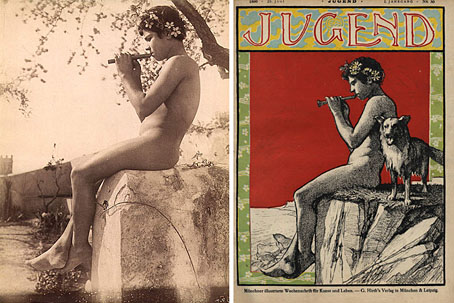
left: Sicilian boy by Wilhelm von Gloeden (no date); right: Jugend cover by Hans Christiansen (1896).

My current reading is The Secret Life of Oscar Wilde (2003), a long and fascinating study by Neil McKenna which attempts to disentangle the true nature of Wilde’s sex life from the myths and evasions of his biography and biographers. Among the pictures in the book, McKenna shows a couple of the “Uranian” photographs by Wilhelm von Gloeden (1856–1931) which Wilde owned. Von Gloeden’s views of naked Sicilian boys were described as “Classical” in a barely-believable subterfuge familiar during the 19th century, and it’s understandable why Wilde, who’d been praising the attractions of Mediterranean youth for most of his adult life, would have found these pictures worthy of purchase. Wikimedia Commons has a substantial set of the photos, although it should be noted that provenance is often uncertain; there were other photographers active in Taormina at the time who catered to a similar market. One photo in particular stood out recently when I recognised it as the possible source for the figure on a Hans Christiansen cover for Jugend magazine of 1896. The cover above has appeared here before but this is the first time I made the photographic connection.

gloeden1.jpg

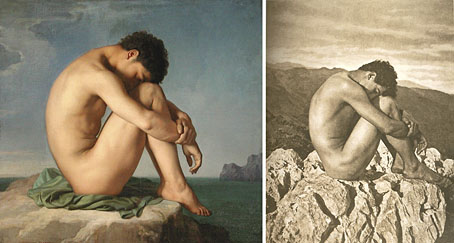
left: Jeune homme assis au bord de la mer by Jean Hippolyte Flandrin (1836); right: Cain by Wilhelm von Gloeden (c. 1902).

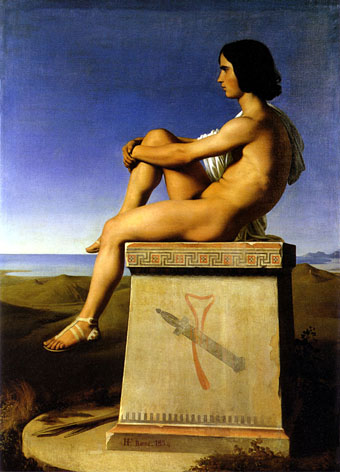
Gloeden, of course, was one of the first people to use the Flandrin pose, as I noted in the original post on that theme. I wonder if he knew he’d been copied in turn? That Jugend cover and its inspiration reminds me a little of Flandrin’s other depiction of Classical youth, his portrait of Polites, a painting which Oscar would no doubt have enjoyed.

polites.jpg

Polites, Son of Priam, Observes the Movements of the Greeks by Jean Hippolyte Flandrin (1834).

Elsewhere on { feuilleton }
The recurrent pose archive
The Oscar Wilde archive

Previously on { feuilleton }
Forbidden Colours
Jugend Magazine
Evolution of an icon

Maruyama Okyo’s peacocks

okyo1.jpg

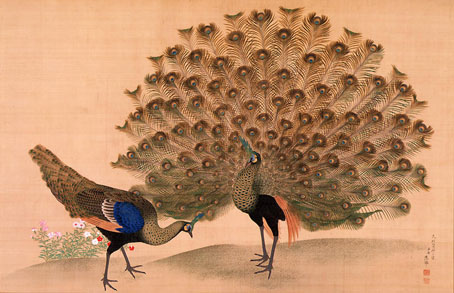
Peacock and Peahen (18th c.).

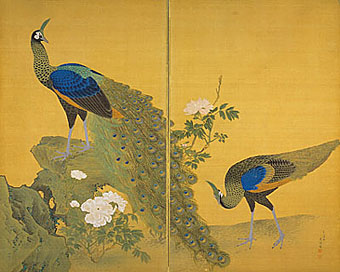
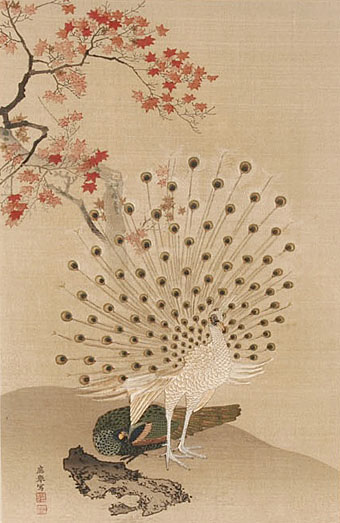
I’ve had an untitled Japanese painting of a peacock as a desktop image for a while now, its origin forgotten, and I’ve wondered a few times who the artist was. A recent posting about Maruyama Okyo (1733–1795) at Bajo el Signo de Libra made me think that Okyo might be the artist responsible. As it turns out, he wasn’t, my bird is by one of his pupils, Nagasawa Rosetsu (1754–1799), and looks like a copy of the picture below. Mystery solved anyway, and the search gives me a good excuse to link to some of Okyo paintings. These differed from the prevailing style of the period, Okyo having studied Western artists and their methods in order to produce work which was more realistic than that of his contemporaries.

okyo2.jpg

Peony and Peacocks (1781).

A realist and an eccentric | Okyo and Rosetsu profiled.

okyo3.jpg

Peacock (no date).

Previously on { feuilleton }
Louis Rhead’s peacocks
The White Peacock
Peacocks
Whistler’s Peacock Room
Beardsley’s Salomé