Joe Orton

oldman_orton.jpg

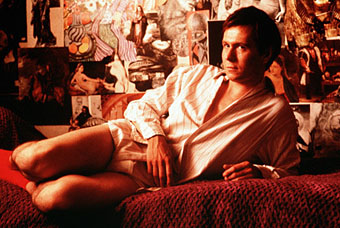
Gary Oldman as Joe Orton in Prick Up Your Ears (1987).

Ken: At least you can say you’ve sat in the same chair as TS Eliot.
Joe: Yes, I’m never going to wipe my bum again.

Gay playwright Joe Orton receives a welcome renewal of attention this month with a showing of films at the ICA in London and the 20th anniversary re-release of Prick Up Your Ears, the great Orton biopic by Alan Bennett and Stephen Frears. Gary Oldman is marvellously sexy (and funny) as Orton in Frears’ film, Alfred Molina is equally good as his increasingly neurotic lover, Kenneth Halliwell (who eventually murdered Orton before killing himself), and there’s decent casting throughout, with Vanessa Redgrave playing Peggy Ramsay and Julie Walters hilarious as Orton’s mother.

Prick Up Your Ears was originally Halliwell’s title for a script Orton was writing for the Beatles (“…much too good a title to waste on a film,” said Orton.) That film idea, variously titled Up Against It and 8 Arms To Hold You, was deemed “too gay” by McCartney and co., not least because Orton had all four Beatles sleeping in the same bed. He also wrote that “…the boys, in my script, have been caught in flagrante, become involved in dubious political activity, dressed as women, committed murder, been put in prison and committed adultery. And the script isn’t finished yet.” Now you know why the third Beatles film was an animated one.

A feature in The Guardian examining Orton’s legacy, as well as the film, has this to say of Prick Up Your Ears:

it was the first mainstream British film to depict the gay underworld of West End toilets and sign language that existed in an age when homosexuality was still illegal.

And much of it was filmed on location in Orton’s haunts. Every time I’ve been through Islington tube station I think of the scene where Gary Oldman picks up a guy he’s been eying in the lift.

Orton had the misfortune to die in 1967, the year homosexuality was decriminalised in Britain. Well… decriminalised so long as you were both 21, not members of the Armed Forces and there was no one else in the room with you; Orton could have made a play out of such farcical restrictions. But the film makes it clear that the existence of a stupid law—which caused the downfall of another playwright, Oscar Wilde—did nothing to prevent him enjoying himself. The Guardian has another quote from him:

[The police] interfere far too much with private morals—whether people are having it off in the backs of cars or smoking marijuana, or doing the interesting little things one does.

They still do, Joe.

The web doesn’t serve Orton’s memory very well; the links below are some of the more interesting finds.

An interview from June, 1967
Joe Orton at the BBC Sound Archive
Joe Orton at GLBTQ
The Disappearing Gentlemens’ Lavatories of Old London
(A hymn to the public convenience by Dudley Sutton, dedicated to Joe Orton.)

Previously on { feuilleton }
Passion play
The Poet and the Pope
Please Mr. Postman
All you need is…
Queer Noises

Beckett directs Beckett

endgame.jpg

Beckett Directs Beckett
In 1985 Samuel Beckett directed “Waiting for Godot”, “Krapp’s Last Tape” and “Endgame” as stage pieces with the San Quentin Players. All three productions were grouped together under the overall title “Beckett Directs Beckett.” As such they toured throughout Europe and in some parts of Asia to wide acclaim. Furthermore, each time a new tour was organized for these productions, after sometimes lengthy lacunae, Beckett has, with the assistance of Walter Asmus, and/or Alan Mandell, brought them back to performance level.

Though the initial productions as staged in 1985 already brought forth substantial changes in the published acting texts of the plays, each time a re-mounting of the productions occurred additional changes were made. The same was true during the production period for these television versions, with Beckett sometimes making textual changes on the telephone even as a given scene was being taped. For these productions, it was our intention and design to open them out beyond the confines of the stage in order to accommodate them to the television medium. Walter Asmus and Alan Mandell, both of whom enjoyed the author’s complete confidence, were responsible for this part of the endeavor.

The producers have a contractual obligation to Mr. Beckett that no changes be made in the original Beckett productions. However, as someone who has done a good deal of work on television (unfortunately not well known in the US), Beckett realizes the constraints and demands of that medium, and the many significant differences between television and the stage. In mounting the television versions of these productions, therefore, we worked intimately with Beckett on these questions as they arose.

Furthermore, Beckett asked that the taping take place in Paris so that, as he said, he could keep an eye on things. In short, Beckett’s was the creative vision which moved the whole enterprise. Walter Asmus and Alan Mandell, the nominal television directors for the series, were perfectly content to act as the guarantors for Beckett’s directorial vision.

Nothing here should be taken to suggest that we lay claim to the only possible interpretations of these plays, that Beckett’s is the last word on the subject. On the contrary: we sought, and believe we have succeeded, in establishing not only the last versions of the texts which Beckett revised prior to his death, but also provided bench-marks, points of departure from which present and future theater and television and film artists can explore other interpretations. The programs were aired by PBS in the US and have been seen in many other countries throughout the world.

More from the indispensable Ubuweb. Would have been nice for these productions to have been some of those mentioned by Colm Tóibín in his piece for the LRB on Jack MacGowran and Patrick Magee but these are still worth seeing for being directed by the writer. As Tóibín notes with regard to Beckett’s direction:

The journalist Clancy Segal wrote about Beckett’s style of directing as he observed him work with the two Irish actors: “His interventions are almost always not on the side of subtlety but of simplicity . . . The actors tend to want to make the play ‘abstract and existential’; gently and firmly Beckett guides them to concrete, exact and simple actions.”

Previously on { feuilleton }
Colm Tóibín on Beckett’s Irish Actors
Not I by Samuel Beckett
Film by Samuel Beckett

Voodoo Macbeth

voodoo.jpg

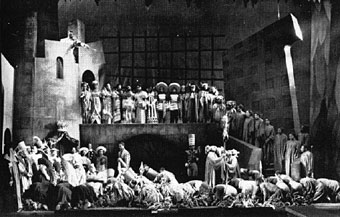
In my obsession with all things Orson Welles, his 1936 production of Macbeth holds a special fascination, partly for being my favourite Shakespeare play, and partly for the curiosity of its production—an all-black cast that included genuine Haitian drummers who famously claimed to have drummed a Broadway critic to death after he gave the play a hostile review. The De La Warr Pavilion in Bexhill-on-Sea is hosting an art event based on Welles’ production.

In 1936, whilst the UK was celebrating the new De La Warr Pavilion, and exciting artistic movement was reaching its close in New York—the Harlem Renaissance. A significant event within of this movement was an all-black African American version of Macbeth, presented by The Federal Theatre Project at the New Lafayette Theatre, Harlem and directed by writer and actor Orson Welles. This production became known as ‘Voodoo Macbeth‘.

There are many things that were remarkable about this unique and innovative project. The play was one of the first explorations of a modern and diasporic spin on the Shakespearian tale. It was also the point at which Welles was introduced to John Houseman, which then led to the formation of the Mercury Theatre Company that produced seminal works such as the War of the Worlds and Citizen Kane. Furthermore, the ‘Voodoo Macbeth‘ production displayed visual and aural motifs using lighting, stage design and overlapping sound which became signature elements to Welles’s later film projects.

The essence, spirit, and cross-artform experimentality of ‘Voodoo Macbeth‘ is the basis for a contemporary art, film and performance season at the De La Warr Pavilion and has been named after the production. This unique project looks at the historical and contemporary dialogue that Welles’s work had and still has with performance, film and visual art.

The curatorial concept of the De La Warr Pavilion’s exhibition Voodoo Macbeth focuses on the debate and the ideas around Welles’s unique and defining aesthetic which continues to attract much critical attention. The exhibition suggests that Welles’s approach has informed the work of many contemporary artists working in film today.

Both the historical and contemporary context of Voodoo Macbeth are explored within the exhibition and wider season of events. Original works by Orson Welles are presented alongside those of his contemporaries including Jean Cocteau, Jacques Tourneur and Lee Miller. These artists were working with film and photography during the period of the 1940s onwards and have a shared concern in exploring visual ideas and motifs around the idea of an ‘expansive frame’. As artists, they blurred the boundaries between visual art, theatre, literature and film, to produce lyrical and poetic visual works.

Work by contemporary artists within the exhibition have been selected on the basis that their work embodies the artistic narrative and the spirituality of Welles’s use of light, dark and spatial composition. The exhibition includes work by Phyllis Baldino, Glenn Ligon, Steve McQueen, Mitra Tabrizian and Kara Walker. In this context, Voodoo Macbeth explores how, for artists today, the genre and its relationship to installation practice in performance, film, sound and visual art is an important part of the process. Importantly, they do not mimic the formalist structure of film, painting and sound but endeavour to embed these works with elements of popular culture, critique and humour. Like Welles, who was a masterful story teller, these artists have developed works which take on the character of an intimate 21st century tale. Unlike Welles, these tales are tailor-made, for a gallery audience to explore and enjoy.

Produced by the De La Warr Pavilion in association with Brighton Photo Biennial and curated by associate curator David A Bailey in collaboration with BPB curator 2006 Gilane Tawadros.
The Galleries are open 10am–6pm except on Christmas Eve (closing
at 5pm), Christmas Day (closed all day) and New Year’s Eve (closing at 3pm). Free.

Voodoo Macbeth, Oct 7th–Jan 7th.

The Voodoo Macbeth exhibition is a part of the Brighton Photo Biennial, for more details on the BPB please visit their website www.bpb.org.uk, or contact them via the details below.
Biennial Office
University of Brighton
Grand Parade
Brighton BN2 0JY

Tel: +44 (01)273 643 052
Email: mail@bpb.org.uk