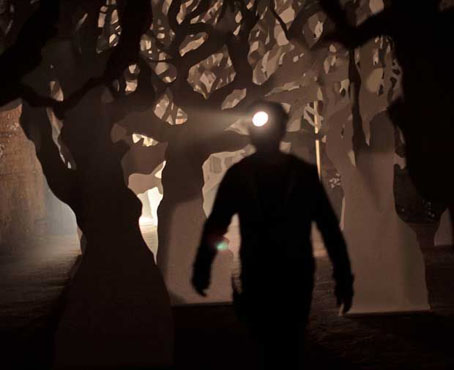
Tunnel 228

tunnel228.jpg

Lightning & Kinglyface’s paper forest; photo by Jeff Moore.

Tunnel 228 is a collaboration between Kevin Spacey in his position as artistic director of the Old Vic Theatre, and experimental theatre company Punchdrunk staging an art installation/performance work in tunnels beneath Waterloo, London. Mention of the magic word “Metropolis” (in its Fritz Lang context) caught my attention, the network of tunnels being filled in part by the sounds of clanking machinery. Visitors get to explore the paper forest shown above and may also see:

…tiny models of people in hidden nooks…a gilded statue of two fighting angels…spooky dummies of masked workers by artist Mark Jenkins, and bizarre still scenes, including a woman slumped over a melting table, by Polly Morgan.

The show runs from May 8th for fifteen days and is free but already seems to be fully booked going by the frustrated comments on this page. The rest of us will have to be intrigued by photos and hope that events such as this inspire artists and theatre groups elsewhere.

Tunnel vision of underground art | Guardian feature.

Previously on { feuilleton }
Polly Morgan, fine art taxidermist
Metropolis posters

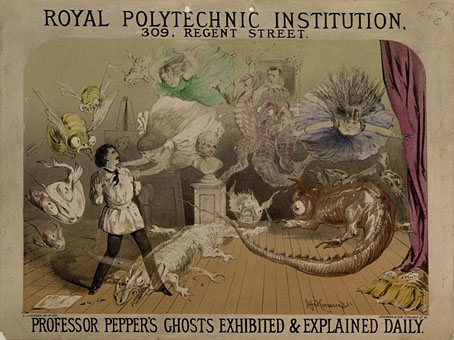
Professor Pepper’s Ghosts

pepper.jpg

Professor Pepper’s Ghosts, c. 1885.

From a page of old theatrical posters. A poster from the Egyptian Hall in London, home to regular performances by celebrated conjuror John Nevil Maskelyne, appears in the background of my Nyarlathotep picture.

For a contemporary explanation of Pepper’s Ghost, look here. Thanks to Thom for the tip!

Previously on { feuilleton }
Nyarlathotep: the Crawling Chaos

Le Sacre du Printemps

roerich.jpg

Backdrop for the League of Composers’ production, Philadelphia, 1930.

Something for the vernal equinox. The painting is a stage design by artist, writer and theatre designer Nicholas Roerich (1874–1947) for an American production of Stravinsky’s Rite of Spring. Roerich designed the costumes and decor for the riotous Paris performance of 1913 and the Roerich Museum has a selection of designs for this and subsequent performances. Stravinsky’s fiercely primitive ballet has long been a favourite musical work of mine so it’s especially satisfying when one enthusiasm bleeds into another. I’ve noted before HP Lovecraft’s praise for Roerich’s paintings of whom he wrote in 1937:

There is something in his handling of perspective and atmosphere which to me suggests other dimensions and alien orders of being—or at least, the gateways leading to such. Those fantastic carven stones in lonely upland deserts—those ominous, almost sentient, lines of jagged pinnacles—and above all, those curious cubical edifices clinging to precipitous slopes and edging upward to forbidden needle-like peaks!

Roerich is also mentioned in At the Mountains of Madness and some of his designs for the Rite—which are, after all, backdrops for a ritual sacrifice—might easily serve as a scene of Cthulhoid invocation. Writer Mike Jay has a fascinating piece about the artist which proposes that he should perhaps be given more credit for the origin of the Rite of Spring. He’s not the first to note that it was the stage designer who nurtured a lifelong passion for mysticism and esoteric ritual, not the composer.

Finally, some slightly more contemporary music: Can performing Vernal Equinox for the BBC in 1975.

Previously on { feuilleton }
HP Lovecraft’s favourite artists

Eonism and Eonnagata

deon.jpg

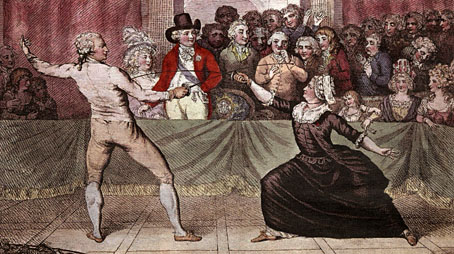
The Chevalier d’Eon wins a fencing bout.

I’ve known of the cross-dressing Charles-Geneviève-Louis-Auguste-André-Thimothée d’Eon de Beaumont—or the Chevalier d’Eon (1728–1810) to give him his title—for some time thanks to a typically witty and informative entry by Philip Core in Camp: The Lie that Tells the Truth (1984). The nobleman rubs shoulders there with the equally flamboyant Henry Paget (1875–1905), Fifth Marquess of Anglesey, known as “the Dancing Marquess”, and Romain de Tirtoff, better known as illustrator and designer, Erté, who we see in a photo dressed as “Claire de Lune”. Aside from his status as a historical curio, and a failed attempt by Havelock Ellis to borrow his name to describe transvestism—Eonism, the Chevalier seems less celebrated than he might be. So it’s a pleasure to hear that theatre director Robert Lepage has created a new stage production, Eonnagatta, based on the Chevalier’s colourful life:

For a long time now, the actor and experimental theatre director Robert Lepage has been fascinated by the life of the Chevalier d’Eon, an 18th-century French soldier who had a flamboyant career as a diplomat and secret agent for Louis XV, and spent much of his adult life dressed as a woman. Officially, the Chevalier’s skirts were worn as a professional disguise: his exceptionally fine features allowed him to pass easily for a woman, and thus move around undetected as a spy. But the Chevalier didn’t just do it for the job. He was a genuine cross-dresser, an 18th-century transvestite.

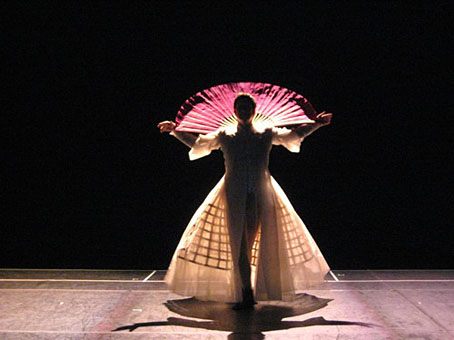
Lepage’s fascination has now led to Eonnagata, a daring collaboration inspired by the life of the Chevalier that gets its British premiere next week. The work has been put together by four very different, and internationally acclaimed, artists: there’s Lepage, the choreographer Russell Maliphant, the dancer Sylvie Guillem and the fashion designer Alexander McQueen. That’s quite a team – and the result is a unique hybrid of their art forms. How would they describe it? Maliphant gives it a go: “It’s not pure dance: it doesn’t have Sylvie doing splits or amazing falls. But it’s not pure theatre, either.” (More.)

deon2.jpg

Eonnagata.

Continue reading “Eonism and Eonnagata”

Further farewells

hp_ek.jpg

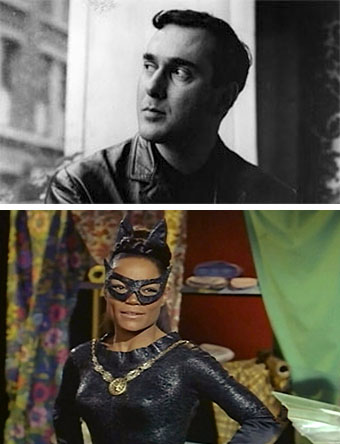
Harold Pinter and Eartha Kitt.

2008: the year that keeps on taking.

The Guardian has a copious collection of Pinter pieces including Michael Billington’s lengthy obituary. Eartha Kitt was just as unique in her own way, prompting Orson Welles in the 1950s to call her “the most exciting woman in the world”. For my sister and I a decade later she was the most exciting Catwoman in the world and that’s how I’ll remember her. But let’s not forget those Cha-Cha Heels

Eartha’s frivolity might seem to jar beside Pinter’s moral and political seriousness but the World Socialist Web Site managed to link the pair with a priceless headline, Harold Pinter and Eartha Kitt, artists and opponents of imperialist war. Their article tells you a few things about Eartha that many of the obituaries would have ignored. I’m sure Pinter would have been proud to hear of her speaking her mind at the White House. The world is a smaller place when talents and voices like these are gone.