The Population of an Old Pear-Tree; or, Stories of Insect Life

becker01.jpg

When one of the illustrations below turned up recently at Enchanted Booklet I had to go looking for its source. The Population of an Old Pear-Tree (1870) is a translated edition of a book by Ernest van Bruyssel (1827–1914), a Belgian writer whose life and work isn’t very well-documented on Anglophone websites. The back of the book does however list his other translated titles, most of which appear to be historical novels. Pear-Tree‘s illustrations are credited to one “Becker”, an even more obscure individual who turns to be Léon Becker (1826–1909), a Belgian artist.

becker02.jpg

Bruyssel’s book is an account of insect life intended to stimulate an interest in tiny creatures for a youthful readership. The narrator describes himself in the opening chapter undergoing a metamorphosis (it later becomes apparent that he’s fallen asleep in his favourite meadow) which gives him a new appreciation of the insect world. The chapters that follow explore a wide variety of insect life, accompanied by Becker’s engraved illustrations. The book isn’t a scientific study—the insects are anthropomorphised into various “tribes”—but Bruyssel avoids the cuteness that often bedevils writing about animals; the destructive habits of locusts are noted in one of the chapters. At the end of the book the narrator is roused from sleep by an entomologist, an ecnounter which leads the pair to discuss their different points of view, one scientific, the other romantic. Bruyssel’s narrative is an argument for generating sympathy in the subject by applying a degree of romance to a field of purely objective study. Léon Becker followed this with an entomological romance of his own, An Alphabet of Insects, in 1883.

becker03.jpg

becker04.jpg

becker05.jpg

Continue reading “The Population of an Old Pear-Tree; or, Stories of Insect Life”

Weekend links 769

koitsu.jpg

Araki Street in Yotsuya (1935) by Tsuchiya Koitsu.

• “Cambridge, home of analytic philosophy, was also a hotbed of psychical research. How did this spooky subject take root?” Matyás Moravec on philosophers and precognitive dreams, Alan Turing’s interest in telepathy, and more.

• DJ Food remembers Doug Lear, founder of the Magic Lantern Narrowboat Theatre. Related: Lear’s Magical Lanterns, a TV documentary from 1983.

• New music: WEM Dominator (Live in London NW1, 2016) by Earth; and Rubber Band Music by Kate Carr.

• At Public Domain Review: Master of Claude de France’s book of flower studies (ca. 1510–1515).

• At Colossal: Landscapes, customs, and culture shape the 2025 Sony World Photography Awards.

• At the BFI: Carmen Gray offers suggestions for ten great Baltic films.

• Mix of the week: DreamScenes – March 2025 at Ambientblog.

• At Dennis Cooper’s: Room Temperature Day.

Vinyl sleeves from Supraphon.

Telephone And Rubber Band (1981) by Penguin Cafe Orchestra | Rubbermiro (1981) by Liquid Liquid | Onions Wrapped In Rubber (1994) by Tortoise

Weekend links 765

fini.jpg

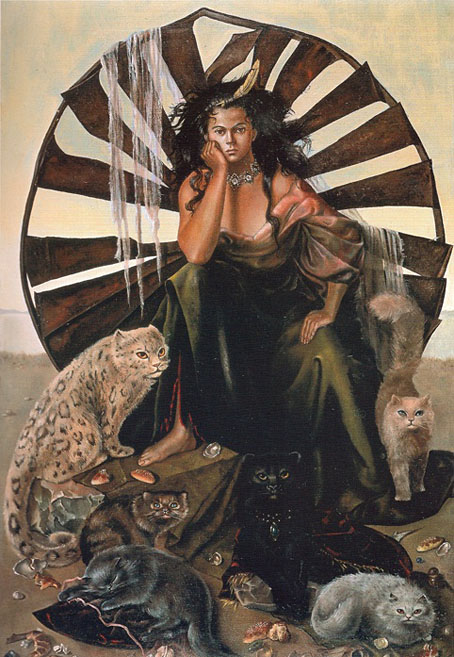
An Ideal Life (1950) by Leonor Fini.

• “…there has not been anything like a general, systematic discussion of what other, semantically different kinds of languages there can be, and the philosophical consequences of this. If reality has a certain structure, it would be a miracle if familiar languages contain all the resources to capture this structure.” Matti Eklund on the potential nature of alien languages.

• “As cats evolved from feral ratters into beloved Victorian companions, a nascent pet-food economy arose on the carts of so-called ‘cat’s meat men’. Kathryn Hughes explores the life and times of these itinerant offal vendors, their intersection with a victim of Jack the Ripper, and a feast held in the meat men’s honour, chaired by none other than Louis Wain.”

• Kinoteka, the UK’s Polish Film Festival, revealed its 2025 programme this week. Among the events will be a screening of the new Quay Brothers film, Sanatorium Under the Sign of the Hourglass (extract), at BFI Imax in London. Also in London (and with free entry), Swedenborg House will be hosting an exhibition of the Quays’ film decors.

• In a recent comment here I said that some of Charles Williams’ metaphysical novels were like John Buchan thrillers with an occult twist. At Wormwoodiana G. Connor Salter investigates the possible connections between the two writers.

Alice Coltrane & Carlos Santana, 1974: Lossless downloads of previously unissued recordings from the Illuminations album and a live set with John McLaughlin at San Francisco’s Kabuki Theater.

• “‘The Köln Concert is the hit he wants to disown’: why Keith Jarrett shunned two new films about his unlikely masterpiece.”

• New music: Shards by Tim Hecker; and Some Other Morning by Memory Effect.

• Mix of the week: DreamScenes – February 2025 at Ambientblog.

• At Colossal: Outdoor light installations by Lachlan Turczan.

• Galerie Dennis Cooper presents…Paul Laffoley.

Cat’s Eye (1977) by Van Der Graaf | Cat’s Eye (2015) by Patrick Cowley | No Cat’s Eyes (2017) by The Belbury Circle

Weekend links 764

marfut.jpg

Bruxelles 1958 Exposition Universelle (1958) by Leo Marfut.

• “In a moment when our collective memory is being systematically eradicated, archiving reemerges as a strong form of resistance, a way of preserving crucial, subversive, and marginalized forms of expression. We encourage you to do the same.” Welcome back, Ubuweb.

• A catalogue of lots at another After Dark: Gay Art and Culture online auction. Homoerotic art, photos, historic porn. etc.

• At Public Domain Review: George Baxter’s print of Crystal Palace dinosaurs (ca. 1864).

• At Spoon & Tamago: Contemporary Nihonga images of hamsters created by Otama-shimai.

• At Discogs: James Balmont explores Japan’s ambient boom of the ’80s and ’90s.

• Mix of the week: A mix for The Wire by Sakina Abdou.

• RIP Mike Ratledge, co-founder of Soft Machine.

• New music: Signals And Codes by Andrew Heath.

• At Dennis Cooper’s it’s Les Blank’s Day.

Signaux Codes Non Identifiés (1978) by Michel Magne | Code Rays (Codex Dub) (1995) by Main | Silent Code (1999) by Robert Musso

Weekend links 763

parent.jpg

I Live in Shock (1955) by Mimi Parent.

• At Public Domain Review: “Ben Hecht’s Fantazius Mallare (1922) is at turns obtuse, grotesque, and moralizing—and sought to provoke the obscenity trial of the century. Only it didn’t, quietly vanishing instead. Colin Dickey rereads this failed satire, finding a transcendent rhythm pulsing beneath the novel’s indulgent prose.”

• “There are no surprises when a pallet of CDs arrives at my office, but when a pressing plant alerts me to a shipment of records headed my way I start to worry.” John Brien, head of Important Records, on the problems involved in the manufacture of vinyl albums.

• The sixth installment of Smoky Man’s exploration of The Bumper Book of Magic has been posted (in Italian) at (quasi).

They were building a vast alternative religion with a lack of dictates but no shortage of rituals and icons. They’d pass through the end of the world to get there first; the next album was based on a vision of the Four Horsemen of the Apocalypse slaughtering their animals and constructing a earth-gouging machine from their jawbones, demonstrating they weren’t quite intending to settle down yet. It would take them far from mainstream culture, and indeed mainstream gay culture given their repeated disdain for sanitised queerness, and into enigmatic territory. Having scared away most fans of synth pop and industrial with provocation, and the weak and tyrannical with ambiguity, they were unencumbered and “allowed to mature in the dark”, sustained by a cult following (you rarely encounter a tepid fan of Coil, most are acolytes).

Darran Anderson looking back at Coil’s debut album, Scatology

• At Smithsonian Magazine: See 15 winning images from the Close-Up Photographer of the Year Competition.

• At The Daily Heller: How did pink become a colour? Meanwhile, Steven Heller’s font of the month is Vibro.

• New music: Even The Horizon Knows Its Bounds by Lawrence English.

SciURLs: A science news aggregator.

Shackleton’s favourite albums.

• RIP Marianne Faithfull.

The Pink Panther Theme (1963) by Henry Mancini | The Pink Room (1988) by Seigen Ono | Pink (2005) by Boris