Design as virus 11: Burne Hogarth

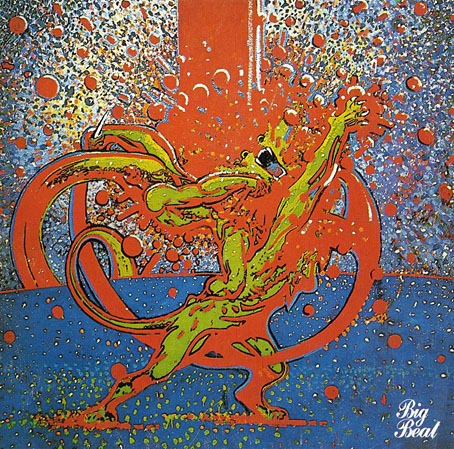
mighty_baby.jpg

Mighty Baby (1969). Illustration by Martin Sharp.

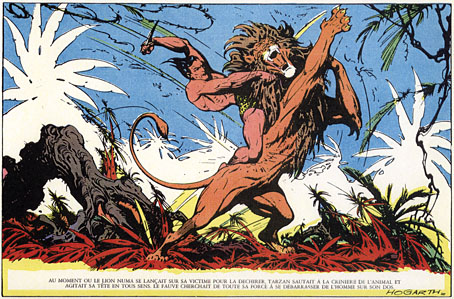
Yet another album cover prompts this post, part of an occasional series. Mighty Baby were a British rock band who formed out of psychedelic group The Action in the late Sixties, and their music is fairly typical of the period, being “heavy” without any of the psych trappings which—for me—often make everything from that time a lot more interesting. This was a journey undertaken by many groups at the end of that lurid decade, a junking of the playful and evocative side of what was now called rock music in favour of a denim-clad earnestness. This album isn’t one I like very much—I’d rather listen to their earlier incarnation—but the cover painting by psych artist Martin Sharp is certainly a startling piece, being a violent mutation of one of the most famous Tarzan drawings by comic artist Burne Hogarth.
hogarth.jpg

Tarzan by Burne Hogarth (194?).

Hogarth was drawing Tarzan for much of the 1940s and this particular panel showing the Ape-Man attacking Numa the lion dates from the latter part of his run on the series. I wish I could pin this to an actual year but I don’t have a complete set of the comics and that detail eluded me. If anyone knows the date, please leave a comment.
Continue reading “Design as virus 11: Burne Hogarth”

Peake’s Pan

pan1.jpg

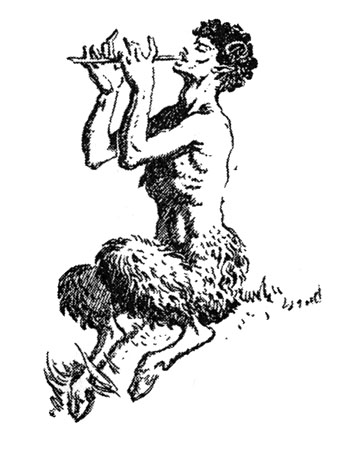
Another charity shop book-raid this week netted me a copy of Ian Fleming’s On Her Majesty’s Secret Service in its 1965 Pan Books edition, one of the Bond series with great covers designed by Raymond Hawkey. The sight of the tiny Pan silhouette above reminded me that this logo was based on drawings commissioned from Mervyn Peake when the company was launched at the end of the Second World War. The design persisted for many years, usually printed on a yellow background.

pan2.jpg

I wasn’t sure I had a copy of Peake’s original version to hand but G Peter Winnington‘s Peake biography, Vast Alchemies (2000), includes a reproduction, one of two drawings Peake produced for the publisher. The other can be seen on this Pan Books site which also reveals that Peake’s Pans were printed at quite large size on the initial run of books. The design model may have been the early Penguin style which nearly always had the famous bird prominently placed in the lower third of the cover. In book terms at least, the Penguin has proved to be the more powerful god, having survived virtually unchanged since 1935. Peake’s Pan is long gone, dropped in favour of two red squiggles.

Elsewhere on { feuilleton }
The illustrators archive

Previously on { feuilleton }
Buccaneers #1
Recovering Bond
Mervyn Peake in Lilliput
James Bond postage stamps
Wanna see something really scary?
T&H: At the Sign of the Dolphin

Vintage movie posters

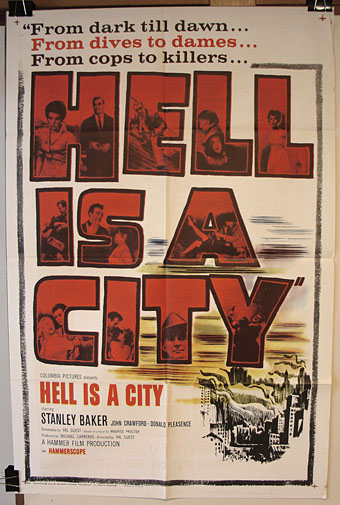
hellis.jpg

An example from this Flickr set.

Hell is a City is a Hammer melodrama from 1960 directed by Val Guest, mentioned here recently for his earlier The Day the Earth Caught Fire. This one doesn’t succeed quite as well, being a misguided attempt to do a film noir in Manchester. The poster tries to disguise the mundane reality by showing a city which looks more like New York than our small northern metropolis. But it’s worth watching for the great Stanley Baker and, like A Taste of Honey and other films with Manchester settings, you can have fun spotting familiar places in the background. If it’s Brit film noir you want, there’s only one place to go: Jules Dassin’s marvellous Night and the City.

Previously on { feuilleton }
Edward Judd, 1932–2009
Franciszek Starowieyski, 1930–2009
Czech film posters
The poster art of Richard Amsel
Bollywood posters
Lussuria, Invidia, Superbia
The poster art of Bob Peak
A premonition of Premonition
Perfume: the art of scent
Metropolis posters
Film noir posters

Philip José Farmer, 1918–2009

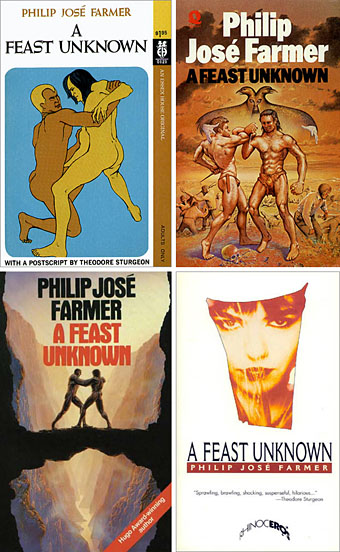
top left: artist unknown (1969); top right: Patrick Woodroffe (1975)
bottom left: Peter Elson (1988); bottom right: artist unknown (1995)

The great science fiction writer Philip José Farmer died today. I wrote about his more excessive works back in August 2007 and that post is as good an obituary as I could offer now. A Feast Unknown remains a favourite for pushing extreme content to a degree which would give William Burroughs pause whilst still functioning as a rollicking page-turner. Few writers could work on both those levels and do much more besides. Feast seems to be out of print today, which isn’t a surprise. Publishers are still a timid bunch for the most part and Farmer never pulled his punches.

Elsewhere on { feuilleton }
The book covers archive

Previously on { feuilleton }
Philip José Farmer book covers