Weekend links 127

whirlpool.jpg

M15, The Whirlpool Galaxy photographed by Martin Pugh. The overall and deep space winner of Astronomy Photographer of the Year, 2012.

The Final Academy, the series of William Burroughs-themed events that took place in London and Manchester in 1982, will be celebrated at the Horse Hospital, London, on 27th October. Academy 23, a publication edited by Matthew Levi Stevens, will include my report on the Manchester Haçienda performances.

• “Architects are the last people who should shape our cities,” says the thrillingly pugnacious Jonathan Meades in a piece from his new writing collection Museums Without Walls. Andy Beckett reviews the book here.

• Ex-Minimal Compact singer/bassist Malka Spigel talks about her new album, Every Day Is Like The First Day, which can be streamed in full here.

What’s new about the current acknowledgments page is that it’s unsolicited—it appears like an online pop-up ad, benefiting no one but the author and his comrades. This is surely why these afterwords are often so garrulously narcissistic and strewn with clichés. The most radical experimentalist adheres to the most mindless acknowledgments-page formula; the most stinging social critic suddenly becomes Sally Field winning an Oscar.

Sam Sacks at the New Yorker on the blight of novelists’ acknowledgments pages. DG Myers at Commentary Magazine piles on.

• Another streaming album: Composed by Jherek Bischoff. Try Insomnia, Death & The Sea featuring Dawn McCarthy.

• Film of Lindsay Kemp being interviewed in 1977 about his production of Salomé.

Electronic Performers (2004): a video by Machine Molle for the song by Air.
djuna.jpg

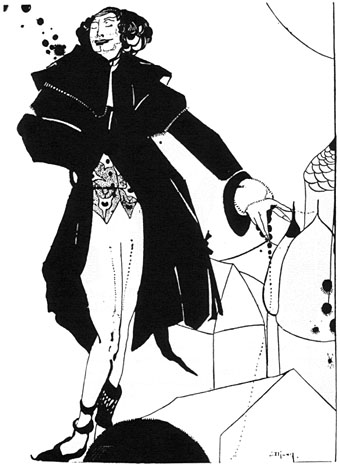
One of a series of Beardsley-like drawings by Djuna Barnes posted at Strange Flowers. The resurgent Ms. Barnes is mentioned three times in this Terry Castle review of All We Know: Three Lives by Lisa Cohen.

Fictitious Dishes, meals from novels photographed by Dinah Fried.

• Life, the Dinosaurs & Everything: Cosmicomics by Italo Calvino.

The Baby Died: Morbid Curiosities found in Old Newspapers.

• Portishead’s Adrian Utley gives a tour of his synth collection.

• Minimal Compact: Babylonian Tower (1982) | Not Knowing (1984) | When I Go (1985) | Nil Nil (1987).

Rue St. Augustin, then and now

augustin1.jpg

Boutique art nouveau, 45 rue st. Augustin (2e arr, 1904–05).

Despite being reasonably familiar with Eugène Atget’s celebrated photos of Paris, this picture of a very elaborate Art Nouveau façade is something I’d not seen until now. The photo is part of the George Eastman House collection of Atget prints, and is unusual for showing a very contemporary shopfront. Atget generally preferred premises redolent of an older, pre-Haussmann Paris, like the window full of barometers at Au Griffon, 39 Quai de l’Horloge. The Rue St. Augustin façade is an especially baroque example of Art Nouveau excess with a flying fish, a large butterfly (or moth) supporting the window, and the ubiquitous fin de siècle female floating above it. Naturally I had to know if the decor had survived but a quick look at Google Maps revealed the mundane scene below. The apartment entrance next door is pretty much unchanged but the wine shop that’s there now shows no traces of its delirious past.

augustin2.jpg

Previously on { feuilleton }
Hector Guimard elevations
Infernal entrances
Hector Guimard sketches
Temples for Future Religions by François Garas
Elizabetes Iela 10b, Riga
Atelier Elvira
Louis Bonnier’s exposition dreams
The Maison Lavirotte
The House with Chimaeras

Weekend links 125

cme.jpg

Coronal Mass Ejection from the surface of the Sun, August 31st, 2012.

• “Most of the main parts were recorded in a single day using Vangelis’s famous technique: try to play as many synths as possible at once.” Simon Drax on the prolific musical output of Zali Krishna. The new Krishna opus is Bremsstrahlung Sommerwind, free to download at the Internet Archive.

• The Northants International Comics Expo (N.I.C.E.) opens on September 22nd. Among the many attendees there will be Mr Alan Moore making his first convention appearance since 1987.

• “Isolated for one night in a boat overlooking the Thames, Geoff Dyer explores representations of reality through the lens of Joseph Conrad’s Heart of Darkness.”

Now seems the right time to revisit this secret archive of public broadcasting. It’s an antidote to the celebrity-led, format-driven nature of so many arts documentaries made today. It shows that it’s possible to produce TV that is both populist and experimental. And it also refutes the cliché that the 1970s was a decade only of crisis and downturn. “Feminism, political theatre, Ways of Seeing: I wasn’t thinking, ‘what a terrible time’. It was very dynamic, activist, political. Creatively it was very exciting. Yet all they show on those television retrospectives are episodes of Top of the Pops.”

Sukhdev Sandhu talks to Mike Dibb, the director of Ways of Seeing.

• From 1999: Colm Tóibín reviews A History of Gay Literature: The Male Tradition by Gregory Woods.

What We See: a song by Julia Holter & Nite Jewel with a film by Delaney Bishop & Jose Wolff.

Rick Poynor on The crash test dummy: from subcultural fringes to pop culture mainstream.

In his 1973 book on Joyce, Joysprick, Burgess made a provocative distinction between what he calls the “A” novelist and the “B” novelist: the A novelist is interested in plot, character and psychological insight, whereas the B novelist is interested, above all, in the play of words. The most famous B novel is Finnegans Wake, which Nabokov aptly described as “a cold pudding of a book, a persistent snore in the next room.” The B novel, as a genre, is now utterly defunct; and A Clockwork Orange may be its only long-term survivor.

Martin Amis on A Clockwork Orange, fifty years on. My old post about the film’s record shop scene continues to be one of the most popular pages here.

• Wild Boys: David Bowie and William Burroughs in 1974, hand-coloured by DB.

Alfred Kubin‘s illustrations for Haschisch (1902) by Oscar AH Schmitz.

• Revolution off: industrial ruins photographed by Thomas Jorion.

• Tetrahedra of Space: 22 pulp illustrations by Frank R. Paul.

The Blue Boy Studiolo: a Tumblr.

Marina Warner visits Hell.

• The art of Casey Weldon.

RainyMood.com

Third Stone From The Sun (1967) by The Jimi Hendrix Experience | Sunrise In The Third System (1971) by Tangerine Dream | 3rd From The Sun (1982) by Chrome.

Austrian arcades

austria1.jpg

The Passage of Palais Ferstel – Shopping Arcade, Vienna #1 by Gary Quigg.

Given their enclosed nature and multiple vistas, arcades are well-suited to panoramic photography, so it’s a surprise when more examples don’t turn up at 360Cities. The ones here are recent additions from Vienna and Steyr in Austria. The Palais Fertsel is a particularly lavish place with some suitably lavish shops which include a branch of the Xocolat chain of chocolatiers. The arcade in Steyr is an oddity since it seems to be filled with clock sellers and watchmakers, and has an elaborate mechanical clock poised above its crossing.

austria2.jpg

The Passage of Palais Ferstel – Shopping Arcade with Fountain, Vienna #3 by Gary Quigg.

austria3.jpg

Steyr, Upper Austria, A Clockwork Arcade by Roberto Scavino.

Elsewhere on { feuilleton }
The panoramas archive

Previously on { feuilleton }
Cours et passages à Paris
Arcades panoramas
Arcades
Passage des Panoramas
Passages 2
Passages

The recurrent pose 49

flandrin.jpg

In which personal obsessions infiltrate the outside world… Rastko (above) writes that he remembered the recurrent pose archive when playing with his camera’s self-timer whilst on holiday on the island of Brac in Croatia. The result was this photo which is posted here with his permission. A rare example of the pose in question being au bord de la mer for once. Thanks Rastko!

Elsewhere on { feuilleton }
The recurrent pose archive