New things for February

fenella.jpg

Fenella Fielding, May 2005.

A few things of interest in the Coulthart world this month.

The Independent on Sunday this weekend ran a feature by Robert Chalmers on film and stage actress Fenella Fielding which included some discussion with my Savoy colleague Dave Britton about the recordings Savoy has been making with Fenella for the past few years. I was fortunate to meet Ms Fielding myself a couple of years ago, during one of the sessions at Lisa Stansfield’s studio in darkest Rochdale, north of Manchester. As well as having the opportunity to chat to La Fielding (as Kenneth Williams used to call her), I got to take a few photos outside the studio, the best of which can be seen above. The IoS interview is an interesting one, revealing some details about Ms Fielding’s mysterious past and confirming what we knew already, that she’s not overly enamoured of her work with the ruffians from the North.

• Also in the Savoy orbit, Michael Butterworth and I were interviewed for the second number of Trespass magazine before Christmas and I’m told the issue featuring that interview has now been published although I’ve yet to see a copy. Considering I spent most of my portion of the piece ranting intemperately about the art world, that may turn out to be a good thing.

Trespass–Issue 2: January–February 2008

trespass.jpgAlasdair Gray tells us why Lanark took so long to write and what he thinks of Gordon Brown. Savoy: a look at the obscenity trials and establishment outrage that mark this infamous publisher’s history. ‘Transgender Adventures’: a frank account of life in the sexual margins featuring Pia. ‘Not a Pursuit for a Lady’: a modern take on Tennyson’s The Lady of Shalott. ‘Stop Talking and Move’: Nottingham’s parkour crew—a growing subculture. Sarah Maple: vote for her or you’re an islamaphobasexistracialist. Also the best of poetry, art and short fiction, including Catherine Smith, A. F. Harrold, Sascha Akhtar, Bernadette Cremin, David Gaffney and Anthony Cantons.

• And finally, the Savoy boys and myself receive a note of thanks in Elric: The Stealer of Souls by Michael Moorcock, one of a new series of reprints from Del Rey. Elric was and is Moorcock’s greatest fantasy character, not so much a hero as an anti-hero, and for me the early stories, which this first volume features, have always been the best. The books in this new series collect a lot of ephemeral material along with the stories (I helped source the picture of Zenith the Albino, the old pulp character Elric is based on) and all have new introductions. The intro for this volume is by Alan Moore and it’s a tremendous piece of writing. You couldn’t ask for better company.

Guido Reni’s Saint Sebastian

sebastian.jpg

Saint Sebastian by Guido Reni (c. 1616).

The Agony and the Ecstasy is an exhibition at the Dulwich Picture Gallery, London, based around Guido Reni’s paintings of the martyr, six of which are on display.

This will be a once-in-a-lifetime opportunity to compare directly the six masterpieces which are coming from all over the world to join the St Sebastian owned by Dulwich Picture Gallery. The paintings are coming from New Zealand, South America, Madrid, Genoa and Rome.

The claim for masterpieces is stretching the truth when art experts apparently believe that only two of the martyr paintings credited to Reni are original—the Genoa picture above and the Dulwich’s own version—the rest being later copies. The Genoa version became a favourite of Oscar Wilde and it was a Sebastian by Guido Reni that also excited the illicit passion of the 12 year-old protagonist in Yukio Mishima’s novel Confessions of a Mask. Wilde used the name Sebastian when he went into exile in Paris but he never took his identification with the saint as far as Mishima who adopted the typical pose in the famous photo taken shortly before the writer’s suicide. Wilde had no need of borrowed martyrdoms, his own was more than enough.

mishima.jpg

Yukio Mishima (1970).

The Agony and the Ecstasy runs until 11 May 2008. For further images of Saint Sebastian, this site is as comprehensive as it gets.

Elsewhere on { feuilleton }
The gay artists archive

Previously on { feuilleton }
Dorian Gray revisited
Beardsley’s Salomé
The art of Takato Yamamoto
Alla Nazimova’s Salomé
Fred Holland Day
The Poet and the Pope
The Picture of Dorian Gray I & II

Earth in Manchester

earth.jpg

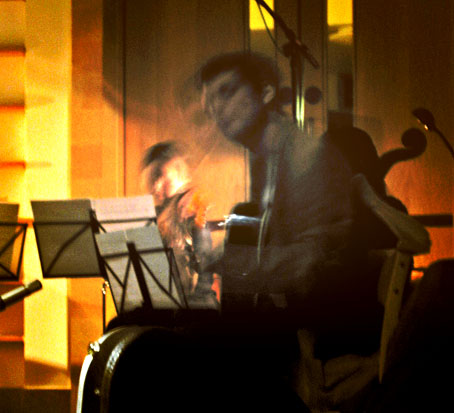
Earth, looking suitably infernal.

Out this evening to the Zion Centre in Hulme to see Seattle drone metal band Earth. I didn’t get to see their performance at the 2005 Arthurfest in Los Angeles but this event made up for that. Support—which we missed due to late arrival—was from Sir Richard Bishop, whose portrait I produced for the last issue of Arthur Magazine.

Earth play that kind of slowed-to-a-crawl metal which has its roots in Black Sabbath (the origin of their name) and Swans. The band have some great album and track titles, among them Thrones and Dominions, Hex (Or Printing in the Infernal Method) and Teeth of Lions Rule the Divine, the latter being borrowed by a drone doom supergroup. Unlike followers Sunn O))), who don robes and fill the stage with fog, the Earth presentation is a minimal one: no vocals, just the music, and no effects, red light only. I’d heard a couple of Earth CDs but what becomes obvious when you see them live is that this kind of music really benefits from loud volume and a good sound system. Both those elements were in place tonight which made for a thoroughly immersive experience.

Earth have a new album out at the end of this month, The Bees Made Honey in the Lion’s Skull, on the Southern Lord label.