Guido Reni’s Saint Sebastian

sebastian.jpg

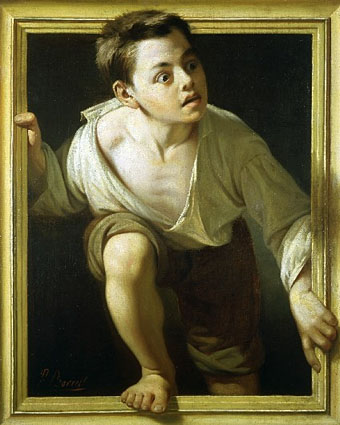
Saint Sebastian by Guido Reni (c. 1616).

The Agony and the Ecstasy is an exhibition at the Dulwich Picture Gallery, London, based around Guido Reni’s paintings of the martyr, six of which are on display.

This will be a once-in-a-lifetime opportunity to compare directly the six masterpieces which are coming from all over the world to join the St Sebastian owned by Dulwich Picture Gallery. The paintings are coming from New Zealand, South America, Madrid, Genoa and Rome.

The claim for masterpieces is stretching the truth when art experts apparently believe that only two of the martyr paintings credited to Reni are original—the Genoa picture above and the Dulwich’s own version—the rest being later copies. The Genoa version became a favourite of Oscar Wilde and it was a Sebastian by Guido Reni that also excited the illicit passion of the 12 year-old protagonist in Yukio Mishima’s novel Confessions of a Mask. Wilde used the name Sebastian when he went into exile in Paris but he never took his identification with the saint as far as Mishima who adopted the typical pose in the famous photo taken shortly before the writer’s suicide. Wilde had no need of borrowed martyrdoms, his own was more than enough.

mishima.jpg

Yukio Mishima (1970).

The Agony and the Ecstasy runs until 11 May 2008. For further images of Saint Sebastian, this site is as comprehensive as it gets.

Elsewhere on { feuilleton }
The gay artists archive

Previously on { feuilleton }
Dorian Gray revisited
Beardsley’s Salomé
The art of Takato Yamamoto
Alla Nazimova’s Salomé
Fred Holland Day
The Poet and the Pope
The Picture of Dorian Gray I & II

Whistler’s Peacock Room

whistler1.jpg

Random browsing this week turned up some nice high-res photos of Harmony in Blue and Gold, as James Abbott McNeill Whistler named the room he decorated for Frederick R. Leyland in 1878. Leyland had bought one of Whistler’s paintings, La Princesse du pays de la porcelaine (1864), and architect Thomas Jeckyll was concerned that the painting and furnishings would clash, hence the invitation for Whistler to help with the colour scheme.

I’ve always preferred this luscious, gold-leafed design to the worthy medievalism of contemporary William Morris. Even though Whistler completed the work prior to the 1890s, the combination of Orientalism and peacocks (the signature bird of the Decadence) seems very much tied to the fin de siècle not least because of Aubrey and Mabel Beardsley’s visit to the room in 1891. Beardsley was very impressed with the painting and with the golden birds, the style of which later formed the inspiration for his famous Peacock Skirt illustration in Salomé (1894).

whistler2.jpg

There’s a good overview here of the history of the room, including details of the falling out between the combative artist and his client, and the story of the room’s removal to America and subsequent restoration.

Previously on { feuilleton }
Beardsley’s Salomé
Alla Nazimova’s Salomé

Yoshitaka Amano in Berlin

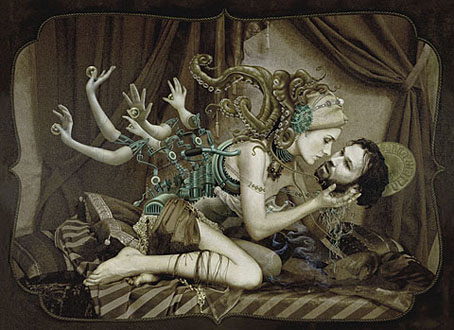
amano1.jpg

Deva-loka (2007).

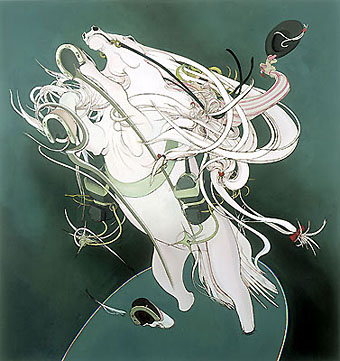
Big new paintings by one of my favourite Japanese artists at Galerie Michael Janssen, Berlin, until February 29, 2008. The wild details in Deva-loka are completely lost at this size but there’s a larger version on Amano’s site.

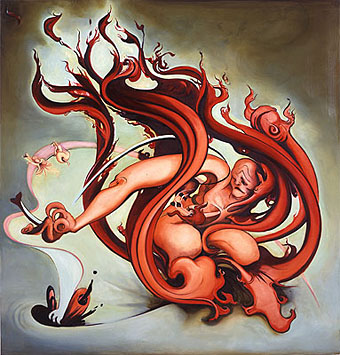
amano2.jpg

Creation (2007).

These works are being sold as fine art but Amano’s reputation rests upon his commercial art which embraces anime, manga and book cover illustration. As is often the case, the art world has a problem with this, regarding work for hire as lower than work for galleries, the latter being no less commercial in the sense that the works are sold to collectors who frequently demand more of the same; Andy Warhol’s studio was named The Factory with good reason. A comment at Creative Europe acknowledges the dilemma:

“There are two reasons why it is necessary to bring Yoshitaka Amano’s immensely successful professional biography into the equation here: on the one hand, the work he has done as a creator of mangas and animes (animations) provides an undisputed frame of reference for his pictures; on the other, it has become difficult where Amano’s oeuvre is concerned to uphold the differentiation popular in German speaking quarters between a more commercial applied visual art and the personally expressive variety.” (My italics.)

Amano’s non-commercial work at Galerie Michael Janssen is for sale, prices on request.

Previously on { feuilleton }
The art of Takato Yamamoto

William Blake in Manchester

blake.jpg

Europe: A Prophecy by William Blake (1794).

Two exhibitions based around the work of William Blake open today at Manchester’s Whitworth Art Gallery, Mind-Forg’d Manacles, “organised to coincide with the 250th anniversary of Blake’s birth as well as the 200th anniversary of the Parliamentary abolition of the transatlantic slave trade” and Blake’s Shadow: William Blake and his Artistic Legacy. The latter seems to be the more interesting of the two.

Blake’s Shadow: exhibition summary

This exhibition explores Blake’s continuing fascination for artists, filmmakers and musicians. It features around sixty watercolours, prints and paintings in addition to numerous illustrated books and a range of audio-visual material. Blake is a unique figure in British visual culture, attracting both academic and popular interest. In the years since his death in 1827, Blake has continued to influence the world of creativity and ideas. He has inspired people with such wide ranging interests as literature, painting, book design, politics, philosophy, mythology through to music and film making. Alongside works by Blake—prints, watercolours, engravings and book illustrations—the exhibition spans two centuries of his influence.

• His contemporaries in the late 18th and early 19th century are represented with works from John Flaxman, Edward Calvert, Samuel Palmer, J.H. Fuseli and Thomas Stothard
• Blake’s influence on artists in the Victorian period is explored through works by Ford Madox Brown, Walter Crane, Frederic Shields, John Everett Millais, Dante Gabriel Rossetti, Simeon Soloman and G.F. Watts.
• British artists working in the 20th and 21st century include Cecil Collins, Douglas Gordon, Paul Nash, Anish Kapoor, David Jones, Ceri Richards, Patrick Proctor, Austin Osman Spare and Keith Vaughan. This section of the exhibition features photographs and original works.
• From the 1960s onward, writers, musicians, film makers like Allen Ginsberg, Bob Dylan, Jim Morrison of The Doors and John Lennon have adopted Blake as a mystical seer and anti-establishment activitist. More latterly, as British musicians and activists like Billy Bragg and Julian Cope have grappled with notions of national identity, Blake has enjoyed something of a renaissance. Blake’s Shadow examines this more recent influence as evidenced in work by the filmmakers Jim Jarmusch and Gus Van Sant, and various musicians, notably Patti Smith and Jah Wobble.

spare.jpg

The Dawn by Austin Spare (no date).

It’s good to see Austin Spare being included in something like this. He always referred to Blake as an influence but, as I’ve mentioned before, he’s frequently been treated disrespectfully by an art establishment that doesn’t know what to make of the occult basis of his work.

Mind Forg’d Manacles runs to 6 April 2008, Blake’s Shadow to 20 April.

Elsewhere on { feuilleton }
The illustrators archive

Previously on { feuilleton }
Austin Spare in Glasgow
Tygers of Wrath
Austin Osman Spare