Weekend links 34

austin.jpg

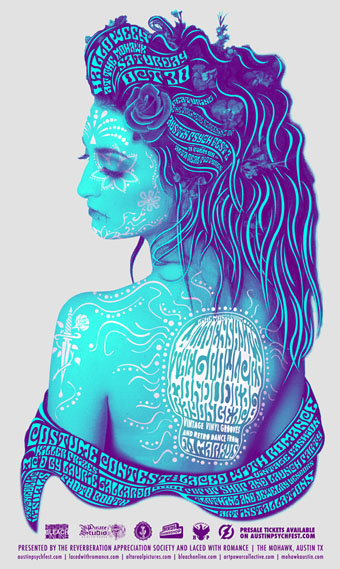
Halloween in Austin, Texas this year will look and sound like this.

• “Blade Runner will prove invincible“: Philip K Dick’s letter of praise to the film’s producers. Related: one of the Blade Runner designers, Syd Mead, has recently styled New York’s Bar Basque and Foodparc.

• “I decided to go into fields where mathematicians would never go because the problems were badly stated…I have played a strange role that none of my students dare to take.” RIP Benoît Mandelbrot.

Science and poetry: “a richly vexed topic badly in need of rethinking”. Related: Why the Singularity isn’t going to happen.

• In case you missed this week’s earlier announcement, a reminder that I was interviewed at Coilhouse. My vanity: it knows no bounds.

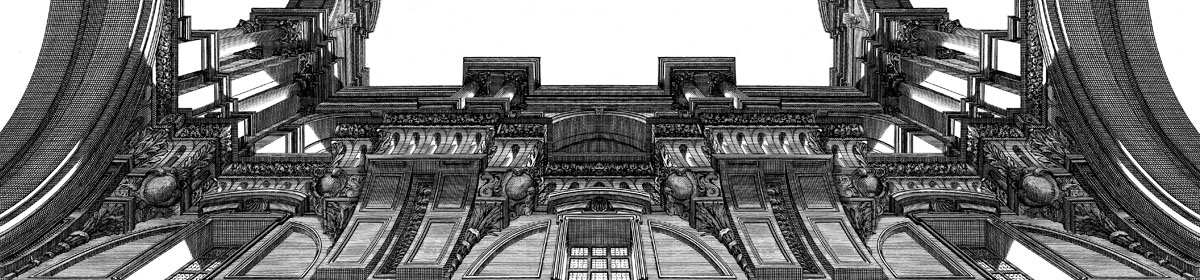
• Franklin Booth’s illustrations for The Flying Islands of the Night (1913) by James Whitcomb Riley.

On the Verge (1950) by Maurice Sandoz, illustrated by Salvador Dalí. Also this and this.
bowie.jpg

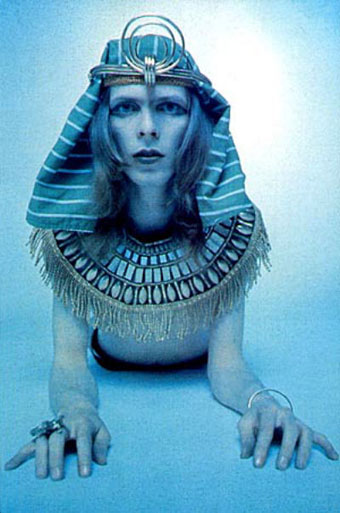
Bowie Sphinx, 1969. Photo by Brian Ward.

The Laughing Gnostic: David Bowie and the Occult.

• “Moonlighting as a Conjurer of Chemicals“: Isaac Newton’s alchemical interests.

• “A sense of otherness that goes right back“: Alan Garner at Alderley Edge.

Jimmy’s End—Alan Moore’s new feature film and spin-off TV series.

A Guide to the New Ruins of Great Britain by Owen Hatherley.

• The It Gets Better Project now has a dedicated website.

Quicksand (1971) by David Bowie.

The Tempest illustrated

tempest.jpg

“Such stuff as dreams are made on”: Heathcote Williams and Toyah Willcox.

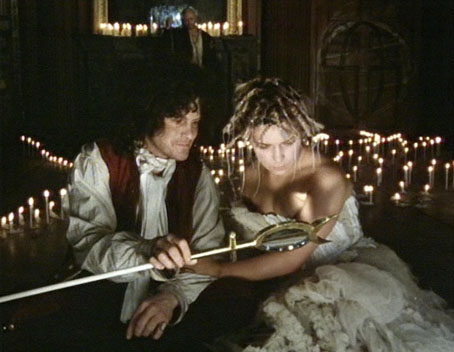
DVD viewing earlier this week was Derek Jarman’s wonderful adaptation of The Tempest which he directed in 1979. This is my favourite of Jarman’s films, partly because the play is my favourite Shakespeare (along with its polar opposite, Macbeth) and also because it’s a film infused with an occult sensibility which comes directly from the director’s own interests, rather than being the usual film or theatre conventions of what magic entails. An example of this is the grimoire which Prospero (Heathcote Williams) is seen leafing through which Jarman reveals in his autobiography, Dancing Ledge, to be his own 17th-century edition of Cornelius Agrippa’s Occult Philosophy. In his account of the filming he also describes his conception of Prospero as being based on Dr John Dee, the Elizabethan occultist who Shakespeare would certainly have known of, and may even have met since the pair both had business with Elizabeth I’s court. The most explicit reference to Dee comes in the shape of Prospero’s magical glass (above), based on Dee’s Monas Hieroglyphica, and a prop I’d dearly love to own. Dee was also a character in Jarman’s Jubilee (1978), and his Angelic Conversations gave a title to Jarman’s later filming of Shakespeare’s sonnets.

Seeing Jarman’s adaptation again had me thinking about the various representations of the characters. Ariel is generally depicted as a fairy type although he’s a lot more powerful than the fairies in A Midsummer Night’s Dream. As for Caliban, like Grendel in Beowulf, he’s an all-purpose monster whose predominant attributes seem to be whatever Ariel isn’t: ugly, earthbound, stupid, treacherous, and so on. I’d be tempted to propose the island’s quartet as representing the four elements—Prospero: water; Miranda: fire; Caliban: earth; Ariel: air—but I’m sure that’s not an original idea given the amount of academic trawling through the Bard’s corpus. Rather than dig for symbolism, what follows is a few pictures found during another trawl of my own through the Internet Archive, where the books aren’t drowned but patiently await their rediscovery.

Continue reading “The Tempest illustrated”

Richard de Chazal’s Zodiac

chazal.jpg

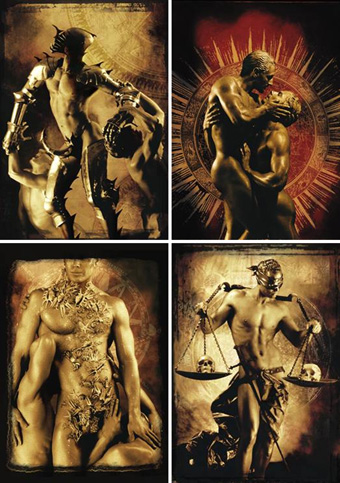
top left: Scorpio; top right: Gemini.
bottom left: Cancer; bottom right: Libra.

Following the zodiac sets from August, here’s a distinctly homoerotic variation on the theme by Australian photographer and fashion designer Richard de Chazal. See the full set here. Also on his site is a selection of his erotic photography which may interest some of the visitors who’ve been arriving here all week from porn site Queerclick. The small size of the photos should be taken as an encouragement to buy Mr De Chazal’s book. Via Chateau Thombeau.

Elsewhere on { feuilleton }
The gay artists archive

Previously on { feuilleton }
Mucha’s Zodiac
Owen Wood’s Zodiac
Palladini’s Zodiac
The Major Arcana by Jak Flash

Horror! 333 Films to Scare You to Death

horror.jpg

Arriving in the post this week was this 350-page guide to horror cinema, a Carlton Books reprint of the 2006 Andre Deutsch volume to which I contributed some 30-plus reviews and essays on Dracula, Lovecraft and occult cinema. This new printing is slightly expanded although the production is a lot less lavish than the earlier book which was a hardback with colour photos throughout. I suppose this one goes by the TV chair whereas the previous edition deserved a place on the bookshelf. I didn’t have a lot of time earlier this year to help with the updating but I did manage to write reviews of The Mist and Cloverfield, two recent horror outings I enjoyed a great deal. Despite the proliferation of online reviews there’s still a place for handy guides such as this, and I’d say that even if I wasn’t a contributor. Kim Newman is a contributing editor at Sight & Sound magazine, and both he and James Marriott have produced their own excellent guides to horror cinema. When sites like IMDB are weighed down with an opinionated rabble, an intelligent and informed counterweight is essential.

Previously on { feuilleton }
Berni Wrightson in The Mist
Stamps of horror
Horror comics
Hail, horrors! hail, infernal world!

Yuri Yakovenko bookplates

jakovenko3.jpg

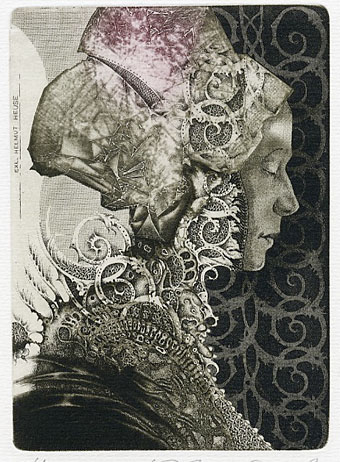
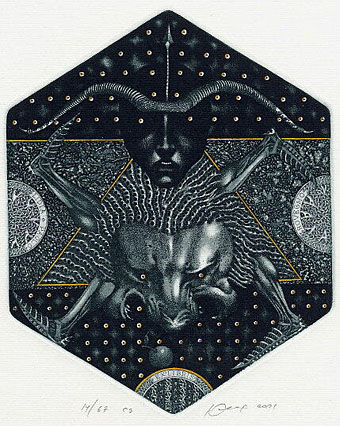
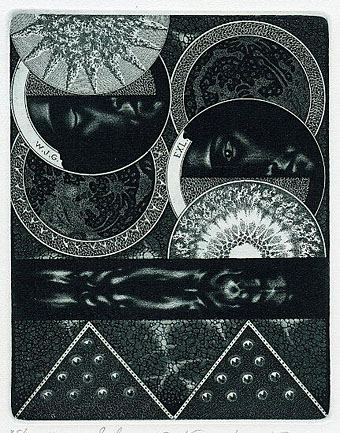
Yet more bookplates, discovered whilst browsing the wealth of material at this Japanese site recommended by Andy Paciorek. Belarus artist Yuri Yakovenko’s name is given a number of spellings on various sites so I’ve gone with the one from a Belarus art page since they can be presumed to know best how to label their fellow artists. Yakovenko’s hyper-detailed, occult-inflected brand of Surrealist imagery is so striking you have to wonder why his work hasn’t gained more visibility. Is it because the contemporary Ex Libris print world appears to be a self-contained zone within the wider art market? Whatever the answer, this is a region worthy of further investigation.

jakovenko1.jpg

jakovenko2.jpg

Elsewhere on { feuilleton }
The etching and engraving archive

Previously on { feuilleton }
Tranquillo Marangoni bookplates
Book-plates of To-day
Louis Rhead bookplates
Pratt Libraries Ex Libris Collection
The Evil Orchid Bookplate Contest
The art of Oleg Denysenko
David Becket’s bookplates