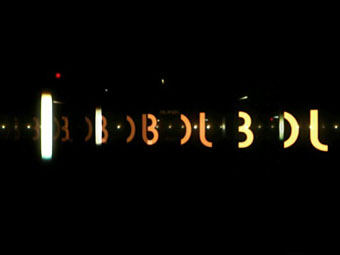
The Invasion of Thunderbolt Pagoda II

invasion.jpgLong, Strange Trip for a Hypnotic Film

By James Gaddy
August 27, 2006
The New York Times

IT TOOK 38 years, but Ira Cohen’s cult film, The Invasion of Thunderbolt Pagoda, which was first screened in 1968 at the high point of the psychedelic hippie head rush, is now commercially available. Given the close calls, the long absences and his chaotic archival system, Mr. Cohen, 71, is a little surprised himself.

“It didn’t really involve patience,” he said in his apartment on West 106th Street in Manhattan, surrounded by books stacked waist high. “It was just reality.”

In 1961 Mr. Cohen built a room in his New York loft lined with large panels of Mylar plastic, a sort of bendable mirror that causes images to crackle and swirl in hypnotic, sometimes beautiful patterns. After a few years experimenting with the technique in photographs, he invited his friends from the downtown scene—like Beverly Grant, Vali Myers and Tony Conrad—to make a film.

The finished product sets languid images of opium smokers (in fantastic makeup and costumes) against a droning, chanting, tabla-beating soundtrack by Angus MacLise, the original drummer of the Velvet Underground. Xavier Garcia Bardon, film curator at the Palais des Beaux-Arts in Brussels, said the film is an important artifact of the era.

“It’s like going on an ecstatic journey to another planet, full of magical beings, animals and plants,” he said. “It’s a hallucinatory, almost trance-inducing experience.”

Mr. Cohen left New York in 1969, shortly after the film’s first screening, for art- and drug-filled travels in India, Ethiopia and Nepal. He roamed through the 1970s and 80s. While he was away, the film’s legend grew, even as the original few copies slowly disappeared.

Mr. Cohen said he dropped off the original print at DuArt Film Laboratories before he left; the staff reached him in Kathmandu in 1978, asking for $300 in storage fees. He asked the lab to send the print to the Museum of Modern Art, but the museum has no record of receiving it.

“If you have money, you can store it any way you want,” he said ruefully. “But for some people, $280, $300 changes the way things turn out.”

It wasn’t until a compilation of Mr. MacLise’s music came out in 1999, 20 years after his death, that interest in distributing the film began. Jay Babcock, editor of the underground magazine Arthur, and Will Swofford, a composer who was then studying at Wesleyan University, independently tracked Mr. Cohen down.

Mr. Babcock said he was curious to see how Mr. Cohen’s early Mylar photographs would look like in a film. “I had dreamed for years what it would look like,” Mr. Babcock said. He began pressing for distribution rights.

Meanwhile Mr. Swofford had persuaded Mr. Cohen, whose health has been failing (he’s had two strokes in the last year), to let him operate as an archivist and agent. Mr. Swofford eventually found 40 cans of unused outtakes in a green trunk, buried beneath books, papers, slides and assorted creative runoff.

“No one had touched the film for 25 years,” Mr. Swofford said.

Because the original version lasts only 22 minutes, he began beefing>up the content for the DVD age. Mr. Cohen wanted to use part of the found film, an eight-minute section in which he is buried in mud, as a prelude; Mr. Swofford used the nearly four hours of outtakes to fashion Brain Damage, a 30-minute coda. The DVD also features a slide show of Mr. Cohen’s photographs, audio recitations of his poetry and two alternate soundtracks to the film.

One of these versions was by the band Acid Mothers Temple, which had recorded a live soundtrack to the film at the music festival Kill Your Timid Notion, in Dundee, Scotland, in 2003.

“I had no idea what a DVD could be,” Mr. Cohen said. “I would have just put the film on there.”

The film was released last month, the result of a collaboration between Bastet, Arthur magazine’s music and video label, and Saturnalia, Mr. Swofford’s label, with distribution limited to the magazine’s Web site and a few independent music retailers. Thanks to labor donated by both parties, the initial 1,000-copy print run cost about $8,000.

But $8,000 is still a lot of money for a magazine like Arthur, a break-even labor-of-love venture. “It’s shameful, with the hundreds of millions of dollars spent on movies every year in Hollywood, it’s left to a penniless publication to put this out,” Mr. Babcock said.

Yet he remains optimistic. The film received positive reviews when screened at the 2006 Whitney Biennial. Next month Mr. Bardon will hold a screening with live music in Brussels, and Tony Conrad, now a professor in the department of media studies at the University of Buffalo, will screen the film in Atlanta.

Mr. Babcock is already making plans to release Mr. Cohen’s two other films if Arthur can recoup the investment on this one. “We hope this is just the beginning,” he says.

Previously on { feuilleton }
The Invasion of Thunderbolt Pagoda

Cockfighter

cockfighter.jpgCockfighter is a film by Monte Hellman from American cinema’s great decade (the Seventies) that we’re not allowed to see in this country because it contains cruelty to chickens. This week the Edinburgh International Film Festival halted a planned screening after being informed it contravened a 1937 law:

Change to Programmed Performance: Cockfighter

Mon 21 Aug 2006

Due to interesting circumstances we are unable to screen COCKFIGHTER (70’s retrospective) on TUESDAY 22 August.

This will be replaced by Monte Hellman’s TWO LANE BLACKTOP (1971) in a spanking new preservation print. Huge thanks to Universal for giving us this and to the BFI for help in sourcing it.

COCKFIGHTER contains scenes which contravene the CINEMATOGRAPHIC FILMS(Animals) ACT 1937 whereby it is a criminal offence to screen the film to the public (whether they pay or not).

We apologise for the disappointment this may cause. The film was never certificated in the UK because it was impossible to deliver a cut that would not contravene the Act.

We were unaware of this combination of circumstances when we programmed the film.

We’re not chicken; it’s the cinema license holder who would prosecuted and as that isn’t me, I’d prefer to take the prudent route.

Ginnie Atkinson, Managing Director, EIFF

Monte Hellman is a serious director and the film has been lauded by other directors and critics such as Alex Cox who praise Hellman’s direction and Warren Oates’ performance. The screenplay was by Charles Willeford based on his novel and the film also features Harry Dean Stanton who was in Hellman’s earlier Two Lane Blacktop.

While I’m not desperate to see chickens pecking and clawing themselves to death, I’d prefer to be allowed a choice of whether I can or not. For some reason odd films like this get singled out yet other films of the period that contain images of violence to animals get by. Offhand I can think of the shooting and slaughter of a buffalo in Nicolas Roeg’s Walkabout, chickens having their heads shot off in Sam Peckinpah’s Pat Garrett and Billy the Kid, and the slow-motion slaughter of a caribou in Apocalypse Now. The Guardian says:

A BBFC spokesman said that The [Cinematograph Films (Animals) Act 1937] made it illegal to show any scene which was organised or directed for the purpose of the film involving cruelty to animals. The Act was originally introduced following complaints that horses were deliberately made to fall in Hollywood westerns.

This seems inconsistent given that the Peckinpah film certainly had chickens killed for the purposes of that scene. Maybe it’s not counted as cruelty if you blow off their heads rather than let them attack each other? I wonder how many of the people who’ve enforced this rule over the years have been chicken eaters? Anyway, this nonsense aside, Anchor Bay has had the film available on DVD for a while and Willeford’s novel is also in print.

La Villa Santo Sospir by Jean Cocteau

cocteau.jpg

A 35-minute color film by Cocteau entitled La Villa Santo Sospir. Shot in 1952, this is an “amateur film” done in 16mm, a sort of home movie in which Cocteau takes the viewer on a tour of a friend’s villa on the French coast (a major location used in Testament of Orpheus). The house itself is heavily decorated, mostly by Cocteau (and a bit by Picasso), and we are given an extensive tour of the artwork. Cocteau also shows us several dozen paintings as well. Most cover mythological themes, of course. He also proudly shows paintings by Edouard Dermithe and Jean Marais and plays around his own home in Villefranche. This informal little project once again shows the joy Cocteau takes in creating art, in addition to showing a side of his work (his paintings and drawings) that his films often overshadow.

La Villa Santo Sospir, 1952, 250 mb, (AVI)

The film is in French but Ubuweb provide a subtitle file if you know how to use those. This isn’t really essential however (despite the copious narration), the film is more concerned with giving the viewer a guided tour of the villa and its decorations. Fascinating seeing Cocteau working with colour even though many of the drawings and murals on display are his characteristic black lines on a white field. Nice also to see again his habitual delight with cinematic trickery in the reverse-motion sequences, wiping a blank canvas with a cloth so that a drawing appears, or piecing together living flowers from fragments of stalk and petal.

Helvetica: the film

helvetica.jpg

Yes, a documentary about a typeface by Gary Hustwit. And why not, say I? More films about typography, please. I paid homage to the ubiquitous Swiss font with my design for Savoy’s A Serious Life which used Helvetica Neue in various weights throughout.

Helvetica is a feature-length independent film about typography, graphic design and global visual culture. It looks at the proliferation of one typeface (which will celebrate its 50th birthday in 2007) as part of a larger conversation about the way type affects our lives. The film is an exploration of urban spaces in major cities and the type that inhabits them, and a fluid discussion with renowned designers about the choices and aesthetics behind their use of type.

Helvetica encompasses the worlds of design, advertising, psychology, and communication, and invites us to take a second look at the thousands of words we see every day.

The film was shot in high-definition on location in the United States, England, the Netherlands, Germany, Switzerland, France and Belgium. It is currently in post-production and is slated to begin screening at film festivals worldwide starting in early 2007.

Interviewees in Helvetica include some of the most illustrious and innovative names in the design world, including Erik Spiekermann, Matthew Carter, Massimo Vignelli, Michael Bierut, Wim Crouwel, Hermann Zapf, Stefan Sagmeister, Jonathan Hoefler, Tobias Frere-Jones, Experimental Jetset, and many more.

Via Typographica.