
Murder most stylish | David Thomson on directorial style. Great piece.
Category: {film}
Film
The art of Ed Emshwiller, 1925–1990
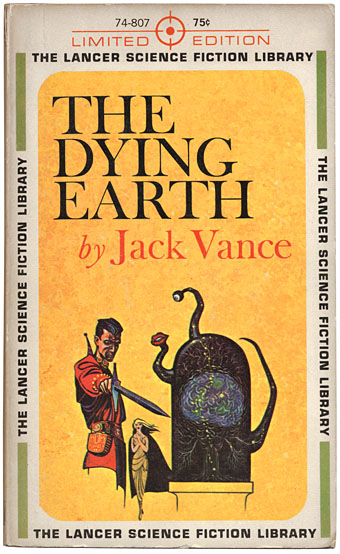
Another item brought to light during the Great Shelf Re-ordering and Spring Clean is this 1962 Lancer paperback of The Dying Earth by Jack Vance, a slim collection of six short connected stories, and another favourite book. Despite the SF label this is far more a work of fantasy (science fantasy, if you must), being tales of the bizarre and occasionally grotesque inhabitants of the last days of the earth. Magic is the order of the day, not advanced technology, although Vance hints that the book’s elaborate spells may be a higher ordering of mathematics capable of manipulating reality. I like the simple cover layout of this edition; Ed Emshwiller’s illustration manages to be sparing yet fully representative of a key scene.
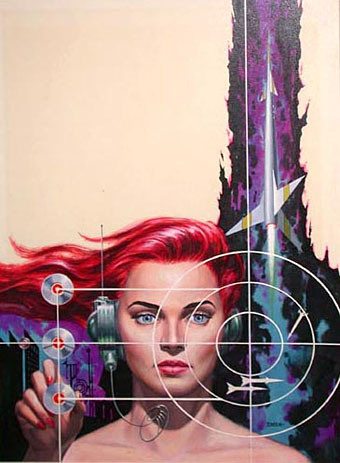
French sf portal Noosfere has recently revamped its artwork showcase and has a substantial collection of Emshwiller’s cover paintings. I’d prefer to see more of his earlier style but the collection includes some striking designs.
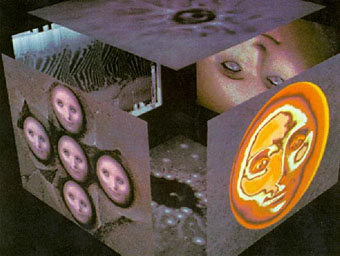
Sunstone (1979).
Emshwiller was a very prolific illustrator but from the 1960s on also developed his own style of experimental filmmaking, some examples of which can be found at YouTube. I’d actually seen Sunstone—a very early piece of computer animation—years ago without registering the credit. In addition there’s also Thanatopsis, a strange b&w short which is remarkably similar in tone to some of the films which William Burroughs and Antony Balch were making at around the same time.
• The genre artist | Jack Vance profiled in the NYT
Elsewhere on { feuilleton }
• The book covers archive
• The illustrators archive
Previously on { feuilleton }
• The King in Yellow
• Ballantine Adult Fantasy covers
• Clark Ashton Smith book covers
• Revenant volumes: Bob Haberfield, New Worlds and others
• The World in 2030
• The art of Virgil Finlay, 1914–1971
• Towers Open Fire
The real Basil Hallwards
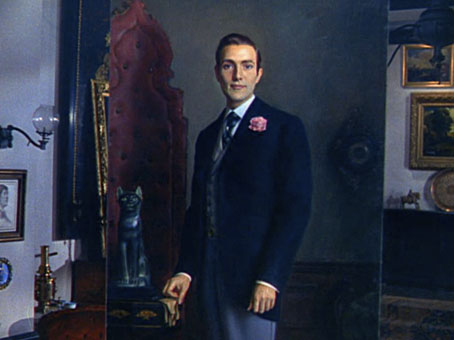
Well, two of them anyway… Discussion with commenter Noel in one of my old (and rather scant) posts about Albert Lewin’s 1945 film of The Picture of Dorian Gray touched on the fate of the original version of Dorian’s portrait (above). For some reason I’d always assumed this to have been produced by MGM’s art department despite a clear credit at the opening of the film for artist Henrique Medina (1901–1988). I no doubt miss this since my eyes always go to the credit for Ivan Albright (1897–1983), the artist responsible for the famous deteriorated final state of the picture (below). That painting is so splendidly grotesque its presence almost overpowers the entire film but its power would be lessened without the contrast of Medina’s elegant original. Examples of Medina’s other portrait works show a distinct similarity.
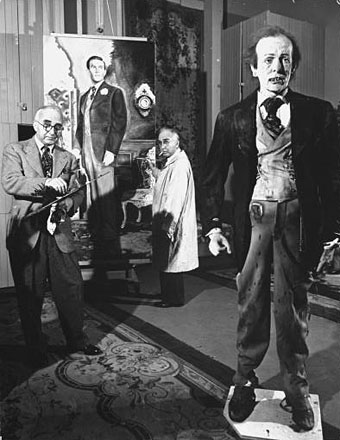
Noel pointed the way to photos from the LIFE magazine archives which show Ivan Albright and his identical twin brother, Malvin, at work on the portrait. (Another here.) Fascinating not only to see an early stage of the painting but also a dummy of the decayed Dorian they were using as a model.
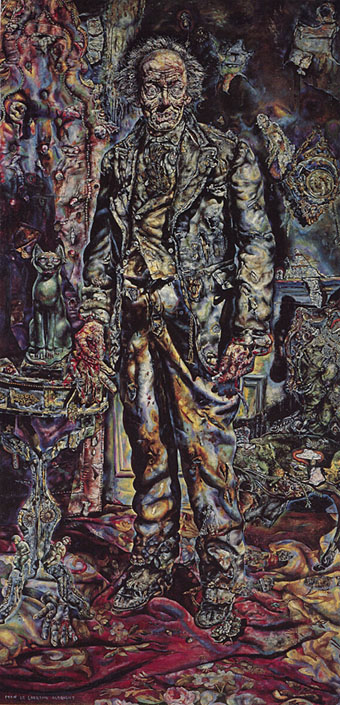
Albright’s dissolute masterpiece can be seen at the Art Institute of Chicago, together with a number of his other works. Noel notes that Medina’s picture was bought at auction for $25,000 but its current whereabouts and ownership remain a mystery. If anyone knows more about this, please leave a comment.
Elsewhere on { feuilleton }
• The Oscar Wilde archive
The eyes of Odilon Redon

L’Oeil, comme un ballon bizarre se dirige vers l’infini from A Edgar Poe (1882).
Another decently thorough Symbolist website covers the life and work of Odilon Redon (1840–1916), an artist whose pastels and prints were strange even by the standards of his contemporaries. His giant eyeballs and other floating figures are always startling and point the way inevitably to Surrealism, especially in dream lithographs like the one below.
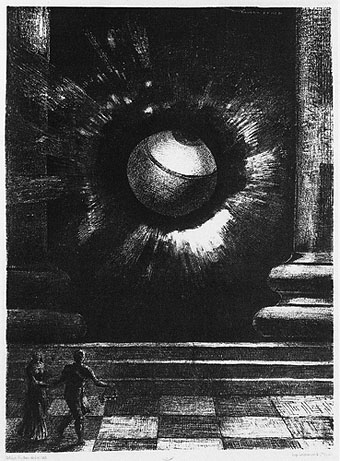
Vision from Dans le Rêve (1879).
I compounded that Symbolist/Surrealist association when I was drawing The Call of Cthulhu in 1987 by showing Ardois-Boonot’s Dream Landscape (which Lovecraft doesn’t describe beyond the word “blasphemous”) as being a Max Ernst-style frottage canvas with a Redon eye rising from the murk. Cthulhu’s presence reduced to a single ocular motif like the eye of Sauron.
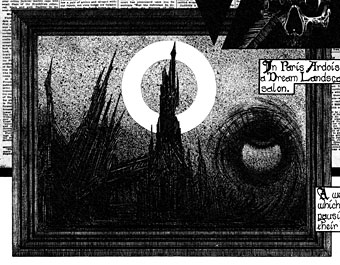
The Call of Cthulhu (1988).
And while we’re on the subject there’s Guy Maddin’s typically phantasmic short, Odilon Redon or The Eye Like a Strange Balloon Mounts Toward Infinity made for the BBC in 1995. Ostensibly based on the balloon picture above, this manages to reference a host of other Redon lithographs and charcoal drawings in the space of four-and-a-half minutes. Sublimely weird and weirdly sublime.
Elsewhere on { feuilleton }
• The fantastic art archive
Previously on { feuilleton }
• Arthur Zaidenberg’s À Rebours
• The Heart of the World