The Tempest illustrated

tempest.jpg

“Such stuff as dreams are made on”: Heathcote Williams and Toyah Willcox.

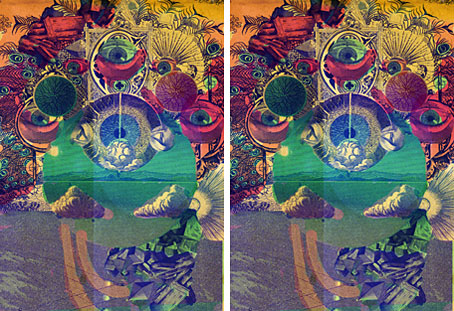
DVD viewing earlier this week was Derek Jarman’s wonderful adaptation of The Tempest which he directed in 1979. This is my favourite of Jarman’s films, partly because the play is my favourite Shakespeare (along with its polar opposite, Macbeth) and also because it’s a film infused with an occult sensibility which comes directly from the director’s own interests, rather than being the usual film or theatre conventions of what magic entails. An example of this is the grimoire which Prospero (Heathcote Williams) is seen leafing through which Jarman reveals in his autobiography, Dancing Ledge, to be his own 17th-century edition of Cornelius Agrippa’s Occult Philosophy. In his account of the filming he also describes his conception of Prospero as being based on Dr John Dee, the Elizabethan occultist who Shakespeare would certainly have known of, and may even have met since the pair both had business with Elizabeth I’s court. The most explicit reference to Dee comes in the shape of Prospero’s magical glass (above), based on Dee’s Monas Hieroglyphica, and a prop I’d dearly love to own. Dee was also a character in Jarman’s Jubilee (1978), and his Angelic Conversations gave a title to Jarman’s later filming of Shakespeare’s sonnets.

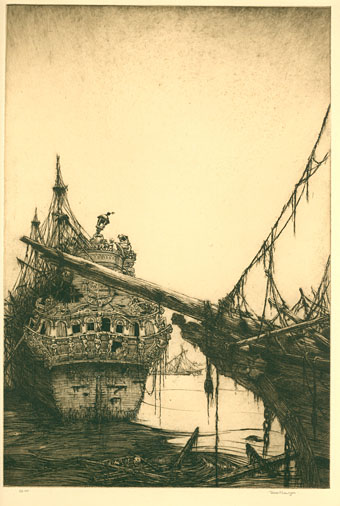
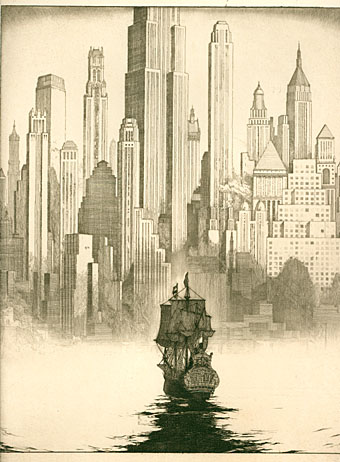
Seeing Jarman’s adaptation again had me thinking about the various representations of the characters. Ariel is generally depicted as a fairy type although he’s a lot more powerful than the fairies in A Midsummer Night’s Dream. As for Caliban, like Grendel in Beowulf, he’s an all-purpose monster whose predominant attributes seem to be whatever Ariel isn’t: ugly, earthbound, stupid, treacherous, and so on. I’d be tempted to propose the island’s quartet as representing the four elements—Prospero: water; Miranda: fire; Caliban: earth; Ariel: air—but I’m sure that’s not an original idea given the amount of academic trawling through the Bard’s corpus. Rather than dig for symbolism, what follows is a few pictures found during another trawl of my own through the Internet Archive, where the books aren’t drowned but patiently await their rediscovery.

Continue reading “The Tempest illustrated”

Infernal entrances

atget.jpg

L’Enfer, Boulevard de Clichy (1911).

A recent posting at The Haunted Lamp showed the interior of L’Enfer, a Montmartre cabaret which described itself as “unique au monde”, pictured here in a memorable photo by Eugène Atget. The interior and portions of the exterior were certainly unique enough, and look like they were created by the same people who designed the carnival show for Harry Lachman’s film Dante’s Inferno (1935), but the yawning mouth as an entrance isn’t without precedent. Some prior examples follow.

zuccari.jpg

Palazzo Zuccari.

L’Enfer is long gone, unfortunately, but the entrance to the Palazzo Zuccari in the Via Gregoriana, Rome, is still extant despite being hundreds of years older. I was hoping that Google’s Street View would have some good pictures but they managed to capture the building in the midst of renovation. A friend of mine was working at an office in this street when I was in Rome in 1993 and the yawning mouths and windows are a very curious sight in a narrow road near the Spanish Steps. Flickr has better views, here, here and here.

bomarzo.jpg

Ogre, Parco dei Mostri.

The Rome palazzo is named after the Mannerist artist who lived there, Federico Zuccari (c. 1542/1543–1609), and Zuccari’s inspiration for his doorway came from another Mannerist creation, the Parco dei Mostri at Bomarzo. The mouth in this case isn’t an entrance to the underworld but a devouring ogre, and one of the park’s many grotesque attractions. I wonder if this was also an inspiration for the giant floating head in John Boorman’s ludicrous science fiction film, Zardoz (1974).

moulin.jpg

Moulin Rouge!

And speaking of films, Baz Luhrmann used the L’Enfer entrance as a gateway to Montmartre itself in the zooming shot which opens Moulin Rouge!. I like that idea, as though it’s an iniquitous equivalent of the old Temple Bar gateway to the City of London. For more pictures of L’Enfer, and details of its history, see here and here. If anyone knows of any other notable doorways like these, please leave a comment.

Update: Nathalie found another Bomarzo influence while Jescie on Twitter drew my attention to a set from this German film.

Previously on { feuilleton }
Villa d’Este
Harry Lachman’s Inferno
Atget’s Paris

Weekend links 32

ji1.jpg

Red Quechquemitls (2010) by Sylvia Ji.

• The Blackout Mix, a pay-what-thou-wilt 49-minute mixtape, “specially designed to accompany (or simulate) a human-plant interaction”. Art by Arik Roper, music selection by Jay Babcock.

An ode to the many evolved virtues of human semen: “the penis is capable of dispensing a sort of natural Prozac” says Jesse Bering.

• The new John Foxx CD & DVD release, D.N.A., has a Jonathan Barnbrook cover, a new collaboration with Harold Budd and a disc of short films.

• “I have been copying Margaret Hamilton my whole life, and I am proud to admit it. The Wicked Witch of the West, the jolie laide heroine of every bad little boy’s and girl’s dream of notoriety and style, whose twelve minutes of screen time in The Wizard of Oz can never be topped … I’m a big butch-lesbian hag. I love the ones with chips on their shoulders and heavy attitude. They’re my real favorites.” John Waters always gives great interviews.

• Listen to a track from the forthcoming Brian Eno album while you’re reading Kristine McKenna’s interview with the man himself at Arthur mag. Includes an appreciation by Alan Moore.

ji2.jpg

Atropa Bella Donna (2009) by Sylvia Ji.

• Steven Severin is touring the UK this month, performing a live accompaniment to screenings of Jean Cocteau’s The Blood of a Poet. He’s at the Tyneside Cinema this Tuesday. Other dates can be found on his website.

• “I know it’s a very emotive subject and you’re either for it or against it but for a jobbing self-employed musician such as me – bootlegging (CD copying) is just killing us.” Finding The Spaces Between: musician Chris Carter (Throbbing Gristle, Chris & Cosey, et al) interviewed.

Mile End Pugatorio (1991), a one-minute film-poem by Guy Sherwin and Martin Doyle. Related: four one-minute movies by The Residents.

• Gijs Van Vaerenbergh installed an Upside Dome at the St. Michiel Church in Leuven, Belgium.

• Sidney Sime illustrates Lord Dunsany at Golden Age Comic Book Stories.

Europe according to gay men. There’s more at Mapping Stereotypes.

• There’s never a dull moment in the High Desert.

• Generative art by Leonardo Solas.

Arthur Penn, 1922–2010

bandc.jpg

Design by Bill Gold.

With respect to Bonnie and Clyde and my other films, I would have to say that I think violence is a part of the American character. It began with the Western, the frontier. America is a country of people who act out their views in violent ways—there is not a strong tradition of persuasion, of ideation, and of law.

Let’s face it: Kennedy was shot. We’re in Vietnam, shooting people and getting shot. We have not been out of a war for any period of time in my lifetime. Gangsters were flourishing during my youth, I was in the war at age 18, then came Korea, now comes Vietnam. We have a violent society. It’s not Greece, it’s not Athens, it’s not the Renaissance—it is the American society, and I would have to personify it by saying it is a violent one. So why not make films about it.

From The Bonnie and Clyde Book (1972)

Thus film director Arthur Penn, whose death was announced earlier this week, speaking at a press conference in Montreal in 1967 following the first screenings of Bonnie and Clyde. Penn’s film shocked critics and audiences at the time ostensibly for its graphic violence although the disturbance went deeper than that. What I found shocking the first time I saw it—home alone one evening, watching TV with no idea what to expect—was the abrupt shifts of tone from near comedy (the speeding cars and bluegrass soundtrack, Gene Wilder’s role) to awful realism as the consequences of a life of bank-robbing became apparent. This was disturbing for audiences used to being spoon-fed their morality tales with easily identifiable heroes and villains; the sudden, savage conclusion was especially jolting. A “nightmare comedy” quality was a hallmark of Penn’s best work, and he followed Bonnie and Clyde with another nightmare comedy that’s also a further exploration of America’s troubled history, Little Big Man (1970). Here Dustin Hoffman’s character finds himself caught between the Native Americans who raised him and the warring Cavalry intent on massacring the native tribes. Like Robert Aldrich in Ulzana’s Raid (1972), Penn was using Western history to make a statement about America’s involvement in Vietnam; the soldiers in Little Big Man are murderous racists and General Custer is presented not as a doomed hero but as an unhinged psychopath. For me the film has always been distinguished by the character of Little Horse, the first (only?) gay Native American character in cinema. There’s plenty of documentary evidence for gay individuals in Native American tribes but these have seldom been seen in films. It’s Thomas Berger we have to thank for this detail, since it was Berger’s novel which Penn adapted, but the film’s writer and director are also to be congratulated for keeping a minor character who might easily have been excised.

It’s surprising when you see Bonnie and Clyde cited as one of the films that enabled directors to have more artistic freedom during the 1970s that Penn didn’t manage to do more during that golden decade. After Little Big Man there were two films which seem minor in comparison but would be major works from many lesser directors. Night Moves (1975) is one of the handful of attempts at updating film noir which appeared in the 1970s (for others see The Long Goodbye, Robert Aldrich’s Hustle and Taxi Driver), with a screenplay by Alan Sharp, the writer of Ulzana’s Raid. It’s a curio even by the standards of the decade, part detective story set in the Florida Keys, part symbolic drama with chess games and boats named “Point of View”; it’s also Penn’s last great film. The Missouri Breaks (1976), another Western, is fascinating for its pairing of Marlon Brando and Jack Nicholson but Brando’s eccentric performance is the start of his decline as an actor. It’s hard to believe that Penn only made five more films after this but he was one of a number of individual talents who flourished in the 1960s and 1970s then found themselves shut out in the 1980s as intellect was ousted by commerce. There’s even less room for him today than there was then. We’ve travelled from a time of intelligent and challenging films made by adults for adults to an era of shitty action movies and worthless adaptations of equally worthless costumed vigilantes. But I never counsel despair; celebrate what we have rather than bemoaning what we might have lost. Fuck Star Wars in 3D, watch Little Big Man instead.

Guardian obituary | NYT obituary
David Thomson on Penn

Diaghilev and the Ballets Russes

diaghilev1.jpg

Ida Rubinstein as Zobeide and Vaslav Nijinsky as the Golden Slave in Schéhérazade (1913) by George Barbier.

Another great exhibition at the V&A, London, Diaghilev and the Ballets Russes gathers a wealth of costumes, stage designs, photographs and ephemera—including some of Stravinsky’s manuscripts—to present a history of the legendary ballet company and their visionary impresario. For those who can’t get to London the museum website shows some of the items which will be on display, and there’s also a blog about the installing of the exhibition. The enormous frontcloth from 1924 based on Picasso’s Two Women Running on the Beach received a flurry of attention in the press here but my own attention was caught by the picture of Natalia Goncharova‘s even more enormous backcloth for The Firebird. The exhibition runs to January 9, 2011.

diaghilev2.jpg

Cover of Le Théatre showing Tamara Karsavina in costume as the Firebird, May 1911.

While we’re on the subject, a new biography of the impresario, Diaghilev: A Life by Sjeng Scheijen, was reviewed last week in the New York Times:

Diaghilev loved beautiful young men, and at a time when the fashion in ballet was to exchange patronage for sex, his company provided a bounty. Scheijen dexterously plays his sources against one another to examine the erotic and professional dynamics between Diaghilev and his stars.

For a fictional (and necessarily heterosexual) account of those erotic and professional dynamics, I recommend Michael Powell & Emeric Pressburger’s The Red Shoes (1948) which not only has a central character based on Diaghilev but includes among the cast of real dancers Léonide Massine, dancer and principal choreographer of the Ballets Russes from 1915 to 1921.

See also:
Russian Ballet History | An archive and documentary site.

Previously on { feuilleton }
Pamela Colman Smith’s Russian Ballet
The art of Ivan Bilibin, 1876–1942
Jack Cardiff, 1914–2009
Magic carpet ride
Le Sacre du Printemps
Images of Nijinsky