Helmets

fmj.jpg

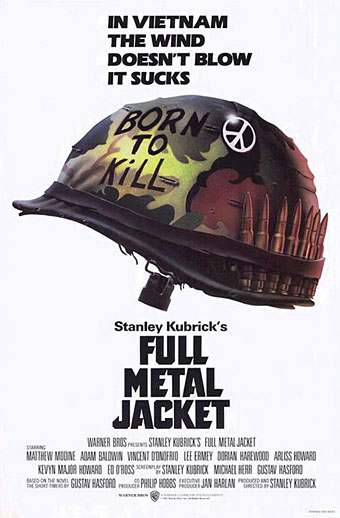
Full metal Jacket poster (1987). Illustration by Philip Castle.

Watching Stanley Kubrick’s Full Metal Jacket on Blu-ray recently I was wondering again whether anyone has noted the similarity between the film’s poster design and the cover for the UK edition of one of its source books, Michael Herr’s Dispatches. At the risk of repeating some common piece of Kubrick lore, here goes.

Airbrush artist Philip Castle painted the helmet that’s become the perennial image used to promote the film. Kubrick often reused the services of people he trusted, and had earlier employed Castle as poster artist for A Clockwork Orange. Kubrick also oversaw the design of publicity materials for his later films so we can be reasonably sure this idea was one of his.
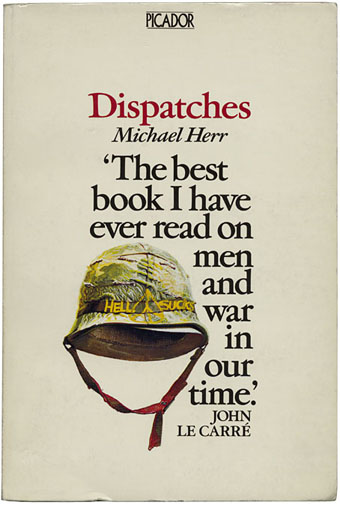
herr.jpg

Dispatches (1979). Illustration by Steven Singer.

Michael Herr’s collection of reports about the Vietnam war was first published in the US in 1977 with a UK edition following a year later. The cover of the US first edition is unremarkable compared to this typically excellent Picador design from 1979 (no designer is credited). That year saw the release of Apocalypse Now for which Herr wrote the narration. Kubrick was eager to turn Herr’s book into a film but neither of them could find a suitable story to provide a structure for Herr’s reportage until the director decided to weld Dispatches to the first two thirds of Gustav Hasford’s novel The Short-Timers (1979). Full Metal Jacket mixes episodes and speech/dialogue from both books: Hasford’s sniper attack on a jungle trail gets transplanted to Herr’s description of the fighting in Hue City.
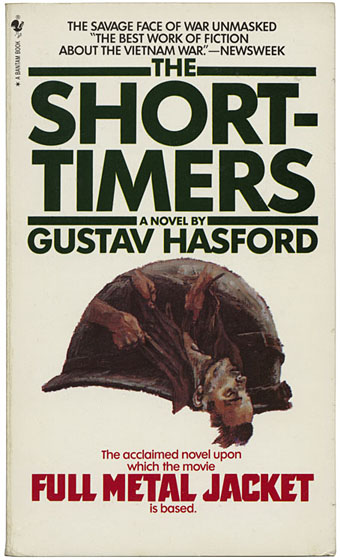
hasford.jpg

The Short-Timers (1987). No illustration credit.

Hasford’s novel was first published in the UK in this shoddy tie-in version with some generic war painting badly cropped into helmet shape in order to match the film poster. Such a good book really deserved better than this hack design. Much as I like Full Metal Jacket, when you read Herr and Hasford you have to admit that the film only captured a fraction of the horror and madness in the books. Herr’s writing is justly celebrated while Hasford’s novel seems to have been forgotten again. Anyone who likes Kubrick’s film ought to search it out, it’s an indelibly memorable and disturbing read. The sniper scene is far more brutal and chilling than its cinematic equivalent, and is delivered by stark prose like this:

The snipers zero in on us. Each shot becomes a word spoken by death. Death is talking to us. Death wants to tell us a funny secret. We may not like death but death likes us. Victor Charlie is hard but he never lies. Guns tell the truth. Guns never say “I’m only kidding.” War is ugly because the truth can be ugly and war is very sincere.

Also worth searching out is Herr’s short memoir, Kubrick, published the year after the director’s death, in which the writer describes his three-year collaboration on Full Metal Jacket‘s screenplay. It’s a generous and insightful piece of writing, worlds away from Frederic Raphael’s condescending and mean-spirited Eyes Wide Open.

Elsewhere on { feuilleton }
The book covers archive

Previously on { feuilleton }
Kubrick shirts

Weekend links 105

klikovac.jpg

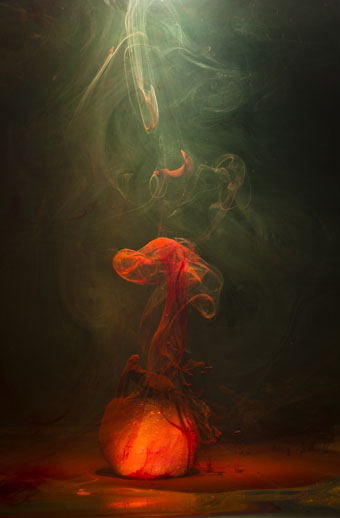
A suspended fluid photograph from Demersal, a series by Luka Klikovac.

• “Soon, Mr. Lachman was writing occult music. His song “(I’m Always Touched by Your) Presence, Dear,” which appeared on Blondie’s 1977 album Plastic Letters, was an example.” Gary Lachman: from Blondie to Swedenborg.

Neil Krug’s cover art for the new Scissor Sisters album, Magic Hour, channels the cloudless skies and photographic surrealism of Storm Thorgerson.

Implicate Explicate, a multiple 16mm film installation by Rose Kallal. Sound by Rose Kallal & Mark Pilkington using modular synthesizers.

Despite conservative queerdom’s best efforts to hide its “otherness” behind a velvet wall of “same as you” Tom and Hank and Jill and Janes, Mattilda and her like will not be ignored. As parades of neo-nuclear same sex families mug for the cameras on courthouse steps, queer body boys parade and flex impossibly taut muscles across our nation’s gym runways and circuit parties, and far, far too many proudly proclaim in knee-jerk defensiveness how “straight-acting” they are across the net, Sycamore blows raspberries at the forced mirage and holds up faded pictures of yesteryear boys and girls whose one claim to fame once was their difference.

Mattilda Bernstein Sycamore is interviewed at Lambda Literary

Paul Oestreicher, an Anglican priest, sets the cat squarely among the pigeons with the question (and answer) “Was Jesus gay? Probably.”

Andromeon, video by Alexander Tucker and Serena Korda for a new song by Alexander Tucker.

• Museums of Melancholy: Iain Sinclair on London’s memorials. An LRB essay from 2005.

FACT mix 325 is by Battles: from Boredoms to Cluster and The Alchemist.

The glass hills of Mars, “a region the size of Europe”.

Labyrinths and clues, an essay by Alan Wall.

The Alchemy of Emptiness.

Drop (1972) by Soft Machine | Drop (2002) by Hope Sandoval & The Warm Inventions | Airdrop (2006) by Kashiwa Daisuke.

The Lumière Brothers at the Exposition Universelle

paris1900-1.jpg

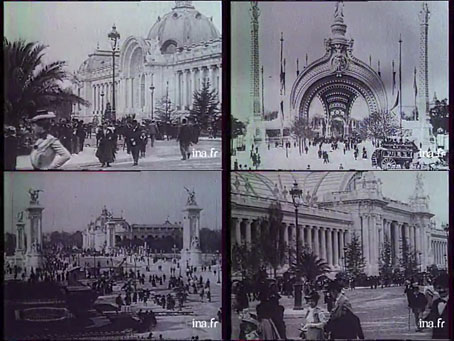
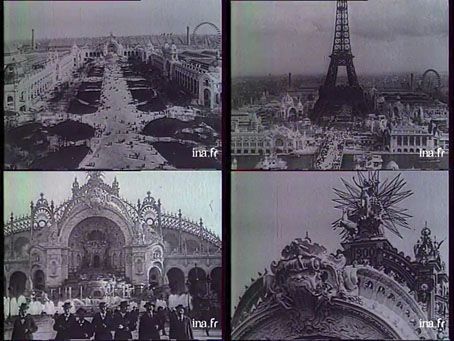
The films shot by the Edison company at the Paris Exposition Universelle of 1900 were featured here a couple of years ago. These screen grabs are from better quality footage made by Edison’s French rivals, Auguste and Louis Lumière, who had the advantage over the Americans in also having their films screened as one of the exposition attractions. The footage is nine minutes from Lumière, a French documentary compiled in 1966 by Marc Allégret, which is hosted here. The clip is still rough but not at all bad compared to the poor quality of online copies of the Edison footage, and it’s mostly projected at a speed so people don’t rush around like Keystone Cops. (On the downside, the audio track has the French speaking clock droning away in the left channel.) Great shots of the pavilions along the Seine, and the escalator. Whatever the quality, these views still strike me as miraculous for the brief impression they give of the exposition as a living event. Oscar Wilde enjoyed his last summer with these teeming crowds. He may be there somewhere among the top hats and parasols.

paris1900-2.jpg

Previously on { feuilleton }
Le Grand Globe Céleste, 1900
Tony Grubhofer’s Exposition Universelle sketches
The Cambodian Pavilion, Paris, 1900
Le Manoir a l’Envers
Suchard at the Exposition Universelle
Esquisses Décoratives by René Binet
Le Palais de l’Optique, 1900
Exposition Universelle films
Exposition jewellery
Exposition Universelle catalogue
Exposition Universelle publications
Exposition cornucopia
Return to the Exposition Universelle
The Palais Lumineux
Louis Bonnier’s exposition dreams
Exposition Universelle, 1900

The Tinderbox

tinderbox4.jpg

HJ Ford (1894).

“Do you see that great tree!” quoth the witch; and she pointed to a tree which stood beside them. “It’s quite hollow inside. You must climb to the top, and then you’ll see a hole, through which you can let yourself down and get deep into the tree. I’ll tie a rope round your body, so that I can pull you up again when you call me.”

“What am I to do down in the tree?” asked the soldier.

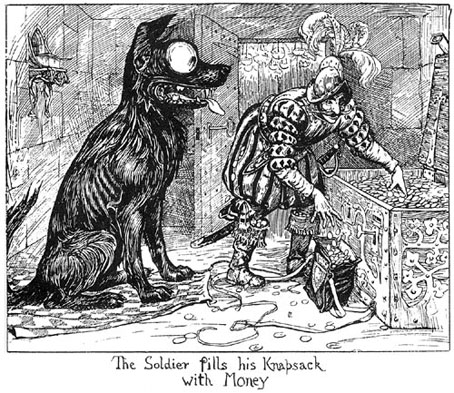
“Get money,” replied the witch. “Listen to me. When you come down to the earth under the tree, you will find yourself in a great hall: it is quite light, for many hundred lamps are burning there. Then you will see three doors; these you can open, for the keys are in the locks. If you go into the first chamber, you’ll see a great chest in the middle of the floor; on this chest sits a dog, and he’s got a pair of eyes as big as two tea-cups. But you need not care for that. I’ll give you my blue-checked apron, and you can spread it out upon the floor; then go up quickly and take the dog, and set him on my apron; then open the chest, and take as many farthings as you like. They are of copper: if you prefer silver, you must go into the second chamber. But there sits a dog with a pair of eyes as big as mill-wheels. But do not you care for that. Set him upon my apron, and take some of the money. And if you want gold, you can have that too—in fact, as much as you can carry—if you go into the third chamber. But the dog that sits on the money-chest there has two eyes as big as the round tower of Copenhagen. He is a fierce dog, you may be sure; but you needn’t be afraid, for all that. Only set him on my apron, and he won’t hurt you; and take out of the chest as much gold as you like.”

The Tinderbox (1835) by Hans Christian Andersen

tinderbox1.jpg

Helen Stratton (1910?)

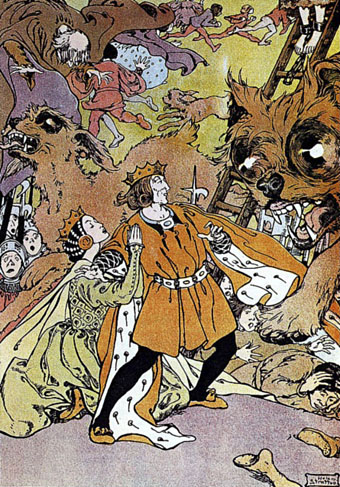
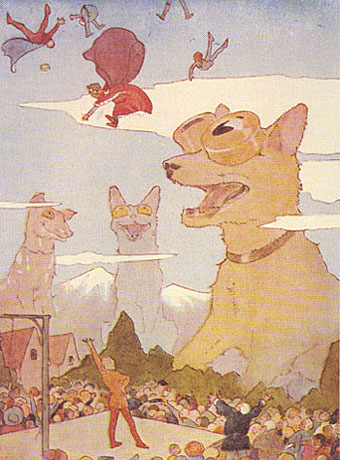
Will at 50 Watts is to blame for this one, the illustrations he posted last week were excessive enough to give even a master of exaggeration like Tex Avery second thoughts. Hans Christian Andersen’s fairy tales have proved so popular over the years that a core group of stories tend to drive out the less familiar works from fresh editions. The Tinderbox is one of these minor stories, the tale of a soldier with a magic tinderbox capable of summoning a trio of supernatural dogs with enormous eyes. My first contact with the story was via a German television adaptation, Das Feuerzeug, filmed in 1958 and later screened in the UK as filler for the children’s TV schedule along with that memorably creepy series (also from Germany), The Singing Ringing Tree. I remembered little about the story but was never able to forget those weird dogs even though their eyes in the TV version are nothing like the way they’re presented in illustrations. They may not be as freaky but the way they’re presented as huge and black makes me think now of the ghostly barghests or black dogs of British folklore.

Searching around for illustrations turned up the handful here. Many illustrators concentrate on other scenes but I’ve only been looking for the dogs. I’m sure there’s more to be found so this may well be a subject to revisit later. The Stratton and Tarrant pictures show the climax of the story when the soldier, about to be hanged for having used the dogs to kidnap a princess, summons his creatures to kill the king, queen and all the people who condemned him. Yes, it’s good wholesome fare for kids.

tinderbox2.jpg

Margaret Tarrant (1910).

Continue reading “The Tinderbox”

Weekend links 104

cummings.jpg

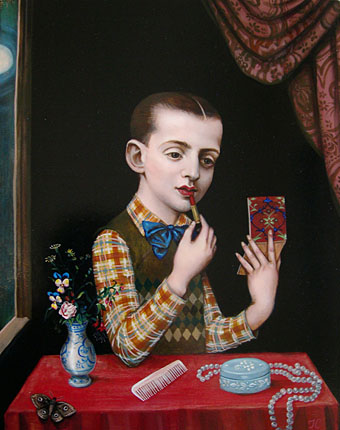
Prettiest Star (2004) by Timothy Cummings.

I Want Your Love, a feature film directed by Travis Mathews catches my attention for having been described as “the gay Shortbus” even though (as the director notes) Shortbus was pretty gay to begin with.

• I’ve always found Hans Christian Andersen’s story of The Tinderbox—a tale of spectral dogs with enormous eyes—to be rather weird. But these illustrations by Heinrich Strub for a 1956 edition beat everything.

• “From an early age, however, I became in secret the slave of certain appetites.” The line that Robert Louis Stevenson deleted from The Strange Case of Dr Jekyll and Mr Hyde.

Scientific American: Homophobes might be hidden homosexuals. Not exactly fresh news but always worth bearing in mind when someone starts ranting about those evil gays.

Minimal Wave: The 80s synth-pop underground. The Minimal Wave label releases a vinyl compilation by Hard Corps this month.

• “Blame the Victorians for making menswear boring.” Alex Jung on the endless tyranny of the suit-and-tie combination.

• Women, Vaginas and Blood: Breaking menstrual taboos with artist Sarah Maple.

London’s lost rivers (again): the hidden history of the city’s buried waterways.

Vincenzo Pacelli says the Knights of Malta murdered Caravaggio.

Street style 1906: Edward Linley Sambourne’s fashion blog.

Architectural Stationery Vignettes at BibliOdyssey.

Hans Bellmer & Unica Zürn at Ubu Gallery, NYC.

Pam Grossman admits to being a “candle hooch”.

Dirty (1986) by Hard Corps | Lost Rivers Of London (1996) by Coil | The Tinderbox (2009) by Patrick Wolf.