Joy Street, a film by Suzan Pitt

joystreet1.jpg

Joy Street (1995) is an animated short whose title is ironic at first, you have to stay with its opening scenes of grim Expressionism to see how things develop. If you’ve seen Suzan Pitt’s uniquely strange Asparagus then you’ll be primed for the unexpected turns the scenario takes. To say any more would be to spoil things, and for once I’ve avoided my usual habit of posting shots that show moments throughout the film.

joystreet2.jpg

Suzan Pitt only made a handful of animations, three of which—Joy Street included—are on 35mm. Joy Street is also the longest at 24 minutes. I always find it admirable when animators are given the opportunity to work with superior resources yet still insist on making something this personal. Despite her small filmography there’s a lot of her work I’ve yet to see. This is a reminder to look for more.

Previously on { feuilleton }
Into the Midnight Underground

Weekend links 742

hughes-stanton.jpg

Thunderstorm (1959) by Blair Rowlands Hughes-Stanton.

• “To create a novel or a painting, an artist makes choices that are fundamentally alien to artificial intelligence,” says SF writer Ted Chiang. A New Yorker essay which has received a fair amount of attention over the past week, with good reason. As someone who found his name on the list of artists whose work was allegedly being fed into Midjourney, I suppose I have a vested interest in the arguments. (Good luck to any machine trying to imitate my “style”. I don’t have one.) Too much of the discussion, however, has been very poor which is why this is the first time I’ve linked to such a piece here.

• “After going their own way for much of the 20th century, mathematicians are increasingly turning to the laws and patterns of the natural world for inspiration. Fields stuck for decades are being unstuck. And even philosophers have started to delve into the mystery of why physics is proving ‘unreasonably effective’ in mathematics, as one has boldly declared.” Ananyo Bhattacharya on why physics is good at creating new mathematics. Having recently finished reading Cormac McCarthy’s final novel, Stella Maris, this was all very timely.

• “…our films obey musical laws. Of course, you can never tell people how they should watch a film. But the musical element provides a narrative of its own.” Thus the Quay Brothers, in the news again with their forthcoming feature film, Sanatorium Under the Sign of the Hourglass. The quote is from a recent interview with Xan Brooks. Meanwhile, Alex Dudok de Wit posted another interview from 2019, originally published in French, now made available in English for the first time.

• At Wormwoodiana: Mark Valentine announces a new book of his essays, The Thunderstorm Collectors.

• At Dennis Cooper’s: 28 books that either faked ingesting LSD or did.

• At Public Domain Review: Antiquities of Mexico (1831–48).

• At Print mag: Kelly Thorn’s Tarot of Oxalia.

USC Optical Sound Effects Library

Strange Thunder (1987) by Harold Budd | Sweet Thunder (1991) by Yello |  Studies For Thunder (2004) by Robert Henke

The Idea, a film by Berthold Bartosch

idea.jpg

Having mentioned Frans Masereel in the previous post, here’s a short animated film based on one of Masereel’s wordless novels. Masereel’s The Idea (1920) concerns the birth and progress of radical thought in an illiberal society, with the troublesome conception embodied as a naked woman. When the idea escapes into the world the authorities try to cover her nakedness, but their efforts fail to prevent her image being disseminated by the printing press…

Berthold Bartosch was a Czech animator whose 25-minute adaptation of the book was released in 1932. Frans Masereel helped with the creation of the film in its early stages but he lost his patience with the slow pace of the animation process. Bartosch’s film is significant for being one of the first animated dramas to aim self-consciously at art rather than comedy or entertainment for children. Also significant is the score by Arthur Honegger whose use of the ondes Martenot is claimed as the first use of an electronic instrument for cinematic purposes. Bartosch’s animation technique brings to life cut-out figures in nebulous, layered compositions that anticipate the films that Yuri Norstein would be making decades later. It’s a shame that all the online copies of the film are so poor, it ought to be seen in better quality. Watch it here.

Previously on { feuilleton }
Destiny, A Novel in Pictures by Otto Nückel
Crime and Punishment, a film by Piotr Dumala
Walls, a film by Piotr Dumala
The Nose, a film by Alexandre Alexeieff & Claire Parker
Yuri Norstein animations
Gods’ Man by Lynd Ward
Frans Masereel’s city

Terra Incognita, a film by Adrian Dexter and Pernille Kjaer

terra1.jpg

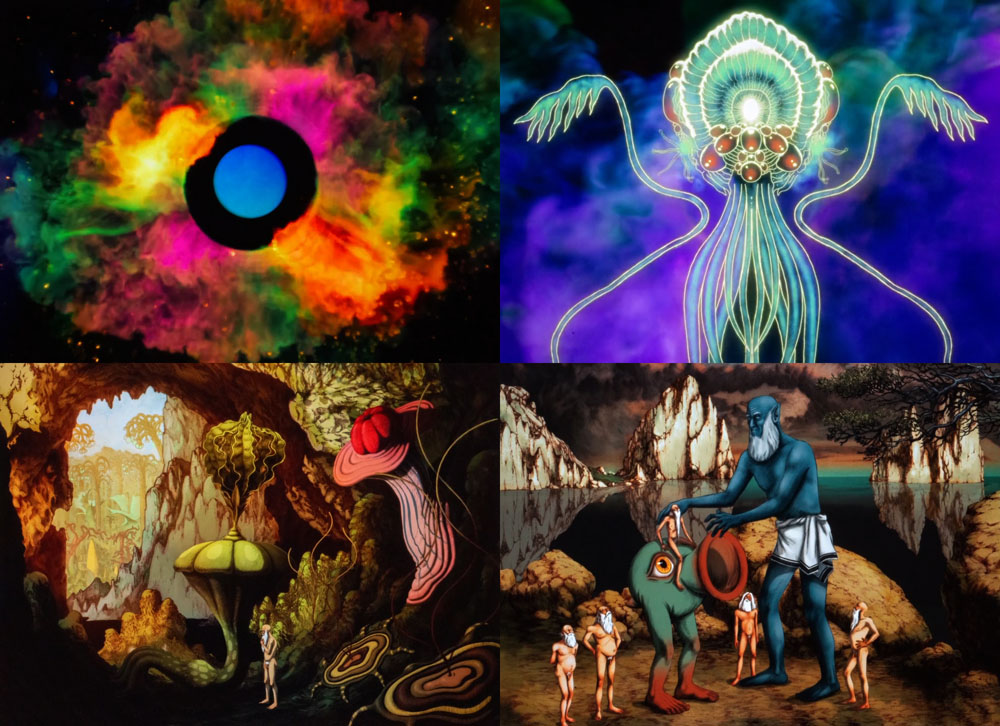
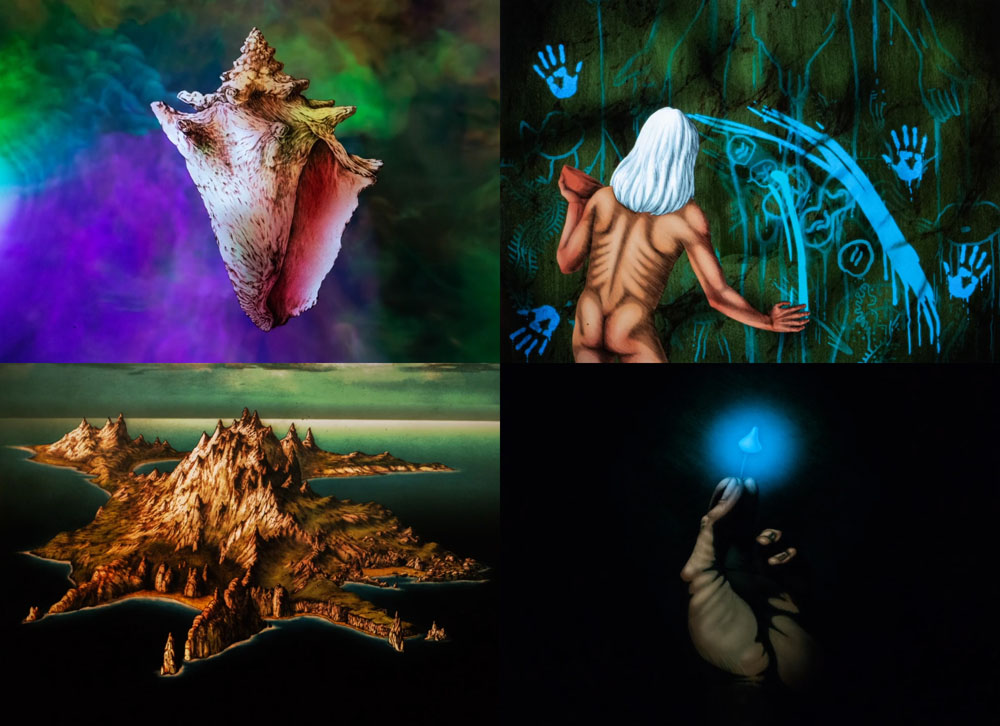
I was going to mention this one a few weeks ago but it vanished from Vimeo for a while following some kind of copyright complaint. It’s good to find it returned. Terra Incognita is 20 minutes of animated fantasy that’s very reminiscent of René Laloux’s cult SF films Fantastic Planet (1973) and Gandahar (1988), also the Brizzi Brothers’ Fracture (1977). Much as I’d like to see another feature in the Laloux manner, something spun from the art styles of Métal Hurlant, short films are the most you can realistically hope for outside Japan. (There is another Caza-designed feature, The Rain Children, but like the Druillet-designed TV series, Bleu, l’enfant de la Terre, it’s a simpler story aimed at a juvenile audience.)

terra2.jpg

Terra Incognita was directed by Adrian Dexter and Pernille Kjaer, with the pair also working on the backgrounds and storyboards. The first part of the film is a creation myth which establishes the genesis of a mysterious island somewhere on the Earth whose inhabitants are four prematurely aged, immortal men. The quartet share the island with the blue giant who created them, together with a variety of unusual flora and fauna which includes luminescent psychotropic mushrooms. The accidental death of their creator leaves the islanders marooned in a world they were only beginning to learn about. The film is meticulously crafted, with an open-ended narrative that avoids melodrama when the men are faced with incursions from the outside world. And there’s a further connection to 70s’ fantasy in the soundtrack which incorporates a piece from Bo Hansson’s prog-synthesizer album, Music Inspired By Lord Of The Rings. Films like this require so much creative effort that you can’t expect more of the same any time soon, but I’m curious to see what Dexter & Kjaer may do in the future.

Previously on { feuilleton }
Arzak Rhapsody
Fracture by Paul and Gaëtan Brizzi
The Captive, a film by René Laloux

Weekend links 736

jupiter.jpg

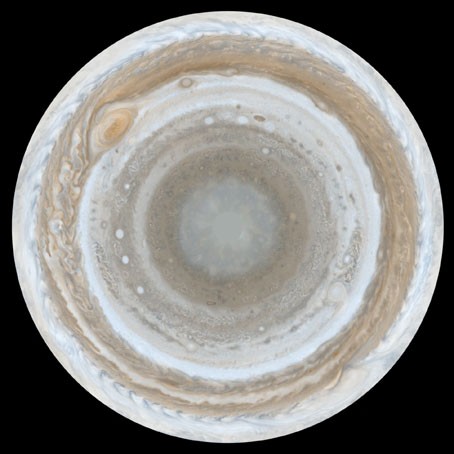
South Polar Map of Jupiter by the Cassini spacecraft, 2000.

• “A ghostly train journey on a forgotten branch line transports a son, Jozef, visiting his dying Father in a remote Galician Sanatorium. Upon arrival Jozef finds the Sanatorium entirely moribund and run by a dubious Doctor Gotard who tells him that his father’s death, the death that has struck him in his country has not yet occurred, and that here they are always late by a certain interval of time of which the length cannot be defined. Jozef will come to realise that the Sanatorium is a floating world halfway between sleep and wakefulness and that time and events cannot be measured in any tangible form.” The Quay Brothers have finished their third feature film, Sanatorium Under the Sign of the Hourglass, a combination of live action and animation which is being premiered next month at the Venice film festival. No sign of a trailer as yet but the curious can prime themselves by watching (or rewatching) the Quays’ Street of Crocodiles—their first adaptation of Bruno Schulz—or Hourglass Sanatorium, the first screen adaptation of Schulz’s stories by Wojciech Has.

• “No one is sure when the tremendous whirl—the largest and longest-lived storm in our current solar system, with a diameter wider than planet Earth and wind speeds of more than 260 miles per hour—began. Or why it’s red. Or even who first observed it…” Katherine Harmon Courage on Jupiter’s Great Red Spot.

• New music: Bórdice by Nestor, and Nightfall by Trentemøller, the latter with a video swiping shots from Maya Deren’s Meshes of the Afternoon. Nice song but musicians really need to stop plundering independent film-makers when they want some visual embellishment.

• At The Daily Heller: Steven Heller talks to Drew Friedman about Friedman’s new book of caricatures, Schtick Figures.

• Mixes of the week: A mix for The Wire by Miaux, and Isolatedmix 127 by David Douglas & Applescal.

• DJ Food’s latest psychedelic trawl is a collection of book covers, puzzles, etc, designed by Peter Max.

• At Unquiet Things: Vic Prezio’s Gothic book covers.

• At Dennis Cooper’s: Morgan Fisher Day.

Jupiter (1990) by NASA Voyager Space Sounds | Jupiter! (Feed Your Head Mix) (1994) by System 7 | Jupiter Collision (2002) by Redshift