Yuri Norstein animations

norstein1.jpg

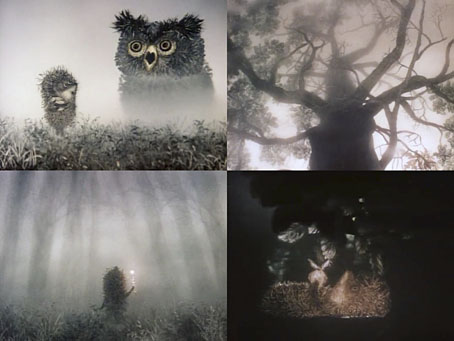
Hedgehog in the Fog (1975).

One more animation post before I move onto other things. Since the 1970s Russian animator Yuri Norstein has been regarded as one of the greatest living practitioners of the medium despite having only made a handful of films. Hedgehog in the Fog is a 10-minute piece with a self-explanatory title: a hedgehog sets out one evening to visit his friend, the bear, but before he can reach the bear’s house he has to cross a fog-filled field. Norstein’s animation style involves the skillful manipulation of hand-drawn paper shapes which in this film and the later Tale of Tales achieve a remarkable sense of depth and solidity. The fog effects in Hedgehog are especially striking, created using layers of translucent paper.
norstein2.jpg

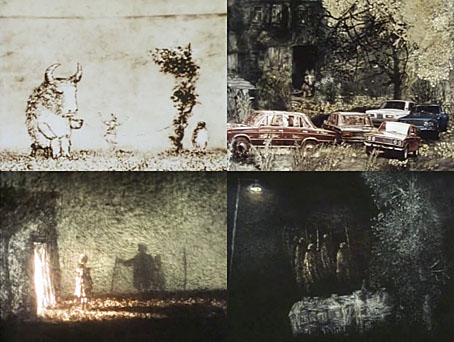
Tale of Tales (1979).

The 29-minute Tale of Tales takes the same technique but lifts the animation into a different league, an elusive and (for want of a better term) poetic meditation on life and memory whose central figure is a small grey wolf borrowed from the Russian lullaby sung in the opening scene. The film’s Wikipedia note compares Tale of Tales to Andrei Tarkovsky’s Mirror (1975), and for once the hyperbole feels justified. There’s the same concentration on natural elements such as fire, wind and water, while the recurrent wordless tableaux of a family whose members comprise a poet, a bull with a skipping-rope, and a talking cat might be compared with Tarkovsky’s dream sequences. If meaning here seems reluctant to disclose itself (and why does everything have to mean something anyway?) then that’s all the more reason to watch it again.

Since 1979 Norstein has been working sporadically on a feature-length adaptation of Gogol’s The Overcoat, work on which has been endlessly delayed due to lack of resources and the animator’s painstaking production methods. A few clips can be found on YouTube if you hunt around. Here’s hoping we get to see the finished film soon.

Previously on { feuilleton }
Barta’s Golem

Metachaos

metachaos.jpg

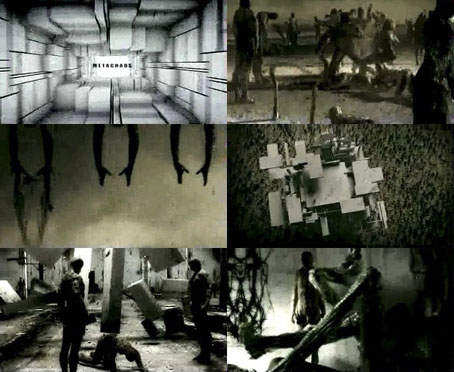
Animation of a more contemporary kind (do you detect a theme?), Metachaos is a frenetic 8-minute apocalypse by Alessandro Bavari whose Photoshop collages I recall being impressed by some years ago. His video uses computer rendering but with a lot more grit than the usual CGI. The soundtrack is the kind of quasi-Industrial thing you’d expect for the imagery but you can always mute the sound and play something else. Thanks to Paul at Dressing the Air for the tip!

Gerald Scarfe’s Long Drawn-Out Trip

scarfe.jpg

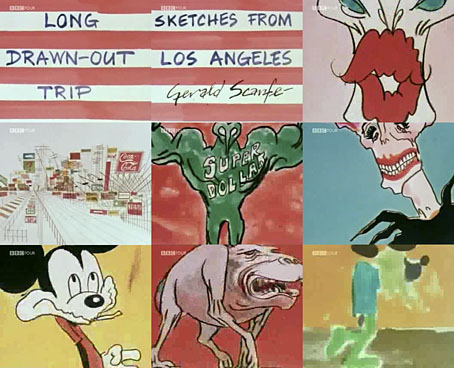
Yet more animation. Long Drawn-Out Trip was Gerald Scarfe‘s first foray into the medium, produced in 1972 at the request of the BBC who sent the artist to Los Angeles to try out the new De Joux animation system. The process needed only six or eight drawings per second of film thus reducing the usual amount of labour. Scarfe says in the first book collection of his work, Gerald Scarfe (1982), that the 16-minute film was still very labour intensive.

The subject of Long Drawn-Out Trip is Los Angeles and America itself, the concerns being the same ones that Ralph Steadman was depicting the same year in his illustrations for Hunter S. Thompson’s Fear and Loathing on the Campaign Trail ’72: venality, violence, vulgarity and the omnipresent spectre of Richard Nixon, a president who had the good fortune to be drawn many times by two of Britain’s greatest living satirists although he wouldn’t have thanked them for it. In Scarfe’s film we also find Mickey Mouse being reduced to his constituent lines and colours after smoking a joint. In the 1980s Scarfe regularly drew Ronald Reagan wearing the famous mouse ears, something that nearly got him fired from his post at the Sunday Times after Rupert Murdoch saw one of the cartoons. Long Drawn-Out Trip had a more favourable effect when it was seen by Roger Waters who asked Scarfe to create some animations for Pink Floyd’s Wish You Were Here tour. The animated sequences for The Wall have their origin in this short film. Watch it here.

Brothers Quay scarcities

quays7.jpg

Igor: The Paris Years (1982).

More animation, and scarce in the sense that some of these films were omitted from the core Quay Brothers canon released in the UK by the BFI as Quay Brothers: The Short Films 1979-2003. Quay obsessives such as myself would have been happy to pay for an extra disc featuring more of their oeuvre but we can at least turn to YouTube to fill in some gaps. This is by no means everything so I may add more discoveries at a later date. Some of the DVD-issued films can be seen on the BFI’s official Daily Motion channel.

I was eager to see the Stravinsky film again having watched it one time only in a Channel 4 screening some 25 years ago. After a fresh viewing it’s not as impressive as I remembered, in part because the Quay’s distinctive approach to animation—and filmmaking generally—developed a great deal following the unforgettable Street of Crocodiles (1986). Igor: The Paris Years concerns the composer’s relationship with Jean Cocteau and Vladimir Mayakovsky, all of whom are animated as cut-out figures in a Modernist cityscape with The Rite of Spring playing on a piano.

quays6.jpg

Leos Janácek: Intimate Excursions (1983). Part 2 is here.

In a similar vein, but more successful, is this portrait of Czech composer Leos Janácek. This uses the same cut-out character style but places the composer in Eastern European settings similar (down to the floating tram pantographs) to those seen in the very first Quay film, Nocturna Artificialia (1979). Among the other puppet characters there’s one figure singing an aria who later appears as Enkidu in This Unnameable Little Broom (1985).

quays1.jpg

Old Piano (1988).

A very short (and poor quality) ident for MTV.

Continue reading “Brothers Quay scarcities”

Achilles by Barry JC Purves

achilles.jpg

I wondered how to focus on the relationship between Achilles and Patroclus without the others getting in the way. This intense physical relationship developed into the focus of the film, rather than any more Harryhausenesque aspects of the Greek myths. Intimacy had not really been treated seriously with puppets…

Barry JC Purves

Several people seemed to appreciate the link a week or so ago to The Torchbearer by Václav Svankmajer so here’s another animated short about helmeted warriors, albeit with a very different tone. Barry JC Purves is a British animator and theatre director who produced Achilles, an 11-minute puppet animation, in 1995, back when the UK’s Channel 4 was still regularly financing animated films. Derek Jacobi narrates an exploration in the style of Ancient Greek theatre of the relationship between Achilles and his alleged lover, Patroclus. (Whether or not the pair were lovers is still a subject of dispute.) It’s rare to find any overt sexuality in the world of puppet animation unless the directors are the Brothers Quay; it’s even more rare for that sexuality to have a homoerotic aspect which is what Purves depicts. A groundbreaking piece of work, then, which can be viewed in full here. The director’s website has more about the creation of the film, and a collection of stills from the production.

Previously on { feuilleton }
The Torchbearer by Václav Švankmajer