Exposition jewellery

grasset1.jpg

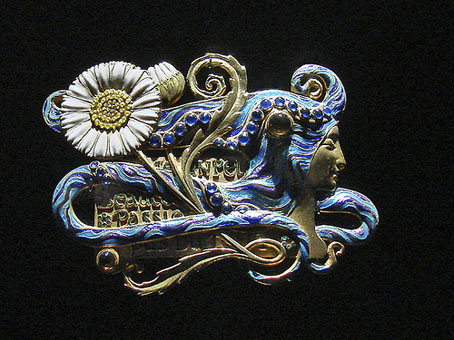
Broche Marguerite.

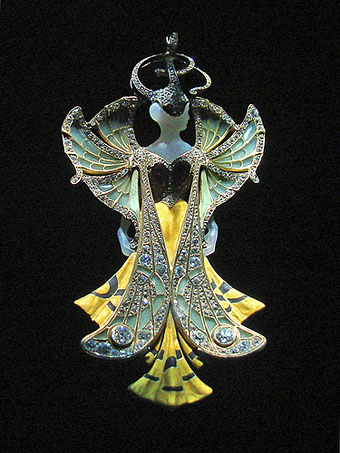
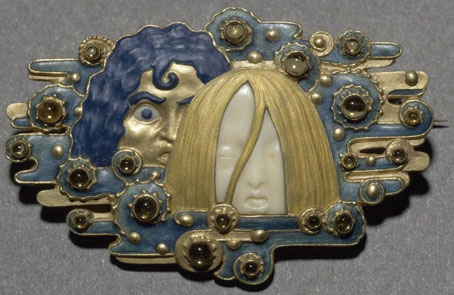
Still in the 19th century, and more contributions to the Paris Exposition Universelle of 1900. The first and third of these are collaborations between Art Nouveau designer Eugène Grasset and jeweller brothers Henri & Paul Vever. The butterfly woman is Henri Vever’s own creation.

Well-known jewellers since the 1870s, Henri and Paul Vever broke new ground at the Universal Exhibition of 1900 when they presented a new line of “artistic” jewellery alongside more traditional pieces. They asked the decorator Eugène Grasset to design the new pieces. Grasset, who was the author of the famous vignette on Larousse dictionaries: “Je sème à tous vents”, had trained as a sculptor, designed furniture, posters, stained-glass windows and ceramics and made a name as an illustrator. (More.)

vever.jpg

Sylvia.

grasset2.jpg

Apparitions.

Previously on { feuilleton }
Exposition Universelle catalogue
Jewelled butterflies and cephalopods
Exposition Universelle publications
Exposition cornucopia
Return to the Exposition Universelle
The Palais Lumineux
Louis Bonnier’s exposition dreams
Exposition Universelle, 1900
The art of Philippe Wolfers, 1858–1929
The Palais du Trocadéro
Lalique’s dragonflies
Lucien Gaillard

Alexander McQueen, 1969–2010

mcqueen1.jpg

“He was a Brothers Grimm of fashion, enchanting and captivating the audience with the most incredibly beautiful clothes, only to make their stomachs lurch with the underlying menace that shot through his work. Because every show contained outfits designed to thrill, shock – and catch the eye of picture editors – many people never realised that much of McQueen’s work was, quite simply, heart-stoppingly gorgeous: exquisite tailoring, beautifully sculpted dresses and glorious print.”
Jess Cartner-Morley. (More.)

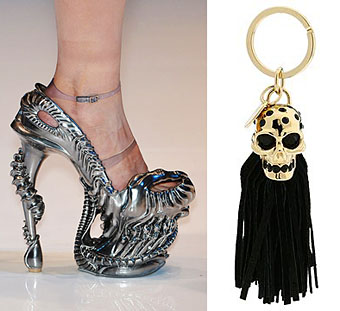
Butterfly-print dresses (how fitting for Darwin Day), Giger-style shoe designs, skull key chains… Yes, Alexander McQueen was something special.

Guardian obituary | Independent obituary

mcqueen2.jpg

Betty Blythe

blythe1.jpg

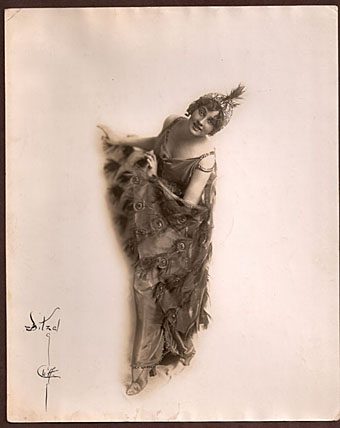
Yesterday’s search for Betty Blythe pictures turned up this pair which I couldn’t resist posting, with Ms. Blythe posed against a peacock in the first and wearing a peacock-styled outfit in the second. As I’ve noted before, silent films are very often like Symbolist paintings come to life, and The Queen of Sheba (1921) would appear to be another of these which makes its loss all the more disappointing. The photo below is from a Flickr set whose user has her own Tumblr blog of silent movie stars.

blythe2.jpg

Previously on { feuilleton }
The Mask of Fu Manchu
Salomé posters
Ruth St Denis
The Feminine Sphinx
Lussuria, Invidia, Superbia
Alla Nazimova’s Salomé