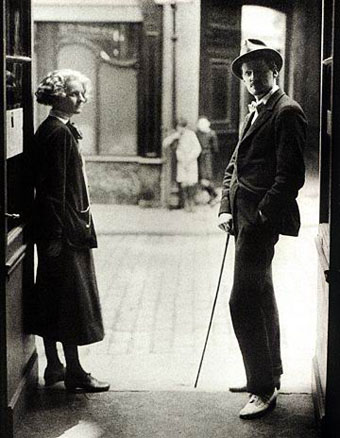
Sylvia Beach and James Joyce, 1920.
Bronze by gold heard the hoofirons, steelyringing Imperthnthn thnthnthn.
Chips, picking chips off rocky thumbnail, chips.
Horrid! And gold flushed more.
A husky fifenote blew.
Blew. Blue bloom is on the.
Goldpinnacled hair.
A jumping rose on satiny breast of satin, rose of Castile.
Trilling, trilling: Idolores.
Peep! Who’s in the … peepofgold?
Tink cried to bronze in pity.
And a call, pure, long and throbbing. Longindying call.
Decoy. Soft word. But look: the bright stars fade. Notes chirruping answer.
O rose! Castile. The morn is breaking.
Jingle jingle jaunted jingling.
Coin rang. Clock clacked.
Avowal. SONNEZ. I could. Rebound of garter. Not leave thee. Smack. LA CLOCHE! Thigh smack. Avowal. Warm. Sweetheart, goodbye!
Jingle. Bloo.
Boomed crashing chords. When love absorbs. War! War! The tympanum.
A sail! A veil awave upon the waves.
Lost. Throstle fluted. All is lost now.
Horn. Hawhorn.
When first he saw. Alas!
Full tup. Full throb.
Warbling. Ah, lure! Alluring.
Martha! Come!
Clapclap. Clipclap. Clappyclap.
Goodgod henev erheard inall.
Deaf bald Pat brought pad knife took up.
A moonlit nightcall: far, far.
I feel so sad. P. S. So lonely blooming.
Listen!
The spiked and winding cold seahorn. Have you the? Each, and for other, plash and silent roar.
Pearls: when she. Liszt’s rhapsodies. Hissss.
You don’t?
Did not: no, no: believe: Lidlyd. With a cock with a carra.
Black. Deepsounding. Do, Ben, do.
Wait while you wait. Hee hee. Wait while you hee.
But wait!
Low in dark middle earth. Embedded ore.
Naminedamine. Preacher is he:
All gone. All fallen.
Tiny, her tremulous fernfoils of maidenhair.
Amen! He gnashed in fury.
Fro. To, fro. A baton cool protruding.
Bronzelydia by Minagold.
By bronze, by gold, in oceangreen of shadow. Bloom. Old Bloom.
One rapped, one tapped, with a carra, with a cock.
Pray for him! Pray, good people!
His gouty fingers nakkering.
Big Benaben. Big Benben.
Last rose Castile of summer left bloom I feel so sad alone.
Pwee! Little wind piped wee.
True men. Lid Ker Cow De and Doll. Ay, ay. Like you men. Will lift your tschink with tschunk.
Fff! Oo!
Where bronze from anear? Where gold from afar? Where hoofs?
Rrrpr. Kraa. Kraandl.
Then not till then. My eppripfftaph. Be pfrwritt.
Done.
Begin!
James Joyce from Ulysses, 1922.