The biter bit

cauty.jpg

For the Love of Disruptive Strategies and Utopian Visions in Contemporary Art and Culture No.2 by James Cauty.

I usually wouldn’t bother writing about the over-rated and over-valued Damien Hirst—I’ll leave that to heavyweights such as Robert Hughes—but one story this week toasted the cockles of my black and cynical heart. Before we get to that, some context is required.

Hirst unveiled his diamond-coated platinum skull, For the Love of God in June 2007. Later that month, artist John LeKay complained that Hirst swiped the idea from LeKay’s series of crystal skulls made in the early Nineties. Hirst certainly knew LeKay at that time and interviewed him for a gallery catalogue in 1993.

(LeKay) said: “I would like Damien to acknowledge that ‘John really did inspire the skull and influenced my work a lot’. Damien’s very insecure about his originality. He used to say, ‘You’re a better artist than me’.

“He can be affectionate and is fun to be around, but he struggles to come up with ideas. It takes years of work to develop something. My stuff with crystals took a lot of research. You don’t just get there. He’s impatient. He’s a lazy artist.”

This wasn’t the first time Hirst was accused of laziness or even plagiarism. In 2000 he was sued for breach of copyright by Norman Emms after he made Hymn, an over-sized copy of Emms’ model for the Young Scientist Anatomy Set. That dispute was settled out of court only to be followed in 2006 with an accusation of theft by computer artist Robert Dixon who claimed that his geometric model of a flower, True Daisy, had been copied by Hirst for a piece entitled Valium. Judge the similarity for yourself.

Fast forward to December 2008 when a teenage graffiti artist who calls himself Cartrain created a collage which includes a photo of Hirst’s skull. The £200 that sales of this netted him also drew the attention of the Design and Artists Copyright Society and Hirst himself who demanded both the money and the artwork. Cartrain said:

I handed over the artworks to Dacs on the advice of my gallery. I met Christian Zimmermann [from Dacs] who told me Hirst personally ordered action on the matter.

I think this is the point where one has to start using the word hypocrite, don’t you? Others think so too, among them Jimmy Cauty (ex-KLF) and Sex Pistols sleeve designer Jamie Reid whose website Red Rag To A Bull describes itself as “a radical institution dedicated to the pursuit of “FREEDOM, TRUTH and JUSTICE in the art world and BEYOND”. And also overblown statements.” Inspired by Cartrain’s treatment, Cauty and co have been producing their own riffs on Hirst’s skull as a deliberate act of provocation. Cauty says, “Unlike Cartrain and his gallery, we are not intimidated by lawyers and if an injunction is issued, we will simply ignore it on the grounds of freedom of speech.” Reid calls Hirst a “hypocritical and greedy art bully”. There’s some funny stuff on their site, all of which is for sale as limited edition prints.

All of the works below are for sale and once TWENTY MILLION POUNDS has been raised ALL the proceeds will go to make an exact copy of a sculpture known as “For the Love of God”. This will then be sold for FIFTY MILLION POUNDS and the THIRTY MILLION POUND profit will then be used to repay the Street Urchin his 200 quid, help other Street Urchins and also feed starving children in Africa and Sussex.

Hirst will no doubt be grudgingly amused by the attention even if it is for behaving more like a grasping corporation than an artist. He’s also become the subject of another artwork by Eugenio Merino, For the Love of Gold, which depicts the corporate entity inside one of his vitrine tanks shooting himself in the head. All of which is silly and juvenile but then the only response much contemporary art deserves is a silly and juvenile one. People are naturally tempted to wave a red rag in the face of the pompous or the hypocritical. More power to them.

Update: Damien Hirst in vicious feud with teenage artist over a box of pencils

Three today

escher_three.jpg

Three Spheres II (1946) by MC Escher.

Celebrating the third { feuilleton } anniversary and post number 1,438. It’s become customary now to list the most popular posts of the past year so here we go again:

The Underwater Sculpture Gallery. This has been surprisingly popular for several months now, despite pictures of the artworks in question having been featured on very popular sites such as Boing Boing. Typing “underwater” into Google’s image search provides the answer, revealing that one of the pictures from the post is on the first results page.

The gay artists archive. This section has also leapt in popularity after the page was linked recently on StumbleUpon. It’s not a definitive archive by any means, plenty of other sites are attempting that already. These archive pages are only a convenience so that people following some of the lengthier visual categories can see at a glance what else is there. At its best this section may introduce people to more recent work which the historical sites omit.

Barney Bubbles: artist and designer. No surprise that this is still popular two years on.

Bare blade. Part of the new semi-serious Men with swords obsession. I think people like this guy’s bum more than anything. Can you blame them?

Two guys kissing. Yes, Googlers, when you search for “Two guys kissing” you get this wonderfully sexy photo by Jack Slomovits. He’s great, buy his book.

Thanks for reading!

John x

Junkopia

junkopia.jpg

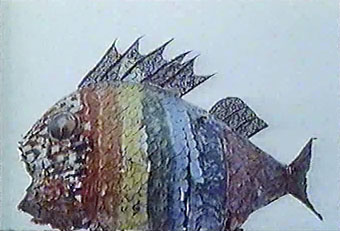
A curious short film over at Ubuweb by Chris Marker, John Chapman and Frank Simeone, depicting driftwood sculptures at the shore of San Francisco Bay which resemble the remnants of some Ballardian cargo cult. The film was made in 1981 and the sculptures look weathered and dated enough (rainbow stripes; what appears to be a lunar lander) to be products of the early 1970s. The atmospheric soundtrack is reminiscent of Max Eastley’s recordings, some of which use the force of sea-borne winds to generate their sounds.

And while we’re on the subject of Mr Marker, I hadn’t noticed this Marker-related blog before.

Previously on { feuilleton }
Max Eastley’s musical sculptures
Penguin Labyrinths and the Thief’s Journal
Short films by Walerian Borowczyk
Monsieur Chat
Sans Soleil

The Kelpies

kelpies1.jpg

Maquettes from which the final works will be produced.

Given the choice between Thomas Heatherwick’s B of the Bang sculpture—a vast bundle of metal spikes situated near the City of Manchester Stadium—and Andy Scott’s proposal for The Kelpies, a pair of giant horse heads due to be erected in Falkirk, Scotland, I’d probably prefer the latter as a piece of colossal public art. Horse heads, from the Selene horse of the Parthenon onwards, are especially suited to statuesque representation and the horse has a venerable history as a symbol in the British countryside. It should be noted that between the two works, Andy Scott has the better location, Heatherwick’s giant piece is stuck in a redeveloped area near busy roads which makes its rusted spikes seem like leftovers from the stadium’s construction. He’s also been unfortunate in having created a work which began falling apart as soon as it was finished, with falling spikes causing a public hazard and a lengthy row with Manchester City Council which was only resolved this week.

kelpies2.jpg

Scott’s enormous horse heads will be standing alone and monumental in newly-created parkland, symbolically representing a gateway to Scotland as they flank and help operate a canal lock. Kelpies is the name for the “water-horses” of Scottish myth and Scott’s Kelpies will stand 35 metres high, taller than the Angel of the North. Unlike Anthony Gormley’s static monument they’ll move back and forth as the level of the locks rises and falls. Scott’s website has more pictures of the maquettes as well as photos of his other public works.

Update: ‘Bang’ sculpture to be taken down

The Kelpies at Falkirkonline
Meet the Kelpies, Scotland’s giant addition to the UK sculptural skyline

Previously on { feuilleton }
Dark horses
Planet by Marc Quinn