Voo-doo: Hoochie Coochie and the Creative Spirit

voodoo.jpg

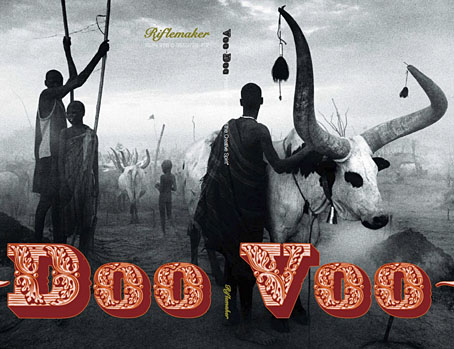
Better late than never mentioning this exhibition which has been running at Riflemaker, 79 Beak Street, London, since mid-January.

The exhibition features those artists, writers and musicians who acknowledge the need to reach a heightened or ‘altered state’ in order to create their work. We look at the mystery of the creative act; not the inexplicable ‘spark’, aka inspiration, but the fire; the non-doing before the doing, the summoning up of elemental spirits from within, or without, during the preparation of some visual or musical work, some theory or idea. This welling-up or ‘possession’, this ‘fever in the heart of man’, this spirit, this spell, might sometimes be referred to as Voodoo.

Among the very varied selection of work the chief attraction for me would be the rare opportunity to see one of Mati Klarwein‘s major paintings, Crucifixion. I referred to this large and detailed picture last year as I was fortunate to be able to use it for the packaging of Jon Hassell’s Maarifa Street CD. And while we’re on the subject of Mr Hassell (who had a track entitled Voodoo Wind on his second album) he has a new CD out on ECM, Last Night the Moon Came Dropping Its Clothes in the Street.

Voo-doo runs until April 4, 2009.

Elsewhere on { feuilleton }
The fantastic art archive

Previously on { feuilleton }
The art of Mati Klarwein, 1932–2002
Exuma: Obeah men and the voodoo groove
Voodoo Macbeth

Le Sacre du Printemps

roerich.jpg

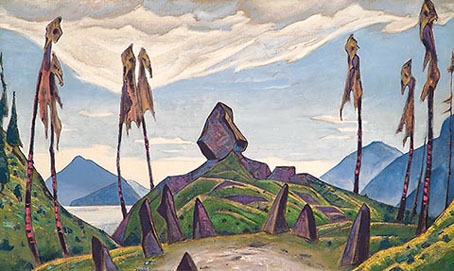
Backdrop for the League of Composers’ production, Philadelphia, 1930.

Something for the vernal equinox. The painting is a stage design by artist, writer and theatre designer Nicholas Roerich (1874–1947) for an American production of Stravinsky’s Rite of Spring. Roerich designed the costumes and decor for the riotous Paris performance of 1913 and the Roerich Museum has a selection of designs for this and subsequent performances. Stravinsky’s fiercely primitive ballet has long been a favourite musical work of mine so it’s especially satisfying when one enthusiasm bleeds into another. I’ve noted before HP Lovecraft’s praise for Roerich’s paintings of whom he wrote in 1937:

There is something in his handling of perspective and atmosphere which to me suggests other dimensions and alien orders of being—or at least, the gateways leading to such. Those fantastic carven stones in lonely upland deserts—those ominous, almost sentient, lines of jagged pinnacles—and above all, those curious cubical edifices clinging to precipitous slopes and edging upward to forbidden needle-like peaks!

Roerich is also mentioned in At the Mountains of Madness and some of his designs for the Rite—which are, after all, backdrops for a ritual sacrifice—might easily serve as a scene of Cthulhoid invocation. Writer Mike Jay has a fascinating piece about the artist which proposes that he should perhaps be given more credit for the origin of the Rite of Spring. He’s not the first to note that it was the stage designer who nurtured a lifelong passion for mysticism and esoteric ritual, not the composer.

Finally, some slightly more contemporary music: Can performing Vernal Equinox for the BBC in 1975.

Previously on { feuilleton }
HP Lovecraft’s favourite artists

Fata Morgana: The New Female Fantasists

foerester.jpg

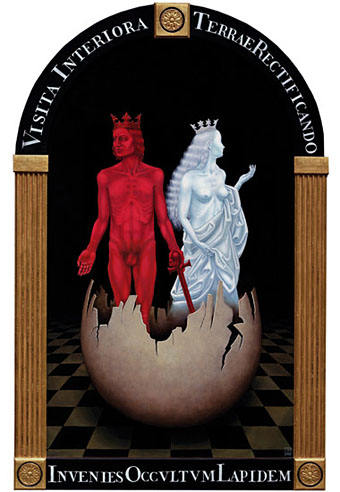
The Chemical Wedding by Madeline Von Foerster (2008).

Art lovers in the NYC area are advised to get down to the Saturday opening of this exhibition at the Dabora Gallery in Greenpoint, Brooklyn, for some great paintings and a free glass of absinthe. Fata Morgana: The New Female Fantasists is curated by Pam Grossman who runs one of my favourite art sites, Phantasmaphile. Further details can be found at the gallery pages which include links to the artists’ websites.

Dabora Gallery and Phantasmaphile’s Pam Grossman are proud to usher in the spring season with the group show “Fata Morgana: The New Female Fantasists,” on view from March 14th through April 12th, 2009. It features fourteen of the most vital and visionary women artists working in the US today.

In literal terms, a fata morgana is a mirage or illusion, a waking reverie, a shimmering of the mind. Named for the enchantress Morgan le Fay, these tricks of perception conjure up a sense of glimpsing into another world, whether it be the expanses of an ethereal terrain, or the twilit depths of the psyche. The artists of “Fata Morgana: The New Female Fantasists” deftly utilize the semiotics of mysticism, fantasy, and the subconscious in their work, thereby guiding the viewer through heretofore uncharted realms – alternately shadowy or luminous, but always inventive.

Yoko Ono recently said, “I think all women are witches, in the sense that a witch is a magical being.” Each artist in this show is a sorceress in her own right. Endowed with fecund imaginations and masterful craftsmanship, their work transforms the viewer: we become spellbound, bearing witness to their attempts to reconcile the desire for a diurnal beauty with the lure of a lush and riotous inner wilderness. The fantastical is counterpoint to the ferocious, the monstrous to the marvelous. Allusions to myth and metamorphosis abound, as these works channel their own heroine spirits and tell their own secret tales. Here, frame is magic threshold, bidding us to take a breath, and cross over.

Elsewhere on { feuilleton }
The fantastic art archive

Butterfly women

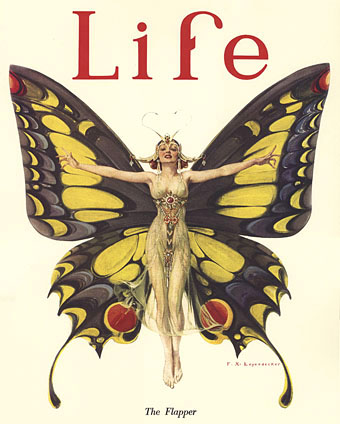
The Flapper by Frank X Leyendecker, Life magazine (1922).

When I posted this splendid cover last July I said that I ought to make a post of Butterfly Women, so here is one. Don’t expect this to be at all comprehensive, women with butterfly wings are as legion as mermaids, these are merely a couple of favourites.

moser_fuller.jpg

Loïe Fuller by Koloman Moser (1901).

The ultimate butterfly woman must be Loïe Fuller (1862–1928) whose Serpentine Dance inspired a host of fin de siècle paintings and sculptures and was also filmed by the Lumière brothers in 1896. The Internet Archive has a tinted copy of the latter while Europa Film Treasures has an Italian short from 1907, Farfale (Butterflies) with a troupe of dancers (also hand-tinted) imitating the Fuller style.

life_benda.jpg

Life magazine cover by Wladyslaw Benda (1923).

These two pictures were discovered via the wonderful Golden Age Comic Book Stories who always has the best scans of vintage art. The Life covers are from the humour periodical which expired in 1936, not the later photojournalism magazine. For more Life covers, look here.

vargas_dragonfly.jpg

Dragonfly by Alberto Vargas (1922).

Okay, so it’s called Dragonfly but those look more like butterfly wings to me. A delicate piece of Vargas cheesecake which echoes the flapper theme of the Leyendecker picture. This Flickr user has a whole set of butterfly girl cigarette cards but we don’t get to see them properly without paying. If anyone has seen them elsewhere, please leave a comment.

Elsewhere on { feuilleton }
The illustrators archive

Previously on { feuilleton }
Mermaids
Wladyslaw Benda
Vintage magazine art II
Vintage magazine art