Harlan Ellison: Dreams with Sharp Teeth

harlan.jpg

Harlan Ellison.

“You have somebody who is one of the greatest writers of the twentieth century.”

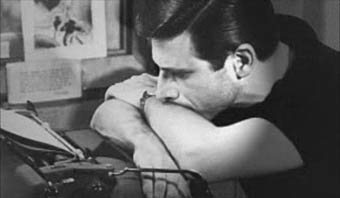
Neil Gaiman on Harlan Ellison, and so say all of us. The quote comes from a trailer for Dreams with Sharp Teeth, a new documentary about Ellison’s life and work which, as far as I can tell, has yet to acquire any distribution. Given Ellison’s reputation you have to wonder why it’s taken this long for someone to make a substantial film about such a great artist and natural performer.
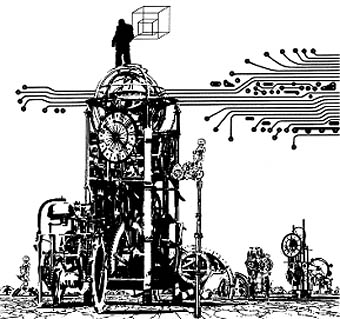
steranko.jpg

“Repent, Harlequin!” Said the Ticktockman, from a 1978 portfolio by Jim Steranko.

But it doesn’t arrive a moment too soon given the quantity of recent web discussion which seems to have forgotten his huge body of work and sees him solely as a person who gets into arguments all the time. He’s always been argumentative, of course, splendidly so, and his take-no-prisoners attitude did much to shake up the conservative world of American science fiction in the late Sixties and early Seventies. As a political commentator he’s always been at the Hunter S Thompson level with a great line in witty vituperation. The filmmakers seem to have caught both sides of Ellison, the writer who doesn’t so much read as perform his texts from memory, and the tightly-wound ball of fury who won’t take shit from anyone. The film site has nearly an hour of clips to watch, including a tremendous speed-reading of Prince Myshkin, and Hold the Relish.

And while we’re on the subject, I’ll give another plug to the landmark collection of HP Lovecraft-derived art due to appear soon from Centipede Press. This features a number of my Lovecraftian works and an introduction from Mr Ellison himself.

Previously on { feuilleton }
The Bradbury Building: Looking Backward from the Future
Revenant volumes: Bob Haberfield, New Worlds and others
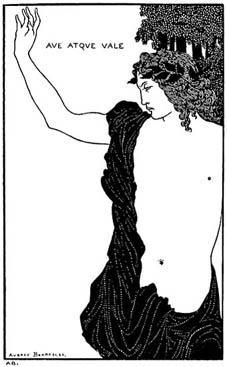
Ave Atque Vale!

ave.jpg

Aubrey Beardsley illustrates Catullus for The Savoy, no. 7 (1896).

Farewell then, Mister Aitch, now he’s decided to call it a day at the wonderful and unique Giornale Nuovo. He’d been blogging (must we call it that? It seems we must…) for five years which probably makes him first generation in the concentrated timescale of web-existence. Five years is a long time to be doing anything never mind regularly throwing hard-won morsels of research to the browsing hordes.

His posts will be missed here since it was his journal, along with a handful of others (Bldg Blog, The Nonist, BibliOdyssey among them), which confirmed for me that this discipline could have a purpose beyond mere diaristic vanity, something I enjoy reading but had no desire to engage in myself. One of the specialist concerns at Giornale Nuovo was the etching or engraving and Mister Aitich managed to cover this area so comprehensively I frequently found that artists I’d considered writing about were already discussed there in far greater detail than I could summon the energy (or the book resources) for myself. Those book resources are a thing of wonder and I remain eternally jealous of Mister Aitch’s library.

Happily Giornale Nuovo will remain online as an archive, which is good to hear. This raises again the spectre of what’s to happen to all this energy and activity when we let it go. Books regularly outlive their creators but all these fragile electronic media are dependent on the whims of webhosts and developing technology. Do we want this work to survive for the benefit of future historians or not? Or should we celebrate it as ephemeral and transient? What happens when the web advances beyond Unix networks, PHP and HTML? The British Library has already expanded its deposit scheme to encompass electronic works but online publications differ from their paper equivalent in that the publisher—legally obliged in the UK to send one copy of every printed volume to the British Library—is invariably also the author. What happens if the author dies before they have a chance to submit their work which then sinks into the swamp of a billion other weblogs? When do you decide to submit a work which is forever unfinished?

I’ll leave those questions to librarians and the scholars at the Long Now Foundation who consider some of the issues presented by the prospective obsolescence of present technology. In the meantime we’ll raise a farewell toast to Mister Aitch and wish him all the very best. Don’t be hesitant in browsing his archives, there’s a wealth of eclectic, eccentric and neglected culture there deserving of your attention.

The art of Julie Heffernan

heffernan1.jpg

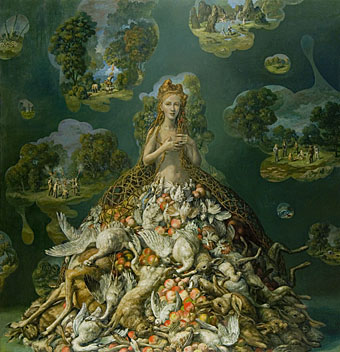
Self Portrait as Booty (2007).

I hadn’t come across Julie Heffernan’s work before until examples turned up a few weeks ago on several different websites in the space of a few days. The picture above—a typical indicator of her current concerns—is featured on the cover of a new edition of Tin House, a collection of fantasy stories by women.

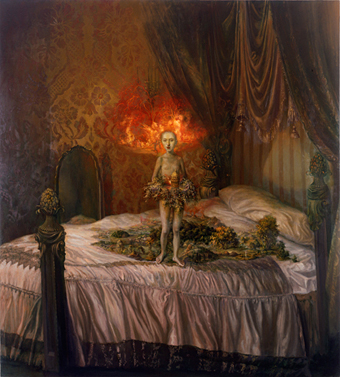
All Heffernan’s paintings are very detailed oil on canvas and no doubt look a lot better at a larger size. A book of these would be most welcome.

heffernan2.jpg

Self Portrait in the Bedroom (2003).

Three picture galleries at PPOW
An appraisal by David Cohen

Elsewhere on { feuilleton }
The fantastic art archive

Family Dog postcards

psych_postcards.jpg

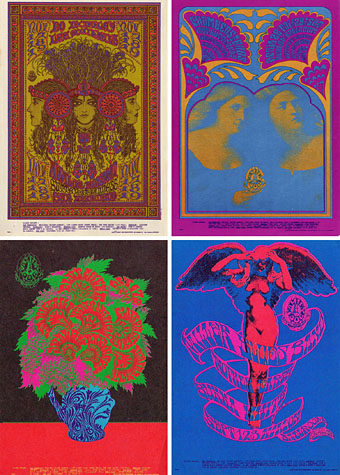
top: William Henry (1967); Victor Moscoso (1967).
bottom: Victor Moscoso (1967); Kelley/Mouse (1967).

Marvellous. Oldhandbills.com has a lot of this stuff, loads of designs I’ve never seen before. Via Arthur.

Elsewhere on { feuilleton }
The illustrators archive

Previously on { feuilleton }
The poster art of Marian Zazeela