Shadow of the House

soth.jpg

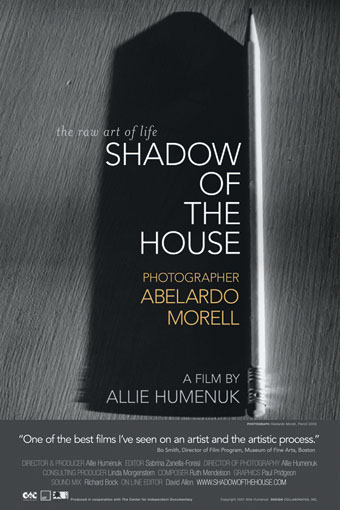
After writing about Abelardo Morell’s remarkable camera obscura photographs last month, filmmaker Allie Humenuk left a comment about her documentary which explores Morell’s work and working methods.

Shadow of the House is about looking closely. Filmed over seven years, it is an intimate portrait of photographer Abelardo Morell, revealing the mystery and method of his artistic process. The narrative skips across time and space from his early childhood escape from Castro’s regime to his status as a world-renowned photographer. The film explores his daily working life as an artist and his eventual return to Cuba after 40 years of living in exile. Shadow of the House uncovers the deep layers of a man who is pushed to confront his past and his familial allegiances as it explores his unique artistic vision.

The film website has a lot more information, including details of North American screenings, and a trailer.

Previously on { feuilleton }
Abelardo Morell’s camera obscura
Abelardo Morell

The recurrent pose 12

ysl.jpg

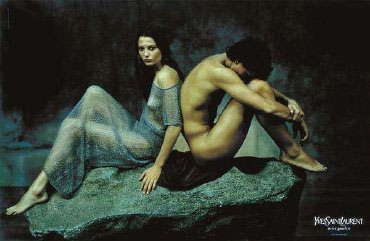
It wouldn’t surprise me if there are more examples of the fashion world borrowing the Flandrin pose but this is the only one I’ve seen so far, part of a 1998 art-inspired photo series by Mario Sorrenti for Yves Saint-Laurent. There don’t seem to be any larger copies available, unfortunately.

Elsewhere on { feuilleton }
The recurrent pose archive

Previously on { feuilleton }
Last Suppers and last straws
The last circle of the Inferno

The art of Sadao Hasegawa, 1945–1999

hasegawa5.jpg

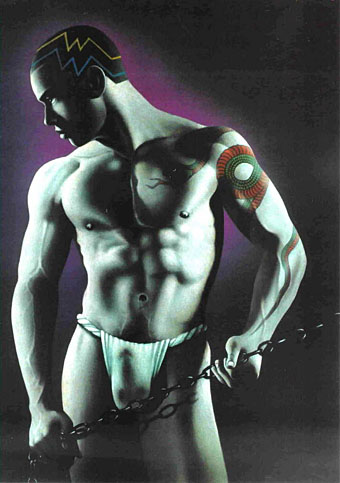
(No title) from Sadao Hasegawa 01 (1990).

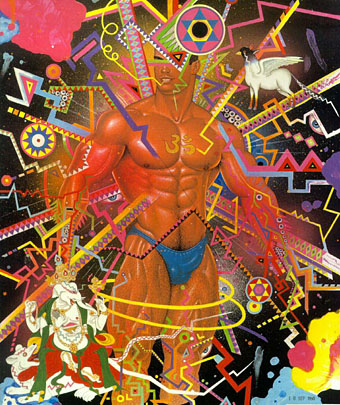
It’s good to be able to finish the year with another artistic discovery. I’d not come across Sadao Hasegawa’s work before but this page has an extensive (complete?) selection of his paintings and drawings. This is gay erotica with a twist, being Japanese in origin yet incorporating figures and symbolism derived from Indian or Thai mythology, detailed psychotropic invention and the kind of angular motifs common in much illustration and design of the 1980s. A heady brew, in other words, and quite unique as a result, which makes it all the more tragic that he committed suicide in 1999. At least one of his books, Paradise Visions, is still available in Japan but a decent collection of his work for a western audience is obviously long overdue.

hasegawa7.jpg

Paradise Visions (1996).

Continue reading “The art of Sadao Hasegawa, 1945–1999”

Hugh Ferriss and The Metropolis of Tomorrow

ferriss1.jpg

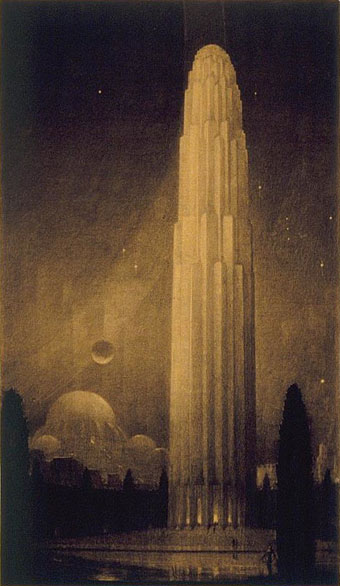
Philosophy from The Metropolis of Tomorrow (1929).

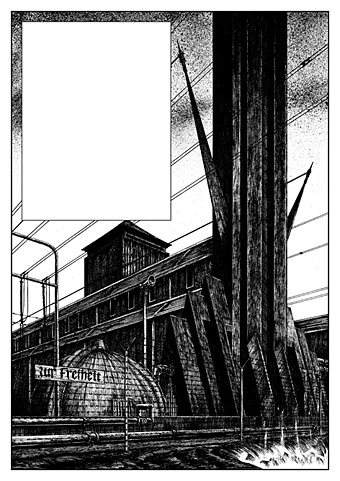
I’ve procrastinated for an entire year over the idea of writing something about Hugh Ferriss and now this marvellous Flickr set has forced my hand. Ferriss (1889–1962) was a highly-regarded architectural renderer in the Twenties and Thirties, chiefly employed creating large drawings to show the clients of architects how their buildings would look when completed. But he was also an architectural theorist and his 1929 book, The Metropolis of Tomorrow, which lays out his ideas for cities of the future, was a major influence on the work I produced for the Lord Horror comics during the 1990s. Ferriss’s book appeared two years after Fritz Lang’s Metropolis but bears little resemblance to Lang’s simplistic tale, despite superficial similarities. Rather than a science fiction warning, The Metropolis of Tomorrow was a serious proposal for the creation of Art Deco-styled megacities.

hch5bw.jpg

Lord Horror: Hard Core Horror #5 (1990).

Continue reading “Hugh Ferriss and The Metropolis of Tomorrow”