The art of Michel Henricot

henricot1.jpg

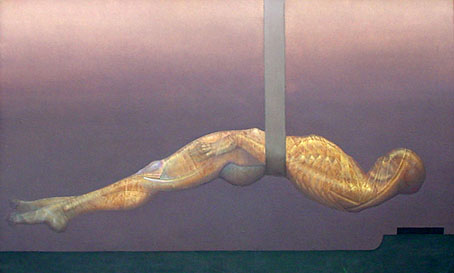
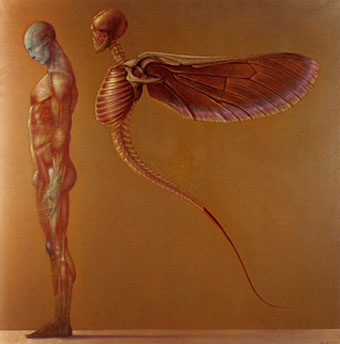
Voyageur IV (1995).

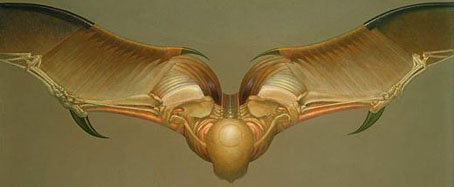
Born in Paris in 1941, he confesses to being largely “…self-taught. I was always at the Louvre, staring like crazy at the pictures there, fascinated by ‘how it’s done’.” … (Leonor) Fini’s works from the 60s influenced, to a degree, the young Henricot. Depicted in a hieratic style with underlying geometrical forms, her graceful elongated figures seem to exist in timeless spaces that are dark and densely atmospheric. Henricot’s earliest figures also have this graceful quality, but were more stylized and cybernetic, with ergonomic designs on their metallic skins. Sometimes they remained mere torsos, lacking hands to grasp or feet to stand. (More.)
henricot3.jpg

No title or date.

henricot2.jpg

No title or date.

Peinture Visionnaire: Michel Henricot at ArtsLivres
BernArt gallery page
CFM gallery page

Elsewhere on { feuilleton }
The fantastic art archive

Previously on { feuilleton }
Surrealist women

The art of Jo Whaley

whaley1.jpg

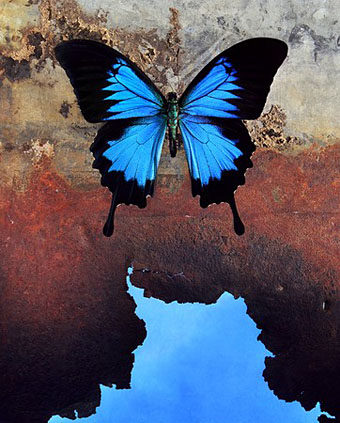
Papilio ulysses (2000).

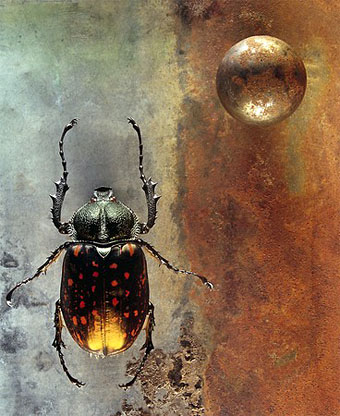
Best. Insect Art. Ever. From a series entitled The Theater of Insects, also the name of a book devoted to Ms Whaley’s photographs which will appear from Chronicle Books later this year.

The photographs in this book are fantastic field illustrations. While the insects in these images are real, the backgrounds are imaginary altered habitats of my devising. Inspired by the old dioramas found in natural history museums, the pinned insects are arranged in constructed environments. The studio where I create the images is as much a theatrical scene shop as it is a photography studio. The prop room looks like an eighteenth-century cabinet of curiosities, in that it is filled with specimens of natural history and visual oddities of manufacture. I use free association and intuition to make decisions about arranging the insect with a particular backdrop. Looking at color, shape, and form, I move the elements about until the magic of the image appears. Lighting the scene is challenging as the sets are only about five by seven inches across with a depth of about an inch and a half. Yet the studio lighting is key to breathing a spirit into these pinned specimens and unifying the disparate elements within the mise-en-scène Finally, the performance of the image is concluded with a single click of the camera’s shutter. (More.)

whaley2.jpg

Coleoptera (2003).

Via Fabulon.

Previously on { feuilleton }
Endangered insects postage stamps
Robert Lang’s origami insects
Lalique’s dragonflies
Lucien Gaillard
Wesley Fleming’s glass insects
Insect Lab

Take Your Time: Olafur Eliasson

eliasson.jpg

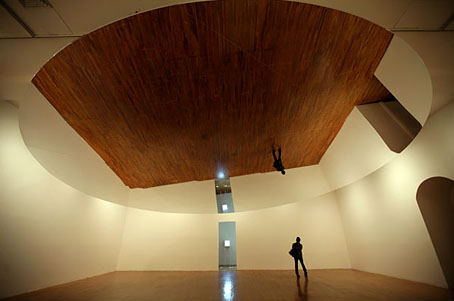
New work by Danish artist Olafur Eliasson is always welcome here and the above is exactly that, a large rotating mirror installed at the P.S. 1 Contemporary Art Center, New York, along with other pieces comprising a major survey of his work.

Take Your Time a new piece at P.S. 1, made for the show, consists of a huge, tilted, disc-shaped mirror suspended horizontally from a gallery ceiling. What strikes you at first is the omniscient, bird’s-eye reflection of the room below, with you standing in the middle of it. Then you notice that the mirror is rotating very slowly, and with a subtly undulating motion that causes the room itself feel warped and unstable. You experience this as much with your sense of balance as with your eyes.

The New York Times takes a critical look at Eliasson’s work and complains about his not being radical enough, an objection which seems curiously old-fashioned as well as being the kind of issue that only plagues art critics, other artforms getting on perfectly well without concerning themselves with being avant garde and challenging above all else. Better to ignore the redundant polemic and look at the slide show of his works.

Take your time: Olafur Eliasson runs until June 30, 2008.

Previously on { feuilleton }
Olafur Eliasson’s BMW
Olafur Eliasson’s Serpentine Pavilion
New Olafur Eliasson

Forever Changes by Jim Lambie

lambie.jpg

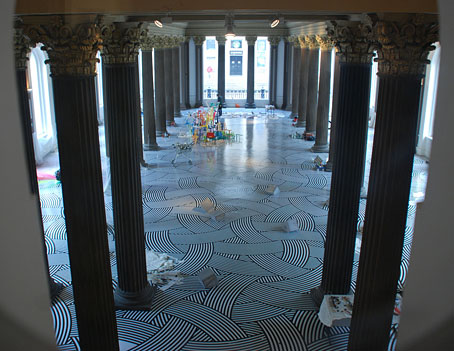
Nothing to do with the late Arthur Lee, well…not directly anyway. I love the contrast between the dizzying floor design (created with vinyl tape) and the rather dour Corinthian columns in Jim Lambie’s installation. I believe the Flickr photo above shows the work being prepared.

Forever Changes, which also includes some of the artist’s playful sculptures, is at the Gallery of Modern Art, Glasgow, as part of the Glasgow International arts festival until September 29, 2008. A review for The Scotsman describes some of its details. Lambie likes his floor coverings, having previously produced dazzlingly vibrant works such as ZOBOP which you can see being created in a little time-lapse movie here.