The Art and Music Collection, 1976–77

am01.jpg

In the mid-1970s Dieter Brusberg and Siegfried E. Loch packaged a series of albums for the German division of Atlantic Records under the title The Art and Music Collection, a reissue scheme which paired each album with a print by a contemporary artist. This is an odd collection which I imagine was aimed at people like the father of one of my friends at school, the first person I met who owned a proper hi-fi system rather than a cheap stereogram. He liked to listen to progressive rock and jazz, and had a shelf of jazz records packaged in boxed editions that looked like they were ordered from an ad in a Sunday magazine.
am02.jpg

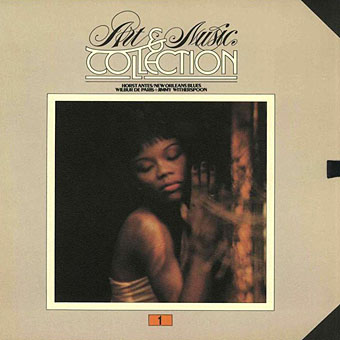
New Orleans Blues by Wilbur De Paris & Jimmy Witherspoon. Art by Horst Antes.
am03.jpg

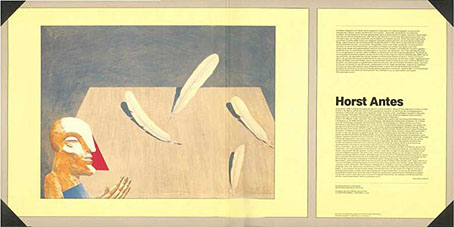
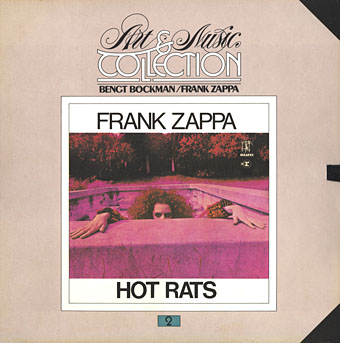
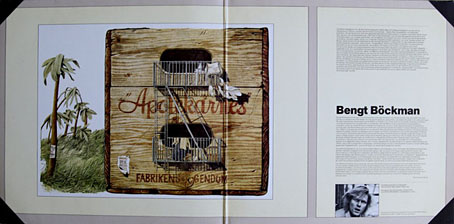
The Art and Music Collection had lower production values than the boxed records but each album was housed in a heavy gatefold sleeve, some of which came with ribbons attached to the front and back covers. Inside the gatefold there was a picture of the piece of art chosen to complement the release, together with a note about the artist and a paragraph of text which I’m guessing attempted to draw a parallel between the picture and the music. With the exception of a lone Briton, Joe Tilson, all the artists were German or Austrian. The series managed eight numbered releases—collect the set!—with albums that might have been chosen at random from the Atlantic back catalogue, a curious mix of jazz, rock and blues. Each artist shares billing with the musicians (the artist names are also on the disc labels), which makes me wonder if the series troubled any musical egos. After album no. 6 someone at the record company must have realised they were giving the wrong impression by listing the artists first so they revised the name of the series to The Music and Art Collection. The artworks seem as randomly chosen as the music, unless the sleeve notes have convincing explanations for their selection. The paintings of Rudolf Hausner—an artist I’d never think to connect with The Doors—became a lot more visible a couple of years later when OMNI magazine used his art for a cover and a number of interior illustrations.
am04.jpg

Hot Rats by Frank Zappa. Art by Bengt Böckman.
am05.jpg

Continue reading “The Art and Music Collection, 1976–77”

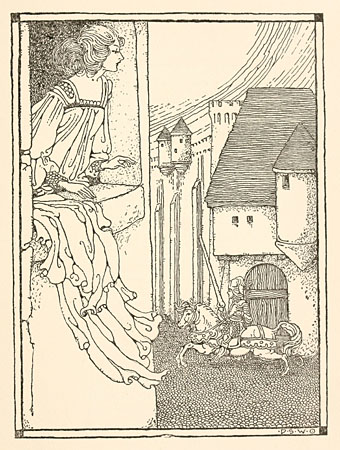
Dugald Stewart Walker’s Rainbow Gold

dsw01.jpg

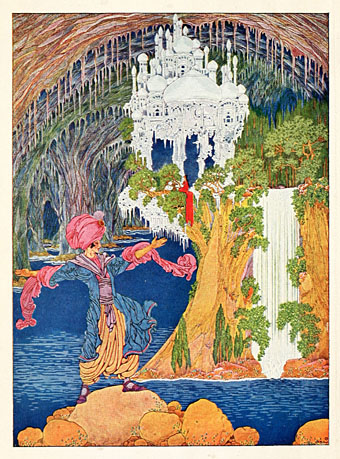
Kubla Khan by Samuel Taylor Coleridge.

The illustrations of Dugald Stewart Walker (1883–1937) have been featured here on several occasions but this is a book of his that I’d missed until now. The Internet Archive has a huge trove of illustrated editions but the illustrators aren’t always credited on the website pages so you either have to rely on chance discovery or search for books by their titles.

dsw22.jpg

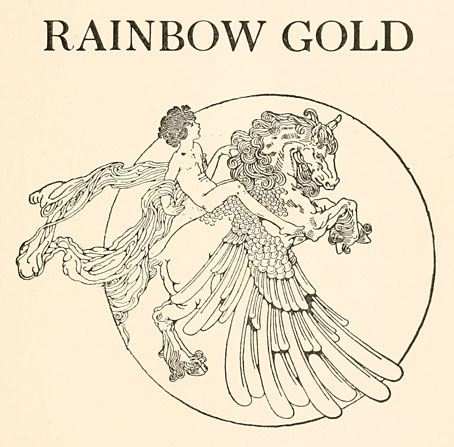
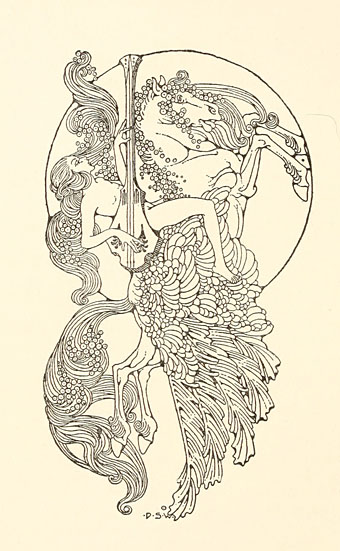
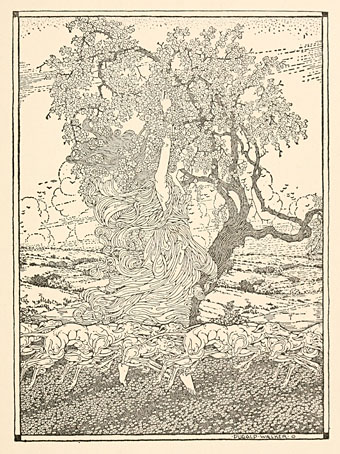
Rainbow Gold: Poems Old and New Selected for Boys and Girls (1922) is a collection compiled by Sara Teasdale that was illustrated throughout by Walker’s full-page drawings and many smaller vignettes. Not all of the poems are given the full-page treatment so some of the omissions are disappointing. I’d liked to have seen what he could do for Yeats’s The Song of Wandering Aengus, for example.

dsw02.jpg

There’s a Virgil Finlay-like quality to a few of these illustrations that I hadn’t noticed in Walker’s art before: the stars in the Israfel drawing, the same kinds of tiny nested circles that Finlay favoured, and dots stippled in white that must have been applied with paint rather than ink. Finlay would have been the right age to have been given (or shown) Walker’s drawings when he was a child which makes me wonder if they exerted a minor influence.

dsw03.jpg

“When the hounds of spring” by Algernon Charles Swinburne.

dsw04.jpg

The Lady of Shalott by Alfred Tennyson.

Continue reading “Dugald Stewart Walker’s Rainbow Gold”

Weekend links 576

haberfield.jpg

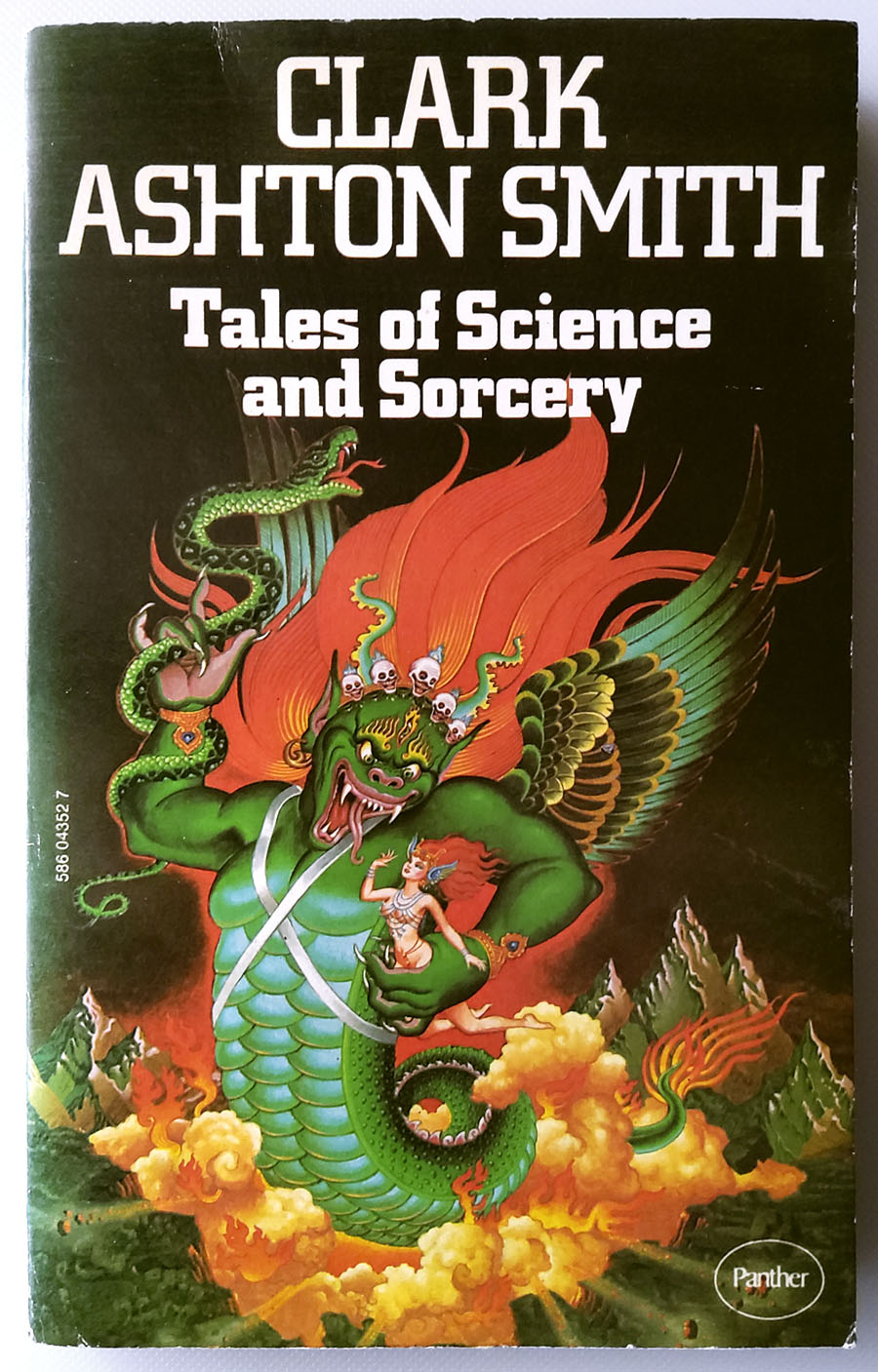
Cover art by Bob Haberfield, 1976.

• I’ve been reliably informed that Australian artist Bob Haberfield died recently but I can’t point to an online confirmation of this so you’ll have to take my word for it. “Science” and “sorcery” might describe the two poles of Haberfield’s career while he was working as a cover artist. His paintings made a big impression on British readers of fantasy and science fiction in the 1970s, especially if you were interested in Michael Moorcock’s books when they appeared en masse as Mayflower paperbacks covered in Haberfield’s art. Haberfield also appeared alongside Bruce Pennington providing covers for Panther paperbacks by HP Lovecraft, Clark Ashton Smith and others, although his work there isn’t always credited. Dangerous Minds collected some of his covers for a feature in 2017. (The US cover for The Iron Dream isn’t a Haberfield, however.)

• “Like Alice, who can only reach the house in Through the Looking-Glass by turning her back to it, Gorey reversed the usual advice to ‘write what you know’ and wrote the apparent opposite of his own situation.” Rosemary Hill reviewing Born to Be Posthumous: The Eccentric Life and Mysterious Genius of Edward Gorey by Mark Dery.

• “Orvil…wanders the countryside, visits churches, rummages in antique shops, and encounters strange men to whom he is no doubt equally strange.” John Self reviewing a new edition of In Youth Is Pleasure by Denton Welch.

• At the Wyrd Daze blog: Q&A sessions with Stephen Buckley (aka Polypores), Gareth Hanrahan, and Kemper Norton.

• “Fellini liked to say that ‘I fall asleep, and the fête begins’.” Matt Hanson on Federico Fellini’s phenomenal films.

• A Beautiful Space: Ned Raggett talks to Mick Harris about the thirty-year history of Scorn.

• Deep in the dial: Lawrence English on the enduring appeal of shortwave radio.

Clive Hicks-Jenkins on making a picture for Annie Darwin (1841–1851).

DJ Food looks at pages from Grunt Free Press circa 1970.

• Mix of the week: Fact Mix 814 by Loraine James.

• New music: Clash (feat. Logan) by The Bug.

• At BLDGBLOG: Terrestrial Astronomy.

LoneLady‘s favourite albums.

• At Dennis Cooper’s: Porn 2.

Tilings Encyclopedia

Betrayal (Sorcerer Theme) (1977) by Tangerine Dream | Science Fiction (1981) by Andy Burnham | Sorceress (2018) by Beautify Junkyards

Gioconda of the Mausoleum

mona1.jpg

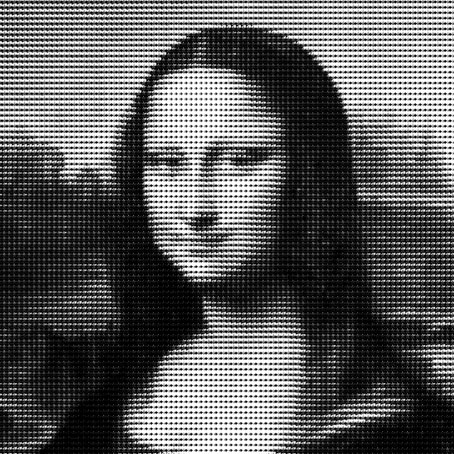
“MAGIC REALISM • Like the video technique of “keying in” where any background may be electronically inserted or deleted independently of foreground, the ability to bring the actual sound of musics of various epochs and geographical origins all together in the same compositional frame marks a unique point in history. • A trumpet, branched into a chorus of trumpets by computer, traces the motifs of the Indian raga DARBARI over Senegalese drumming recorded in Paris and a background mosaic of frozen moments from an exotic Hollywood orchestration of the 1950’s [a sonic texture like a “Mona Lisa” which, in close up, reveals itself to be made up of tiny reproductions of the Taj Mahal], while the ancient call of an AKA pygmy voice in the Central African Rainforest—transposed to move in sequences of chords unheard of until the 20th century—rises and falls among gamelan-like cascades, multiplications of a single “digital snapshot” of a traditional instrument played on the Indonesian island of JAVA, on the other side of the world.” — Jon Hassell

mona2.jpg

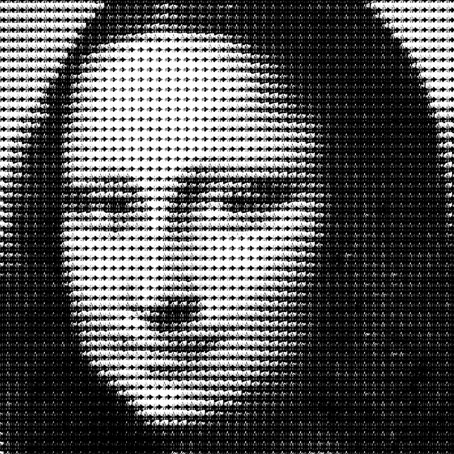
Jon Hassell’s text is part of the sleeve note for his Aka—Darbari—Java (Magic Realism) album which was released on Editions EG in 1983. The description of a picture of the Mona Lisa made from tiny reproductions of the Taj Mahal always intrigued me even though it’s only a shorthand metaphor for the sampling process, as well as being an encapsulation in miniature of one aspect of Hassell”s “Fourth World” concept: the blending of East and West, the sacred and the profane. Nevertheless, 20 years ago—17th May, 2001, according to the date on the file—after realising that Photoshop allowed the creation of just this kind of mosaic imagery, I decided to try and bring Hassell’s metaphor to digital life.

mona3.jpg

The end result in its full-size version looks at a distance like an ordinary halftone rendering of the painting but it really is made of tiny images of the Taj Mahal, albeit very rough ones since the process always resulted in a bitmap image. So much time has elapsed I’ve forgotten the procedural details although I do recall the involvement of one of those legacy features of Photoshop that most people ignore, possibly the Apply Image function. And I only did this at all because I’d found a tutorial somewhere that described how to create a mosaic image in this manner. The resulting picture wasn’t particularly satisfying but as a proof of concept it did at least work.

Continue reading “Gioconda of the Mausoleum”

Weekend links 575

barbier-gazette.jpg

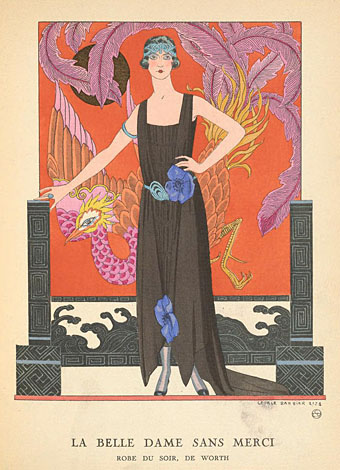
La Belle Dame Sans Merci (1921) by George Barbier.

• “Organic Music Theatre goes beyond jazz into something else entirely—an ecstatic, openhearted melding of cultures. It is the first live recording of Don and Moki’s ‘organic music’ concept, a holistic blend of the arts and education. It is an album that everyone should own, an absolute marvel.” Geeta Dayal on Don and Moki Cherry’s Organic Music Theatre: Festival de jazz de Chateauvallon 1972.

DJ Food continues his dig into the history of London’s Middle Earth venue with an account of a Magical Mystery Tour that ended up being more mystery than magic.

The Lamp Magazine is running a Christmas Ghost Story contest with a first prize of publication in the Christmas issue of the magazine, plus $1000.

Dennis Cooper‘s favourite fiction, poetry, non-fiction, film, art, and internet of 2021 so far. Thanks again for the link here!

• From sport to sex: Louis Staples on how the jockstrap became part of gay culture.

• At Wormwoodiana: Mark Valentine on the weird fiction of AE Coppard.

• “How vinyl records are trying to go green.” Trying…

• Mix of the week: XLR8R Podcast 701 by 40 Winks.

• New music: Rushes Recede by Sarah Davachi.

Lisa Gerrard‘s favourite music.

• RIP Peter Zinovieff.

Organic (1982) by Philip Glass | Core (Organic) (1995) by Main | Organic Mango (1996) by HAT