Ephraim Moses Lilien’s Lieder des Ghetto

lilien01.jpg

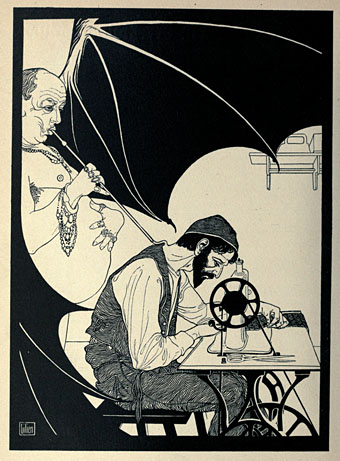
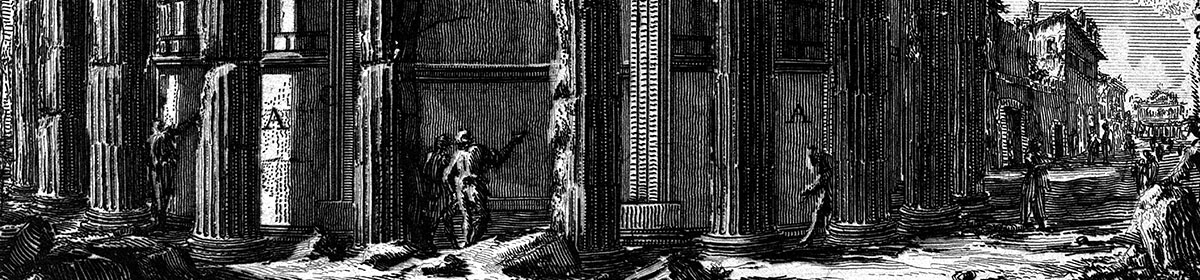
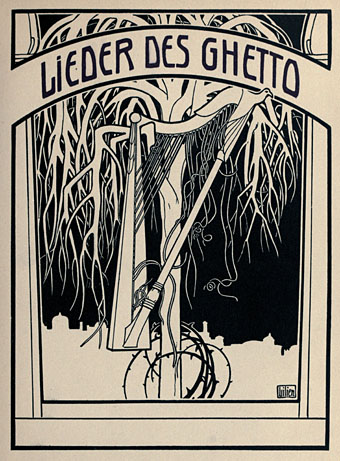
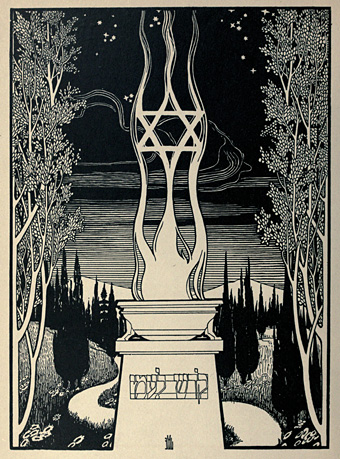
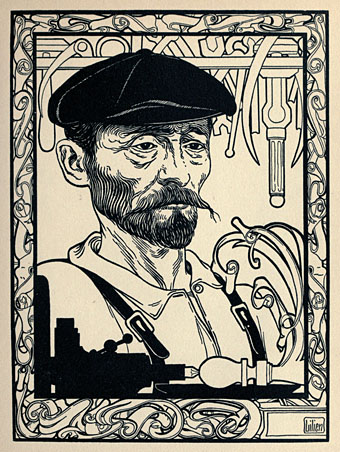
There are no golems in Morris Rosenfeld’s Songs of the Ghetto (1899), translated here by Berthold Feiwel for a German readership as Lieder des Ghetto (1902). But the Berlin edition does contain many superb full-page illustrations and embellishments by Ephraim Moses Lilien (1874–1925), a German artist whose work has featured here on a number of occasions. I’d seen a couple of these drawings before but hadn’t quite registered the pronounced Beardsley influence until now. Aubrey had only died four years before this book was published, and while Lilien’s style is strong enough to establish its own identity you can find a Beardsley-like quality not only in the heavy blacks and areas of white, but also in the border designs, the treatment of landscape and foliage, and even the jewellery on the demon figure below, details which resemble the similar jewellery on Beardsley’s title page for the story of Ali Baba. There’s more of Lilien’s work at this Flickr set while the rest of the book may be browsed or downloaded at the Internet Archive.
lilien02.jpg

lilien03.jpg

lilien04.jpg

Continue reading “Ephraim Moses Lilien’s Lieder des Ghetto”

Wildeana 7

wilde1.jpg

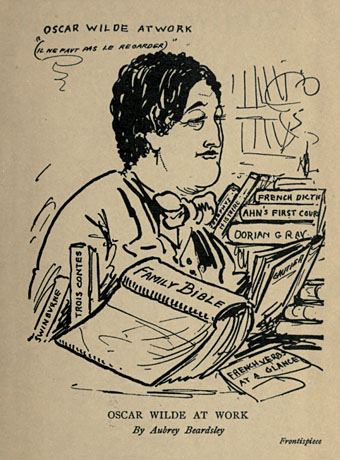
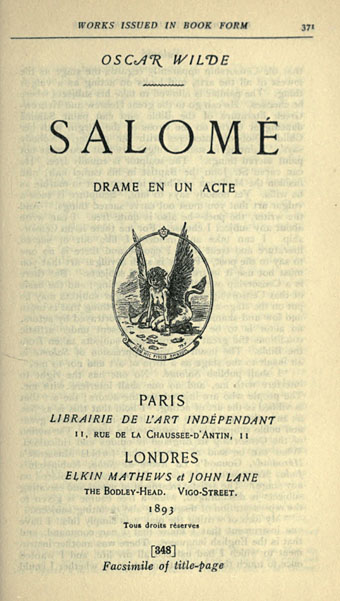
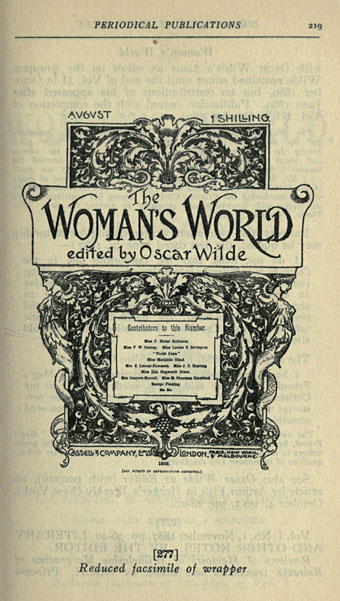
Continuing an occasional series. The drawing above is frequently credited to Aubrey Beardsley in books about Oscar Wilde but receives an “anonymous” attribution in books of Beardsley’s work. The copy here, and the pages below, are from Bibliography of Oscar Wilde (1914) by Stuart Mason.

Last November it was announced that Wilde’s lipstick-blotched tomb in Père Lachaise cemetery is to be cleaned (again) then shielded from the persistent kissers and graffiti writers by a glass screen. Flickr has a collection of photos showing the earlier condition of the tomb and its embellishments.

wilde2.jpg

• Maria Bustillos in The Vexed Posthumous Life of Oscar Wilde chronicles the story of the blue plaque on Wilde’s former home in Tite Street, London.

• “A hundred and twenty five years ago, Oscar Wilde edited a fashion magazine, his first and only office job. We have yet to learn from the experience.” Wilde in the Office by Kaya Genç.

wilde3.jpg

Elsewhere on { feuilleton }
The Oscar Wilde archive

Further echoes of Aubrey

verhagen.jpg

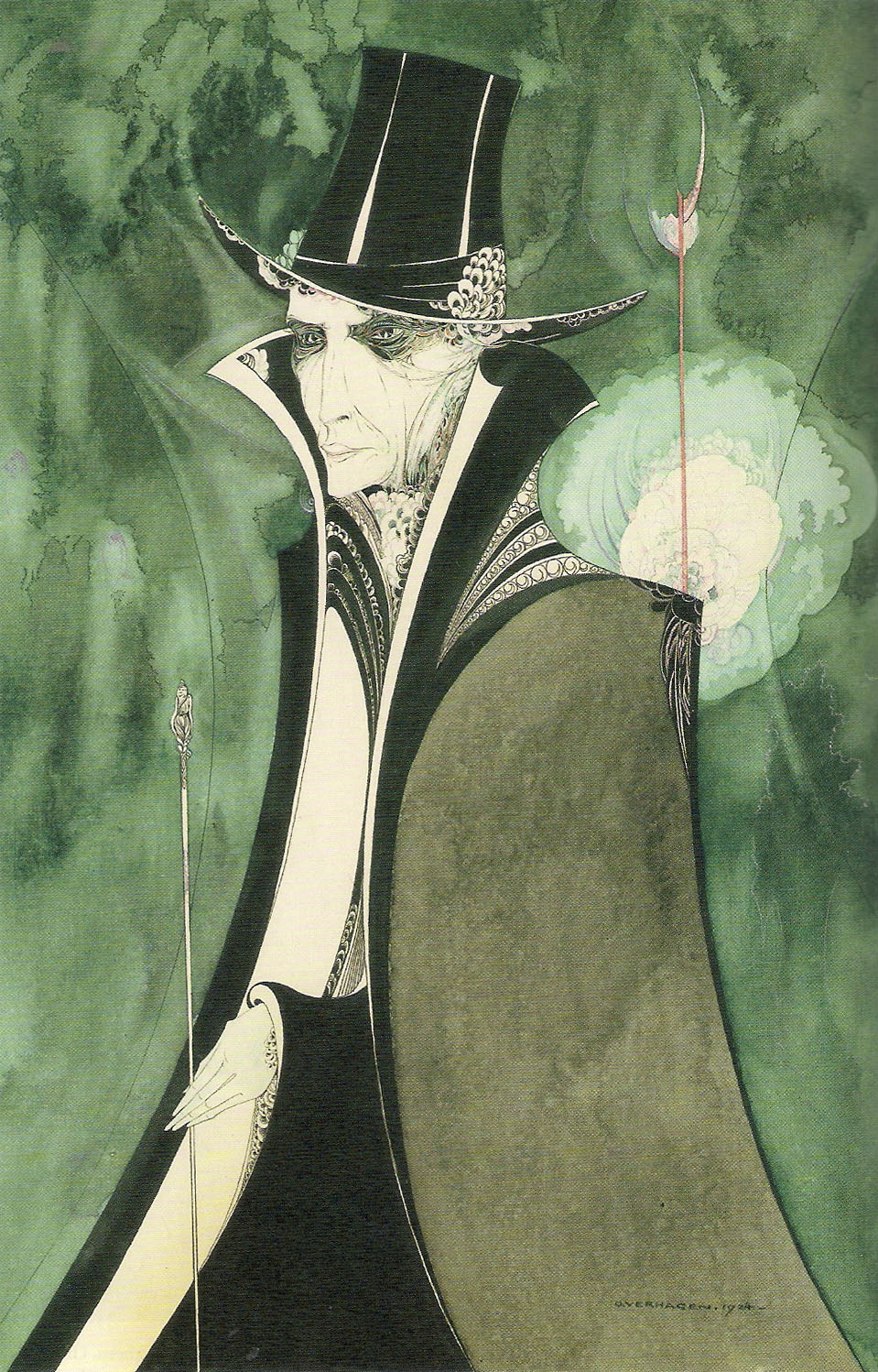
Dorian Gray (1924) by Otto Verhagen (1885–1951).

If you need an idea of the colossal impact Aubrey Beardsley’s drawing had on the art world of the 1890s consider that the entirety of his career—from his first public exposure in The Studio in 1893 to his very untimely death in 1898—lasted a mere five years. Decades afterwards artists around the world were still imitating his style. The later disciples are so numerous and so widespread it’s no surprise if some have yet to be fully acknowledged by subsequent generations. Sander Bink who maintains the Rond1900 site sent copies of these drawings (from Lopende Vuurtjes, Verloren Publishers, 2012) and provided some information about the artists:

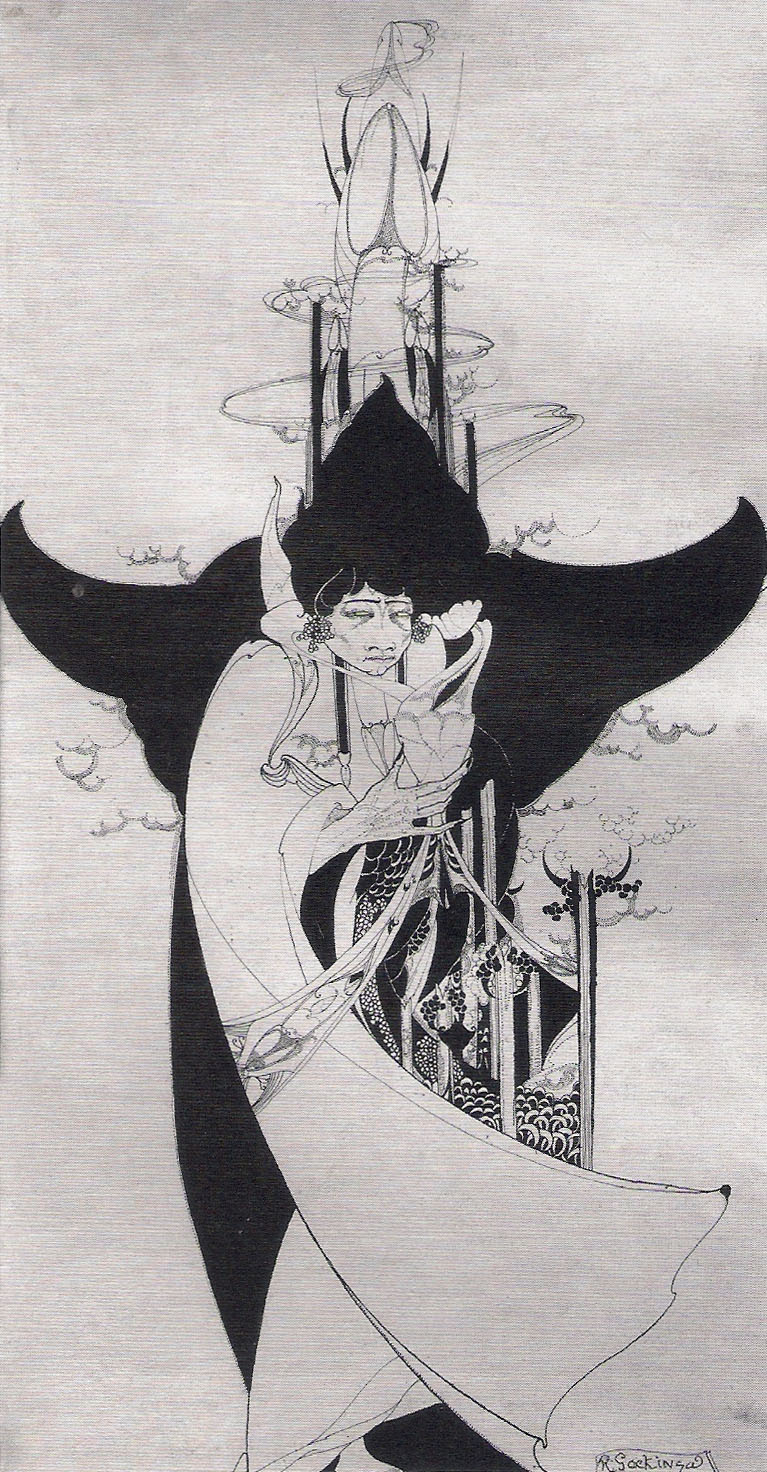
Verhagen was a government official for most of his life and seems to have led a very respected life and made his Beardsley-esque work privately, no expositions as far is I know. Gockinga appears to have led a more interesting life: born in Indonesia, lived in Holland 1908–1922, the Indonesia (Java) again, then New York, and the Indonesia and after wwii Amsterdam, probably homosexual. Had one exposition of his work in 1917.

Sander’s site has further examples of Verhagen’s drawings, and he says that both artists were probably inspired by Carel (or Karel) de Nerée, some of whose work was featured here a while back. Always good to have the dots joined. Verhagen’s Dorian Gray is a curious piece; in style it’s a little like the angular drawings that Beresford Egan was producing in the 1920s, while the subject can’t be Dorian himself unless it’s a rendering of his aged portrait. As for Gockinga’s drawing, it’s a lot more faithful to Beardsley’s early style (complete with phallic extrusions) than the poor Nichols fakes that appeared in 1919. If you want a successful forgery it’s always best to find someone with talent.

(Thanks Sander!)

gockinga.jpg

Old lady with ghost (c.1916) by René Gockinga (1893–1962).

Elsewhere on { feuilleton }
The Aubrey Beardsley archive
The illustrators archive
The Oscar Wilde archive

The art of Ismael Álvarez

alvarez1.jpg

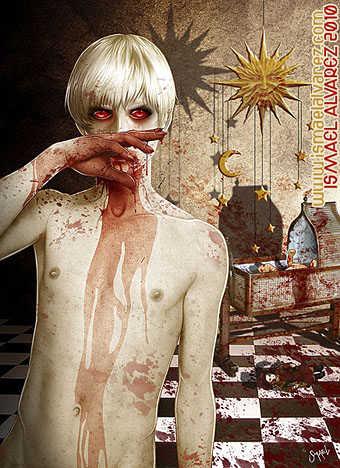
Sangre Virgen.

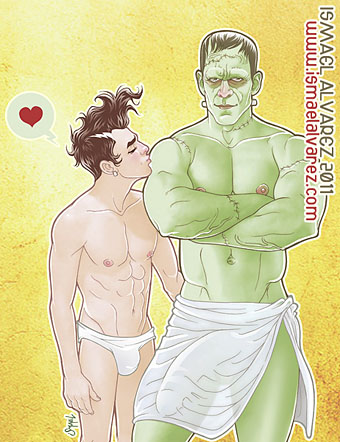
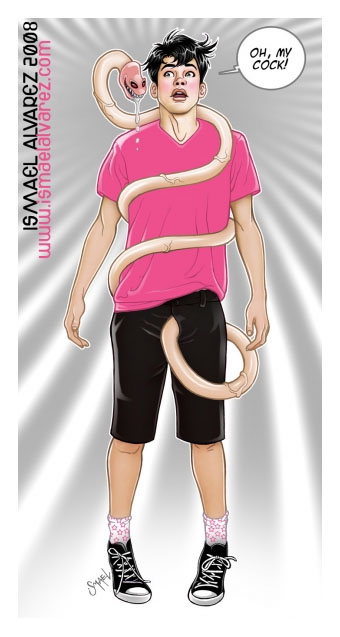
Yeah, trust me to pick the gore-drenched teen out of a gallery of otherwise wholesome drawings… Ismael Álvarez is a Spanish artist with a nice clean line, a sense of humour and an imagination that can encompass comic imagery like the pictures below or run to full-on erotica. Of the latter there’s a separate gallery replete with the Enormous Cocks that now seem de rigueur for a certain kind of gay art in the same way that Enormous Breasts are a feature of much straight erotica. I’m not complaining—heaven forbid!—merely acknowledging a trend. In addition to his art, Señor Alvarez also maintains a blog and creates his own YouTube broadcasts, all of which are of course in Spanish.

alvarez2.jpg

My boy is a monster (cock).

alvarez3.jpg

Oh My Cock.

Elsewhere on { feuilleton }
The gay artists archive

A Trip to Mars

mars3.jpg

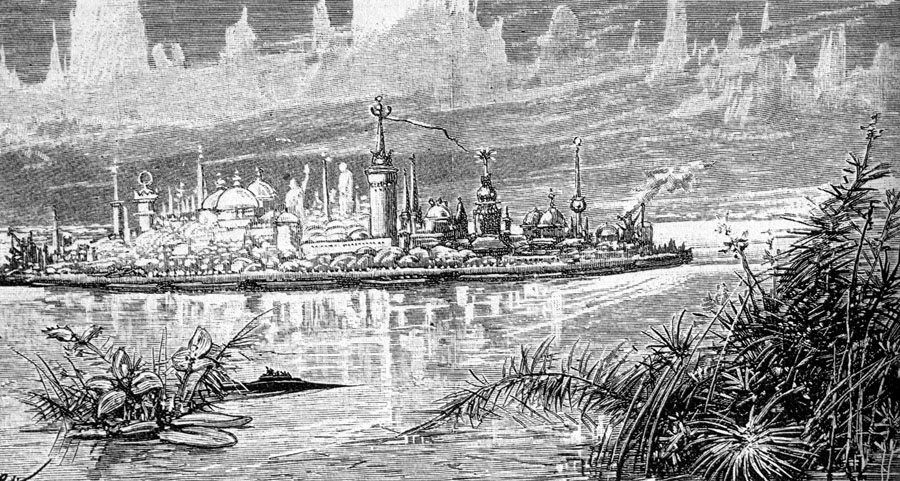
A floating Martian city from Letters from the Planets (1890) by WS Lach-Szyrma. Illustration by Paul Handy.

In honour of the remarkable landing on Mars of the Curiosity Rover, a handful of random illustrations from the vast stock of imagery generated by the Red Planet over the past century-and-a-half. When it comes to Mars I’m afraid you can keep your terraforming and geodesic domes, I prefer the more fanciful scenarios involving air-boats, cloaks and actual canals. Paul Handy’s illustration above shows what I believe is a Venusian vehicle sailing past a Martian city, Lach-Szyrma’s book concerning a journey through the solar system. I only have small copies of these pictures in a book, so far they don’t seem to have turned up online.

mars2.jpg

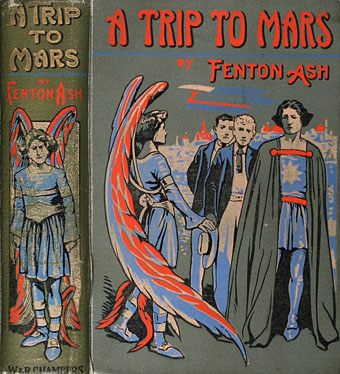
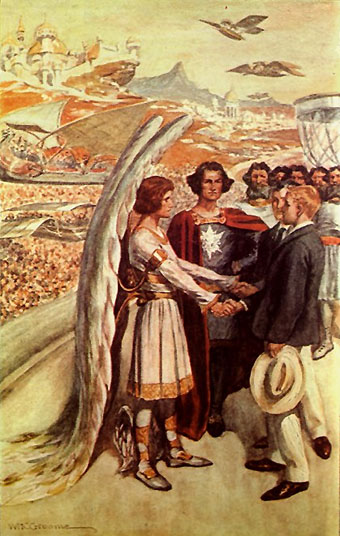
A Trip to Mars (1909) by Fenton Ash. Illustrations by WHC Groome.

Fenton Ash was the nom de plume of British author Francis Henry Atkins. A Trip to Mars concerns another exploratory journey taken this time by a pair of Edwardian schoolboys.

mars1.jpg

Continue reading “A Trip to Mars”