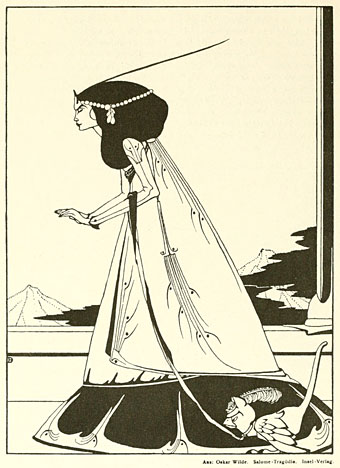
The art of Marcus Behmer, 1879–1958

behmer05.jpg

Salomé: Der Wunsch.

Back in March I wrote something about Alex Koch’s art periodical, Deutsche Kunst und Dekoration, a guide to German arts, crafts and architecture founded in Darmstadt in 1897. The Internet Archive has a nearly complete run of these and I’ve recently been working my way through their scans, a process which takes a while as there’s more than 10,000 pages to be looked at. When I find the time I’ll be posting some of the finds from this wonderful publication, the early issues of which are devoted to the best examples of the Art Nouveau style in Germany and elsewhere.
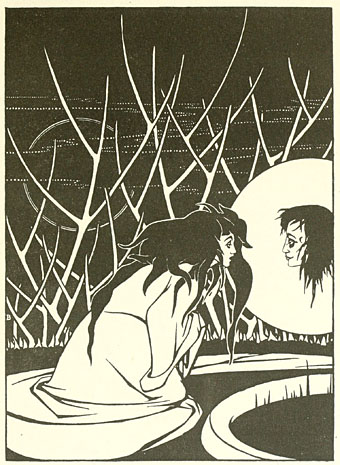
behmer06.jpg

Salomé: Die Erfüllung.

For now, however, I can’t resist posting these pictures from volume 18 (April–Spetember 1906) which form part of a feature about German illustrator Marcus Behmer. I’ve only seen one or two of Behmer’s drawings before and they didn’t really show him at his best. What’s immediately apparent is the great debt his work owed at this point to Aubrey Beardsley, right down to the treatment of foliage and a deliberately grotesque approach to character. It’s also good to find another treatment of the Salomé theme in black-and-white, and the pictures here are credited as being based on Wilde’s play.
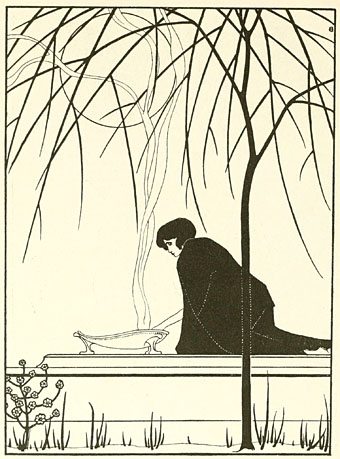
behmer07.jpg

Salomé: Das Opfer.

Wikipedia has a page about the artist but it’s all in German, unfortunately, so a crude translation has to suffice. As with Beardsley, the grotesquerie extended to the sexual sphere and it would be nice to know more about the byways of Behmer’s career if only to see where his curious erotic drawings pieces come from. Wikipedia notes that “Behmer was already since 1903 member in the first homosexual organization of the world in Berlin” so I assume that means he was part of Adolf Brand’s circle, and may have contributed to Brand’s publication Der Eigene. A few examples of the erotic work can be found here and here. Further examples from Deutsche Kunst und Dekoration follow.
Continue reading “The art of Marcus Behmer, 1879–1958”
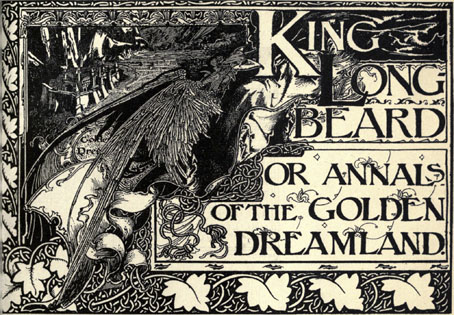
Charles Robinson’s King Longbeard

robinson1.jpg

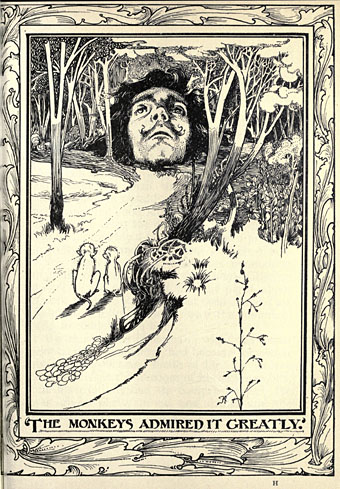
For proof that it’s worth persevering with the eccentric tagging or non-labelling at the Internet Archive, look no further than this tremendous edition of King Longbeard (1898) by Barrington MacGregor which features some astonishing illustrations by Charles Robinson. The illustrator’s name isn’t attached to the book files, I found this by cross-referencing, something I’ve been doing a lot of in order to find other books about design history. I’ve written about Robinson’s work before but I was still taken aback by some of these drawings, a handful of which verge on outright Surrealism. The two monkeys peering at a giant head is one I’ve seen reproduced elsewhere, although I couldn’t say where, so it’s good to be able to find the source at last. I haven’t read through any of the stories so the explanation of that scene remains a mystery. If you want the solution then the book files are here (click the “All files: HTTP” link for the full set).

robinson2.jpg

robinson3.jpg

Continue reading “Charles Robinson’s King Longbeard”

The art of Ephraim Moses Lilien, 1874–1925

lilien1.jpg

Marvellous black-and-white work from a Galician artist whose drawings were predominately concerned with Jewish and Zionist themes. These are from a small monograph about the artist, The New Art of an Ancient People; The Work of Ephraim Mose Lilien (1906) which can be downloaded at the Internet Archive. Elsewhere there’s a page here about the artist with further examples and links, a gallery site with a catalogue of his drawings of Palestine, and some of his illustrations can also be found in back issues of Jugend magazine.

lilien2.jpg

lilien3.jpg

Elsewhere on { feuilleton }
The illustrators archive

Previously on { feuilleton }
Jugend, 1900

Wildeana 3

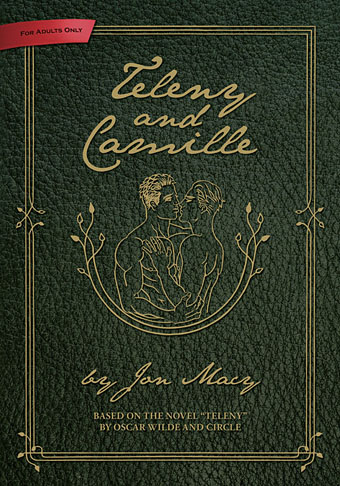
teleny.jpg

Some recent pieces of Wilde news. The cover above is for a new edition of Teleny and Camille, Jon Macy‘s comic strip adaptation of the erotic novel attributed to Oscar Wilde and members of his Uranian circle:

Teleny is the haunted musical genius that everyone desires but no one has truly touched… until the fateful night that he senses Camille’s presence in the audience. The wealthy young man is instantly seduced by Teleny’s dark beauty and smoldering melancholy. This groundbreaking and powerful early gay novel, written in secret by Oscar Wilde and his anonymous circle of writers, is now re-interpreted as a graphic novel, in all its lush, pansexual excess.

I wrote something about the novel last year. I’m not convinced that Wilde penned the whole thing but I can see places where he may have contributed. There’s a marvellous scene in an all-white room, for example, which seems inspired by the obsessive decor in Des Esseintes’ house from À rebours, the novel which had a great influence on Dorian Gray (both book and character). I’d been intending on writing something substantial about Macy’s adaptation all summer but failed dismally due to a deluge of deadlines. Suffice to say it’s a very accomplished and (most important) erotic work, doing full justice to a story that makes many later erotic novels seem timid and evasive. The drawings are black-and-white throughout which gives a Beardsley-like quality in places, and Macy conveys a period feel without fretting over details as I’m afraid I’d be tempted to do. Northwest Press have published the new edition and have a selection of reviews here.

For the other Wildeana, Lambda Literary had a review of a new book by Matthew Hofer and Gary Scharnhorst, Oscar Wilde in America: The Interviews which sounds like another essential purchase. And the Independent had this story about a sale of Wilde letters which included one to a magazine editor that may be read as a proposition. Readers of Neil McKenna’s The Secret Life of Oscar Wilde will be familiar with the form and know that there’s no “maybe” about it; Priapus was calling.

Elsewhere on { feuilleton }
The gay artists archive
The Oscar Wilde archive

The art of Karel de Nerée tot Babberich, 1880–1909

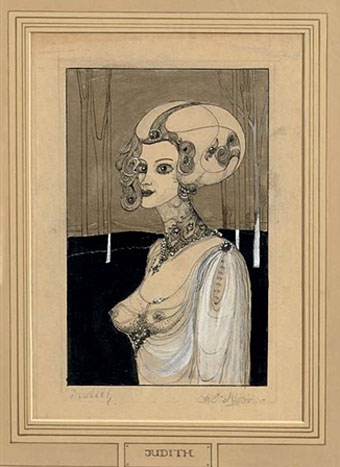
babberich1.jpg

Judith (no date).

Another Decadent type who died young, de Nerée was a Dutch artist and illustrator whose work in these pictures owes a great deal to Aubrey Beardsley. As Beardsley-influenced pieces go they’re rather crude, although it’s unfair to be too judgemental since there’s so little of his work available to see online. Following yesterday’s post, it’s inevitable that he produced a Salomé picture of his own but there’s no sign of that, the curiously space-age (or alien) Judith above is the closest you’ll get.

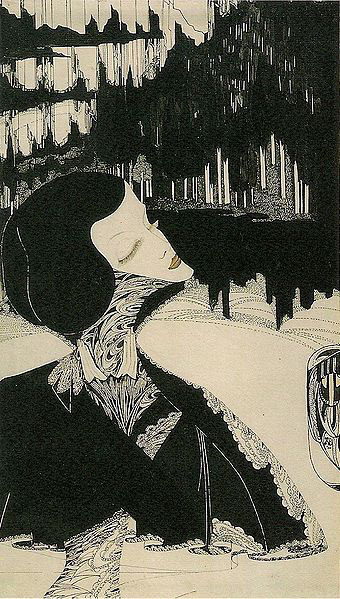
babberich2.jpg

Introduction to Extaze (1900-01).

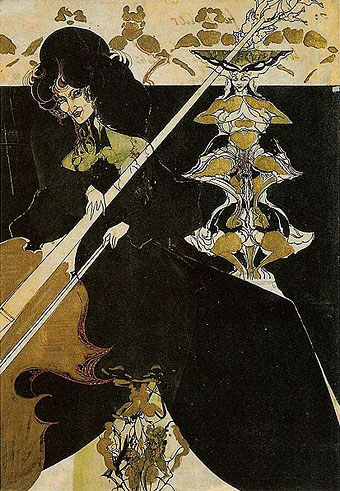
On the strength of these drawings I’d probably have de Nerée down as a post-Beardsley pasticheur similar to Alastair (aka Hans Henning Voigt) but there’s another side to his output evident in his painted works which show a far more assured Symbolist style, with a figurative approach closer to another Dutch artist of the period, Jan Toorop. It’s a shame the photos there are little more than snapshots, I’d like to see more of these. The Wikipedia article has a couple more drawings, and there’s another Beardsley-esque piece here.

babberich3.jpg

La musique (1904).

Elsewhere on { feuilleton }
The illustrator’s archive

Previously on { feuilleton }
More decorated books from the Netherlands