Terror and Magnificence

spitalfields.jpg

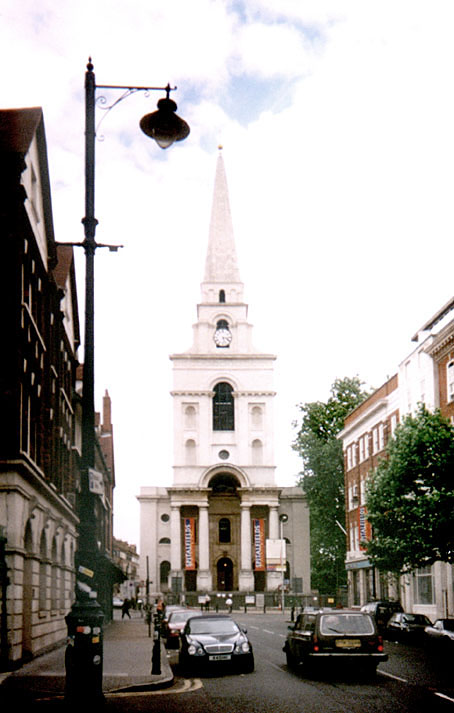
Christ Church, Spitalfields, London, in 2001. A photo I took with a disposable film camera.

And so let us beginne; and, as the Fabrick takes its Shape in front of you, alwaies keep the Structure intirely in Mind as you inscribe it. First, you must measure out or cast the Area in as exact a Manner as can be, and then you must draw the Plot and make the Scale. I have imparted to you the Principles of Terrour and Magnificence, for these you must represent in the due placing of Parts and Ornaments as well as in the Proportion of the several Orders: you see, Walter, how I take my Pen?

Hawksmoor (1985) by Peter Ackroyd

*

Bentley had laid down tracks for a shot that would feature the saxophonist and composer John Harle tooting away at his Terror and Magnificence in the setting of Hawksmoor’s church, which was now established, post-Ackroyd, as a cathedral of baroque speculation. Harle, in the notes published with the CD, writes that “darkness beneath the architecture and the very fabric of the stones pushed the idea towards a text.” The language here harks back to Ackroyd, towards privileged notions of place. The church was, in its proportions, a score to be unravelled; an overweening Pythagorean geometry to be tapped and sounded.

Iain Sinclair in Rodinsky’s Room (1999) by Rachel Lichtenstein & Iain Sinclair

Iain Sinclair first drew the world’s attention (or the minuscule portion of the world that was reading his books) to the strange character of Hawksmoor’s London churches in 1975 with Lud Heat, a book-length poem. Peter Ackroyd a decade later turned Sinclair’s esoteric excavation into a bestselling architectural murder mystery with his novel Hawksmoor, since when Sinclair’s psychogeography (if that term still has any valid currency) has found its way into From Hell by Alan Moore & Eddie Campbell, where Christ Church dominates the proceedings, and a musical work, Terror and Magnificence, by composer John Harle which takes its title from Ackroyd’s novel.

tandm.jpg

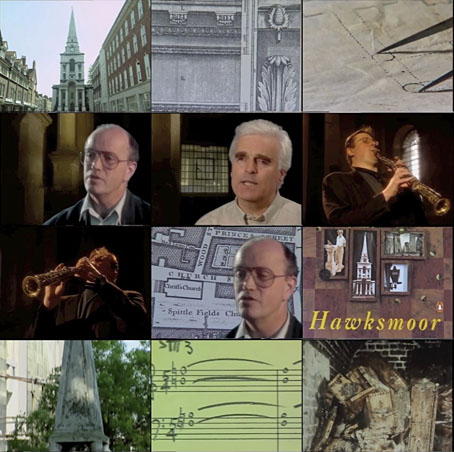
The short BBC film to which Sinclair refers can be seen on Harle’s YouTube channel. In addition to running through the Hawksmoor mythology we receive some glimpses of David Rodinsky’s abandoned room in the Princelet Street synagogue, a location (and a life) explored in detail in Sinclair’s book with artist Rachel Lichtenstein.

Bob Bentley’s film of Harle, Sinclair and Keith Critchlow was broadcast in 1995. In the same year Harle was commissioned by the BBC Proms to write an opera. The resulting work, Angel Magick, with libretto by David Pountney, advertises itself as “the first Dr Dee Opera”, a subject equally of interest to both Sinclair and Alan Moore, who in Sinclair’s Liquid City (1999) take a walk to John Dee’s home at Mortlake. (“We were a thrift-shop Dee and Kelley cupping our ears for whispers from tired stone.”) In that piece Sinclair mentions having been in on the early discussions for the opera but doesn’t go into any detail. I haven’t heard Angel Magick but you can hear a complete performance of Terror and Magnificence by the John Harle Band, the Balanescu Quartet, and the London Voices, here.

Previously on { feuilleton }
Mister Jarman, Mister Moore and Doctor Dee
Compass Road by Iain Sinclair

Weekend links 151

yongliang.jpg

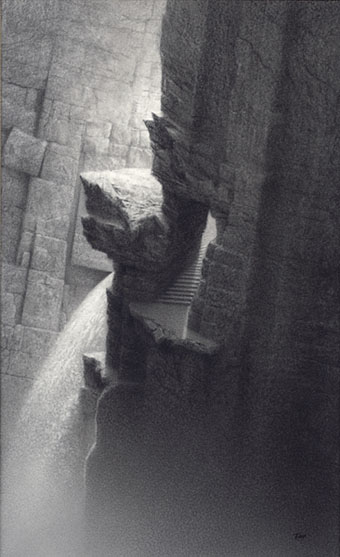
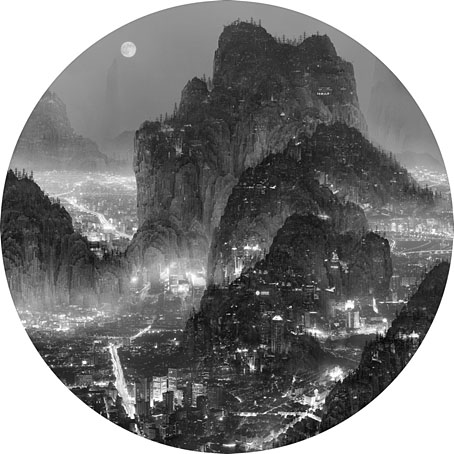
Untitled art by Yang Yongliang. There’s more at But Does It Float.

• “Newly unearthed ITV play could be first ever gay television drama“. Writer Gerald Savory, incidentally, also adapted Dracula for the BBC in 1977, still the version that’s closest to the novel.

Craig Redman and Karl Maier‘s poster designs for the Bavarian State Opera.

Lustmord: ambient’s dark star, and The Strange World of Scanner.

The cats are tapping the old man for psychic sap, milking him, stalking through rubbled dreams of the coming Land of the Dead. On subsequent US visits – to Bastrop in Texas and Phoenix, Arizona – I learned about the fellowship of those internal exiles, the hardcore writers: Michael Moorcock, Jim Sallis. Like Burroughs, they kept cats and guns (Mike’s was a replica). Cats infiltrate mystery fiction: men with coffee habits, ex-drinkers, post-traumatic spooks solving crimes the hard way. Moorcock uses cats like a scarf, like Peter Sellers in The Wrong Box; their claws scratch runes into his easy chair.

Iain Sinclair remembers visiting William Burroughs. I remember meeting those Moorcock moggies; not as interesting to reminisce about, however.

The Ghosts of Antarctica: Abandoned Stations and Huts.

• A Masterpiece of the Ridiculous by Jocelyn Brooke.

• “Chance is a good librarian,” says Alberto Manguel.

• Mix of the week: dub from Bristol duo Zhou.

The Aleph: Infinite Wonder / Infinite Pity.

Sarah Lee‘s underwater photography.

Arthur #34 is out!

Underwater (1979) by Harry Thumann | Underwater Church (1992) by Conrad Schnitzler | Underwater Flowers (2003) by John Foxx & Harold Budd

Wavelength

wavelength1.jpg

Thanks be to YouTube for once more resurrecting moments of underground cinema which would otherwise be very difficult to see. Wavelength (1967) is Michael Snow’s experimental masterwork, a 45-minute zoom across a New York loft that ends on a photograph of waves that fills the screen. This recipe for ennui is not without incident: we see a bookcase being installed, someone plays a Beatles record—Strawberry Fields Forever—a man breaks into the apartment and collapses. (He may be dead but we never find out.) Throughout this, the film is subject to flashes of colour filtering, moments of negative inversion and sudden flares of light. For at least half the running time the sound is replaced by a droning oscillator tone which rises inexorably the closer the camera brings us to its destination.

wavelength2.jpg

Between these events there’s plenty of time to meditate upon the meaning of the title: the various wavelengths of sound and light, the distance across the room to the view of the waves, the waves themselves. It’s a fascinating film which is linked for me (and may have influenced) two other takes on the long take: JG Ballard’s short story The 60 Minute Zoom (1976), in which a man monitors his wife’s infidelity from a hotel balcony, and the celebrated shot at the end of Antonioni’s The Passenger (1975) when Jack Nicholson’s character is assassinated off-screen in another hotel room while the camera floats miraculously through the iron bars of the window. You can see Wavelength in full here. I’d recommend watching it full-screen, it requires immersion.

Previously on { feuilleton }
() by Morgan Fisher
La Région Centrale
Downside Up

Raising the roof

ramases1.jpg

Roger Dean’s album cover art extends further than his sleeve illustrations for Yes. His earlier designs for the Vertigo label showed his visual invention to good effect, and a couple of those designs have had their imitators. The cover art for Dedicated To You, But You Weren’t Listening by the Keith Tippett Group is one that I’ve seen copied although I forget where for the moment so you’ll have to take this on trust. (Ahem.)

ramases2.jpg

The church steeple blasting off from Space Hymns (1971) by Ramases is borrowed somewhat crudely in a 2011 ad for the Wien Museum which shows Vienna’s St Stephen’s cathedral undergoing a similar transformation. The Ramases idea is so eye-catching I’m surprised I’ve not seen it imitated before, although it wasn’t Dean’s invention; in his Views book he says that it was the group’s idea, and they gave him a thorough brief. I presume by this he means that they also wanted the spire as a cover detail, and looking sufficiently rocket-like to give a surprise when the sleeve is opened.

wien.jpg

“Ramases” was Martin Raphael Barrington Frost, an Egypt-obsessed British musician who recorded two albums and a single with wife, “Selket”. The single B-side, Mind’s Eye (1968), is a decent piece of psychedelia that turns up on compilations. The same can’t be said for Space Hymns, unfortunately; the presence of 10cc as backing band isn’t enough to rescue songs whose cosmic titles offer more than they deliver. But that’s still a great sleeve. Thanks to @weird_prophet for the Wien tip!

Elsewhere on { feuilleton }
The album covers archive

Previously on { feuilleton }
Roger Dean: artist and designer

Babel details

babel01.jpg

The Tower of Babel (c. 1563) by Pieter Bruegel the Elder. Kunsthistorisches Museum, Vienna.

Seeing as how I have a fetish for Towers of Babel I ought to have examined this one sooner, the copy at the Google Art Project being one which allows you to explore the surface of the picture in greater detail than the artist himself would have seen unless he was using a magnifying glass. I still find the Art Project interface awkward so the grabs here were taken from a massive jpeg at Wikipedia: 30,000 pixels across, or 243 MB, scaling up to around 1.84 GB in Photoshop which means it’ll make older machines grind in complaint.

babel02.jpg

The detail is astonishing even by Bruegel’s standards. I’d never realised before how much care is given to the individual actions of every single worker on the tower, however small. Bruegel’s close observation of the working habits of the people around him is here reflected in the myriad figures, all of whom are doing something purposeful. At this resolution you’re able to see that the workers have taken their wives and children up the tower with them—there’s the familiar line of washing hung out to dry—while various beasts of burden haul building materials up the spiral roadway. You could spend a long time exploring the details of the tower before even looking at the background where tiny boats are sailing the sea and the rivers, and more fortunate animals have been left to graze in fields.

Wikipedia has several more of these enormous images. It’s a shame there aren’t many more of Bruegel’s works available at this size, his other crowded paintings deserve equal scrutiny.

babel03.jpg

One of the builders on his lunch break.

babel04.jpg

A jug on a window sill.

Continue reading “Babel details”