The art of Nicomi Nix Turner

turner1.jpg

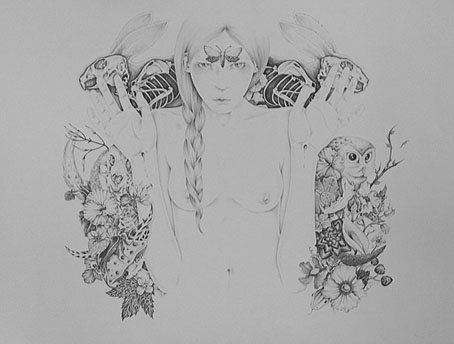
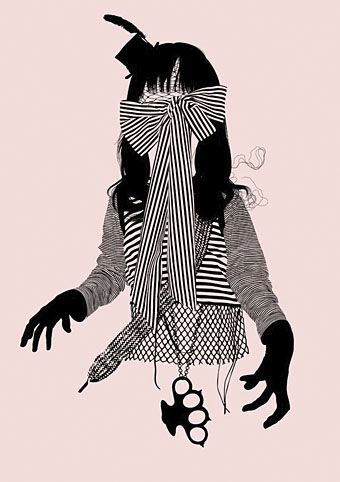
The Shaman.

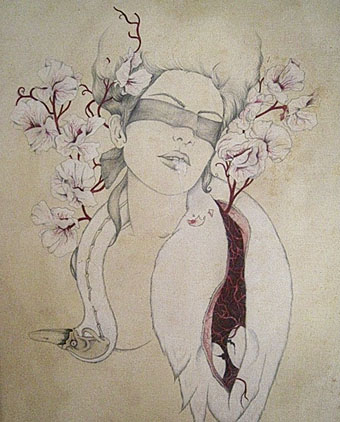
Gorgeous drawings from this American artist, none of which are as innocent as they first appear. Some of my friends with Wunderkammer obsessions will be interested in the three-dimensional constructions detailed on her blog and her Flickr pages.

Via Phantasmaphile.

turner2.jpg

Arsenic.

Previously on { feuilleton }
The art of Juliet Jacobson

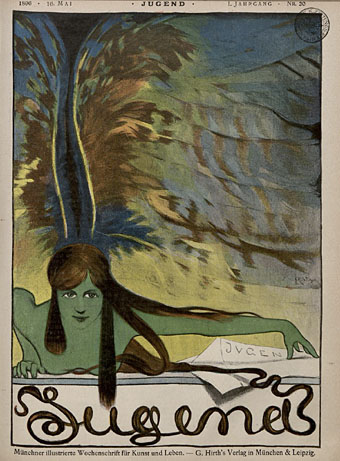
Jugend, 1896

jugend-96-05.jpg

So, then, I’ve now looked through several thousand pages of Jugend magazine and a few things have become apparent. If you’re interested in fin de siècle art and design then all the most interesting material is in the first four years of the magazine’s run, from 1896 on. After 1900 there are still examples of the florid Art Nouveau motifs which filled their earlier pages but the overall style becomes progressively dull, with endless pictures of German towns and hearty country folk. The magazine also begins to reflect an obviously belligerent mood in the country as a whole, pictures of military types and patriotic themes proliferate and the satirical material grows overtly aggressive towards neighbouring nations. Racist cartoons are to be expected—British magazines of the period are much the same—but there’s also a vicious antisemitism boiling away in later issues of Jugend which creates a toxic mix when seen beside the war-mongering on display elsewhere.
jugend-96-01.jpg

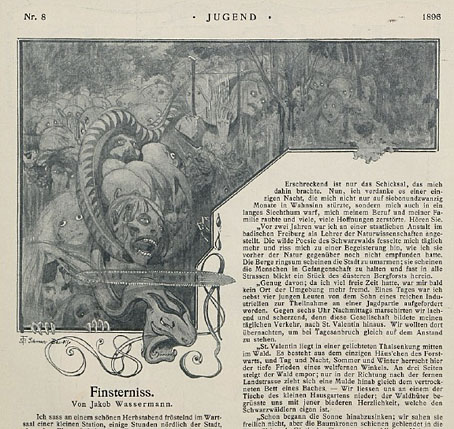
Politics aside, these magazines are still a revelation. Pan magazine was being published at the same time (its entire run is also available in the Heidelberg archives) and is the finer journal if it’s art you’re interested in. But Jugend, being a lighter read, contains a wealth of strange and surprising illustrations. Many are naive or just plain bad, of course, but some are quite remarkable. This is the first of a number of posts I’ll make which highlight illustrations that catch my eye. I’ll also be making some follow-up posts about individual artists as the magazine has been a great introduction to minor illustrators I’ve not come across before. This first post is from the two volumes covering 1896 which can be browsed and downloaded here and here.

Continue reading “Jugend, 1896”
Keim & Czeschka’s Nibelungen

czeschka1.jpg

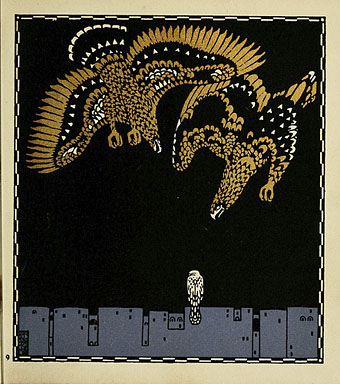
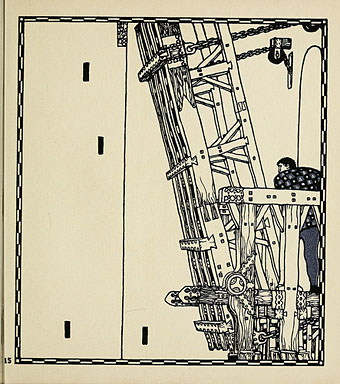
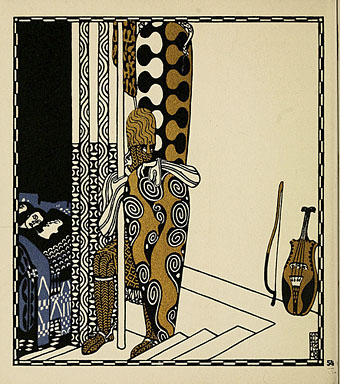
It’s all Art Nouveau again round here while I go through back issues of Jugend preparing a series of posts about the artists and graphics featured in that magazine. Just now, however, I’m too busy to do anything substantial so this will have to suffice, some of the illustrations by Carl Otto Czeschka (1878–1960) for a 1909 adaptation of the Nibelungen Saga by Franz Keim (1840–1918), for which Czeschka utilised the rectilinear style of Art Nouveau popularised by the Wiener Werkstätte.

This small, almost square volume in the popular series of children’s books is rather unassuming in its external appearance, only sporting a small vignette with the title on the cover. Carl Otto Czeschka (1878–1960) was responsible for the complete design of the text to be found inside, and interspersed it with the illustrations characteristic of his work. These reveal his credentials as an outstanding artist of the Secessionist school and the Jugendstil. The eight double-page spreads coloured in clay block technique and rare gold prints, in particular, contributed to the volume’s fame. (More.)

The rest of the pages can be seen on this great Art Nouveau site which has a wealth of material from the period.

czeschka2.jpg

czeschka3.jpg

Elsewhere on { feuilleton }
The illustrators archive