Amy Sacker, book designer

sacker1.jpg

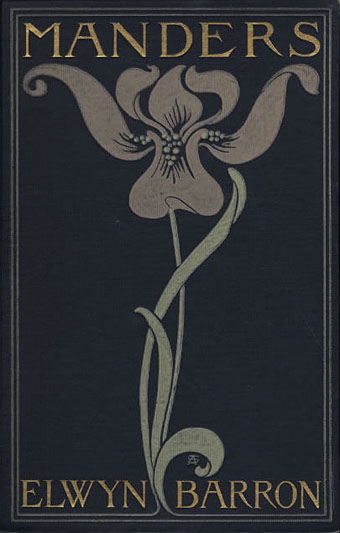
Manders: A Tale of Paris (1899) by Elwyn Barron.

Amy Sacker (1872–1965) was an American book designer, illustrator and bookplate artist, one of a number of female designers and illustrators whose careers began in the last years of the 19th century. I’ve mentioned before how women struggled at this time for acceptance in the male-dominated spheres of painting and sculpture. Those who insisted on pursuing an artistic career were encouraged to concentrate their impulses in the decorative arts with the result that women are a lot more visible in the illustration and design of this period. (See this earlier post about Margaret Armstrong, and these pages at Princeton University Library about women printers, binders and book designers.)

sacker2.jpg

The Kindred of the Wild (1902) by Charles G. D. Roberts.

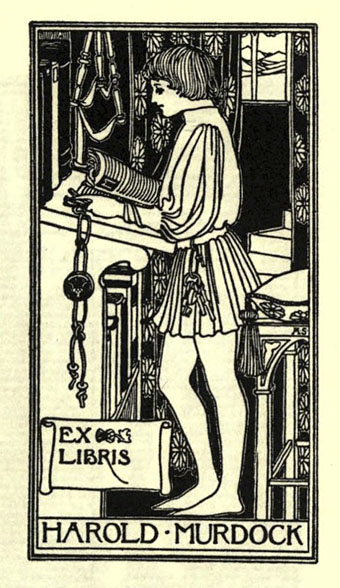
The cover above is from the Amy Sacker website which features information about Ms Sacker’s bookbindings, illustrations and bookplate designs. A recent post here mentioned the Troutsdale Press collection of Amy Sacker bookplates from which the two examples below are taken. These often show people in Renaissance or medieval garb drawn in a style reminiscent of Walter Crane. More of them can be seen at the Internet Archive while the University of North Carolina archive has 120 examples of her cover designs.

sacker3.jpg

sacker4.jpg

Elsewhere on { feuilleton }
The book covers archive

Previously on { feuilleton }
Troutsdale Press bookplates
Margaret Armstrong book designs
Maps of Midtown Manhattan

manhattan1.jpg

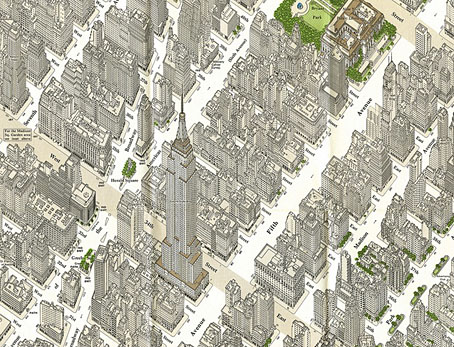
Midtown Manhattan by Constantine A. Anderson.

Yesterday’s link to a Domus article, The importance of being axonometric, features an interview with map and chart collector Michael Stoll whose Flickr account has some wonderful samples from his archives. Among the many city charts there are several maps of New York in various axonometric projections including this example designed by Constantine A. Anderson for the Manhattan Map Corporation in 1985. Anderson’s map is like a modern equivalent of Turgot’s map of Paris, and caught my attention for possibly being the one that comic artist Dave Gibbons used for reference when he was drawing Watchmen in 1986. Gibbons and Watchmen writer Alan Moore mentioned the map in the huge round table discussion I posted here in 2006 (the discussion at this point concerns the story’s recurrent street corner location):

Dave Gibbons: I didn’t actually make a model of it, although when we first conceived it I did draw a streetmap.
Alan Moore: Well, we checked it up on a map of New York.
Fiona Jerome: It’s really there?
DG: It’s a feasible corner—I’ve got a map at home.
Steve Whittaker: I noticed you put Forbidden Planet N.Y. in there at one stage—where they’re selling all the pirate comics.
AM & DG: No, that’s Treasure Island.
DG: Which would, if you had pirate comics, be FP. At home I’ve got this brilliant map they do which is an isometric projection of New York, so not only is it a street map but it’s all the buildings standing up and it’s got all the post boxes and the trees.
AM: It’s lovely, it’s a work of art you can wander round New York in your head.
DG: It’s about this big but… you know the joke about New York people look at it and say “When’s it going to be finished?” It’s the same with this map, it’s never actually finished because as fast as they put buildings in it, other ones are torn down. There are places in it where there’s just a site with a crane or something.
[…]
DG: But that corner, l’m sure that at some time I’ve been to New York I must have walked past that corner. In fact, what I’d really like to do, the next time I go, is actually walk to that junction and see what’s there. On the isometric map there is a fairly new high rise building which could be the Institute for Extra Terrestrials, another building which looks like a cinema to me because it’s got a curved front, and there are some other, lower buildings.
SW: And a fast food chain, perhaps?
DG: That intersection is feasible, right down to the way that the sun rises. This isn’t just down to me. Alan obviously made specific provision for this in his script. The sun actually does rise in the east end sets in the west, and if you look at the thing, if it’s afternoon the shadows are going this way and in the mornings the shadows are going the other way.

I could no doubt have confirmed this by asking DG on Twitter but didn’t want to pester him. Suffice to say there can’t have been many super-detailed axonometric maps of New York being produced at this time. As Gibbons notes, city maps date very quickly: to see a century of change at work compare this equally detailed map from 1879 with Anderson’s views. Stoll has a more recent axonometric map of New York by Tadashi Ishihara but that’s now twelve years old so it’ll also be out-of-date. If we want a close view of New York’s streets today we can simply fire up Google Earth but there’s still something graceless and clunky about the 3D boxes it imposes on the city’s streets. For the moment these views, especially Anderson’s meticulous line renderings, remain hard to beat.

manhattan2.jpg

Previously on { feuilleton }
The Turgot Map of Paris
Watchmen

Weekend links 97

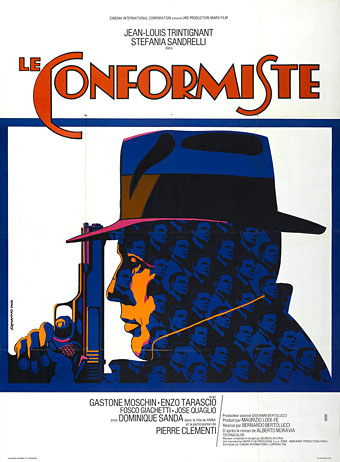
conformist.jpg

Illustration by Ermanno Iaia. Hard to believe that Bernardo Bertolucci’s The Conformist (1970) is only now appearing on DVD in the UK. Arrow Films release a dual-format edition at the end of this month.

• The week in perfume: Perfumes: The Guide by Luca Turin & Tania Sanchez is reviewed by Emily Gould (“this is a golden age of perfume criticism”) and prompts a meditation on the art and process of scent from Rishidev Chaudhuri.

Electrical Banana by Norman Hathaway & Dan Nadel is “the first definitive examination of the international language of psychedelia, focusing on the most important practitioners in their respective fields”.

Sacred Monsters is a forthcoming collection of essays and criticism by Edmund White. Related: Colm Tóibín from 1999 reviewing A History of Gay Literature: The Male Tradition by Gregory Woods.

Medium, a video by Clayton Welham and Sam Williams for Emptyset whose imminent release (also entitled Medium) I’ve designed. Related: Dave Maier on music versus noise.

• Couldn’t happen to a nicer guy: the face of US presidential contender Rick Santorum rendered as a collage of (mostly) gay porn. More provocation: All Dead Mormons Are Now Gay.

• Coilhouse discovered a rough copy of Bells of Atlantis (1952), an experimental film which features Anaïs Nin, input from Len Lye and an electronic score by Louis & Bebe Barron.

• “The idea that we should have but two options when it comes to our gender presentation, male or female, has always felt ludicrous to me,” says LaJohn Joseph.

Bely paints “a universe of strange manifestations” which drifts across Apollonovich’s consciousness every night before he falls asleep. We are even shown congeries of images that are shards of events which took place that day for the senator: “all the earlier inarticulacies, rustlings, crystallographic figures, the golden, chrysanthemum-like stars racing through the darkness on rays that resembled myriapods”

Malcom Forbes on Andrei Bely’s masterwork, Petersburg (1916).

RIP Barney Rosset, publisher of Grove Press books and the Evergreen Review.

The Brothers Quay will be at work in Leeds city centre this May. Lucky Leeds.

Warm Leatherette, a short film by Analogue Solutions.

Cormac McCarthy, Quantum Copy Editor.

The importance of being axonometric.

Always Crashing In The Same Car (1977) by David Bowie | Crash (1980) by Tuxedomoon | Crash Dance (1983) by Yello.

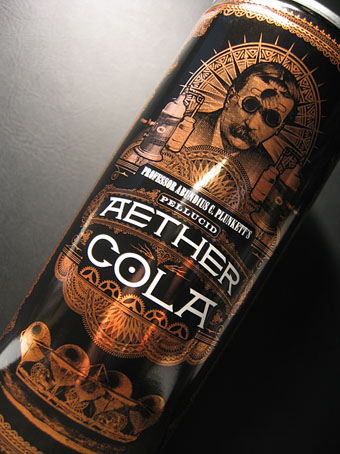
Aether Cola

aethercola.jpg

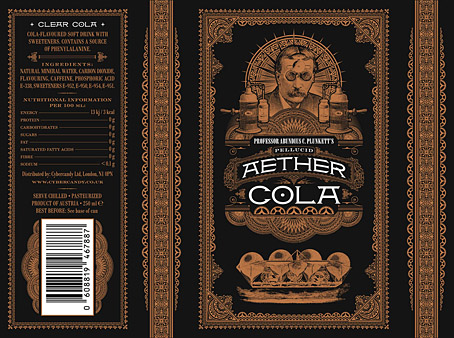
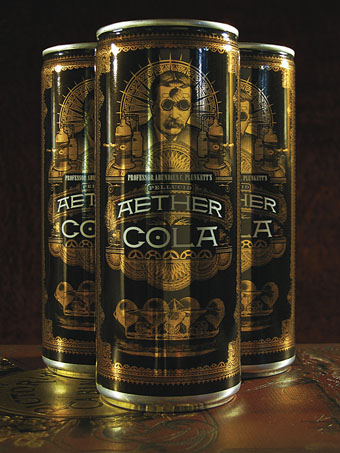
Another piece of work from the end of last year has now been unveiled. The brief this time was from UK company Cybercandy who asked for a steampunk-themed cola can. If this sounds like the mechanical shark has been well-and-truly vaulted then it’s necessary to note that Cybercandy specialise in novelty food products with science fiction (or similar) themes. They also import food products from other countries. The cans are small size (250 ml) for which I chose a bronze/copper metallic ink that looks great on the finished articles. The job made a welcome change from work for books or CDs.

aethercola2.jpg

Aether Cola is available from Cybercandy’s UK outlets. I’m not sure about the availability elsewhere but there’s a dedicated site for the drink here with details of their shops here.

aethercola3.jpg

Previously on { feuilleton }
Crafting steampunk illustrations
SteamPunk Magazine
Morlocks, airships and curious cabinets
The Steampunk Bible
Steampunk Reloaded
Steampunk overloaded!
More Steampunk and the Crawling Chaos
Steampunk Redux
Steampunk framed
Steampunk Horror Shortcuts

The art of Elmgreen and Dragset

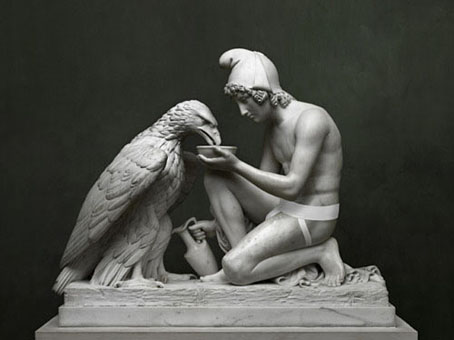
eandd1.jpg

Ganymede (Jockstrap) (2009).

Artist partners Michael Elmgreen and Ingar Dragset—Danish and Norwegian respectively—became better known to the British public this week (well, Londoners anyway…) when their Powerless Structures, Fig 101 was unveiled by Joanna Lumley in Trafalgar Square. The pair’s bronze boy on a rocking horse is their contribution to the series of works that temporarily occupy the square’s Fourth Plinth, a site originally intended to display an equestrian statue of William IV. Elmgreen & Dragset admit that their new piece is slightly camp but also say:

“One thing that is absolutely forbidden in the public realm is to show emotions and be fragile,” Elmgreen says. “That is something we wanted to touch upon in the square, where it’s all about power. The sculpture is not about pop culture issues, or what is in trend at the moment. You step outside the whole thing and try to speak with another voice.”

“It’s beyond that,” says Dragset. “It’s like daring to expose sides of yourself you’re not supposed to show. Like vulnerability. It is often on our minds at the moment. Dare to be uncool!” (more)

eandd2.jpg

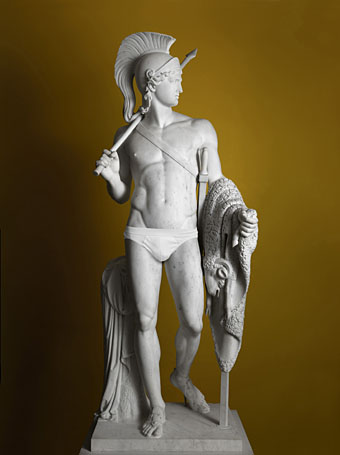
 Jason (Briefs) (2009).

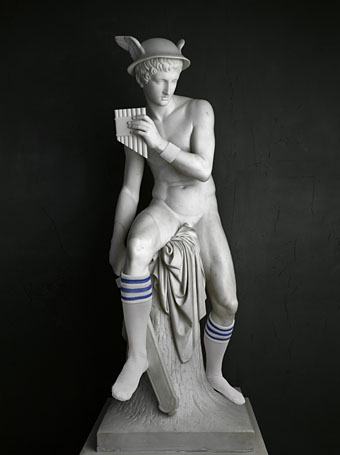
Rather more overtly camp are these photos of additions by the artists’ to statues by Danish sculptor Bertel Thorvaldsen (1770–1844), amendments which lend an erotic frisson to cold marble. The Thorvaldsens Museum in Copenhagen commendably hosted an exhibition of these photo prints last year, and have a page detailing Elmgreen & Dragset’s intentions.

Powerless Structures, Fig 101, will be on display in Trafalgar Square throughout the year.

eandd3.jpg

Mercury (Socks) (2009).

Elsewhere on { feuilleton }
The gay artists archive