Helmets

fmj.jpg

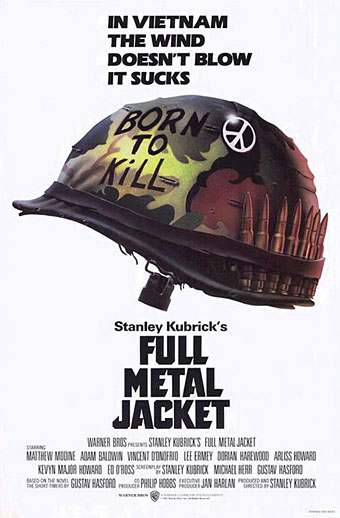
Full metal Jacket poster (1987). Illustration by Philip Castle.

Watching Stanley Kubrick’s Full Metal Jacket on Blu-ray recently I was wondering again whether anyone has noted the similarity between the film’s poster design and the cover for the UK edition of one of its source books, Michael Herr’s Dispatches. At the risk of repeating some common piece of Kubrick lore, here goes.

Airbrush artist Philip Castle painted the helmet that’s become the perennial image used to promote the film. Kubrick often reused the services of people he trusted, and had earlier employed Castle as poster artist for A Clockwork Orange. Kubrick also oversaw the design of publicity materials for his later films so we can be reasonably sure this idea was one of his.
herr.jpg

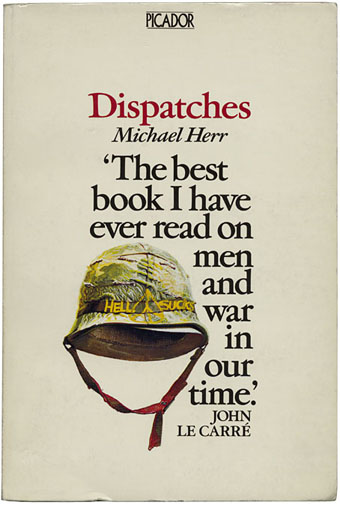
Dispatches (1979). Illustration by Steven Singer.

Michael Herr’s collection of reports about the Vietnam war was first published in the US in 1977 with a UK edition following a year later. The cover of the US first edition is unremarkable compared to this typically excellent Picador design from 1979 (no designer is credited). That year saw the release of Apocalypse Now for which Herr wrote the narration. Kubrick was eager to turn Herr’s book into a film but neither of them could find a suitable story to provide a structure for Herr’s reportage until the director decided to weld Dispatches to the first two thirds of Gustav Hasford’s novel The Short-Timers (1979). Full Metal Jacket mixes episodes and speech/dialogue from both books: Hasford’s sniper attack on a jungle trail gets transplanted to Herr’s description of the fighting in Hue City.
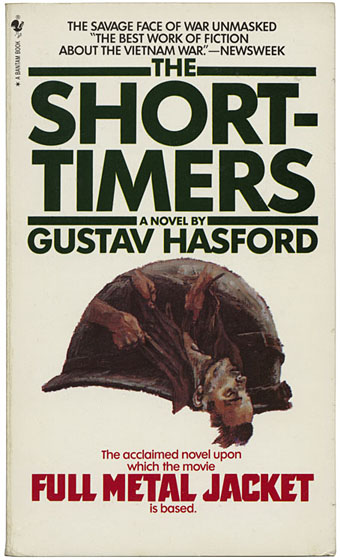
hasford.jpg

The Short-Timers (1987). No illustration credit.

Hasford’s novel was first published in the UK in this shoddy tie-in version with some generic war painting badly cropped into helmet shape in order to match the film poster. Such a good book really deserved better than this hack design. Much as I like Full Metal Jacket, when you read Herr and Hasford you have to admit that the film only captured a fraction of the horror and madness in the books. Herr’s writing is justly celebrated while Hasford’s novel seems to have been forgotten again. Anyone who likes Kubrick’s film ought to search it out, it’s an indelibly memorable and disturbing read. The sniper scene is far more brutal and chilling than its cinematic equivalent, and is delivered by stark prose like this:

The snipers zero in on us. Each shot becomes a word spoken by death. Death is talking to us. Death wants to tell us a funny secret. We may not like death but death likes us. Victor Charlie is hard but he never lies. Guns tell the truth. Guns never say “I’m only kidding.” War is ugly because the truth can be ugly and war is very sincere.

Also worth searching out is Herr’s short memoir, Kubrick, published the year after the director’s death, in which the writer describes his three-year collaboration on Full Metal Jacket‘s screenplay. It’s a generous and insightful piece of writing, worlds away from Frederic Raphael’s condescending and mean-spirited Eyes Wide Open.

Elsewhere on { feuilleton }
The book covers archive

Previously on { feuilleton }
Kubrick shirts

Weekend links 105

klikovac.jpg

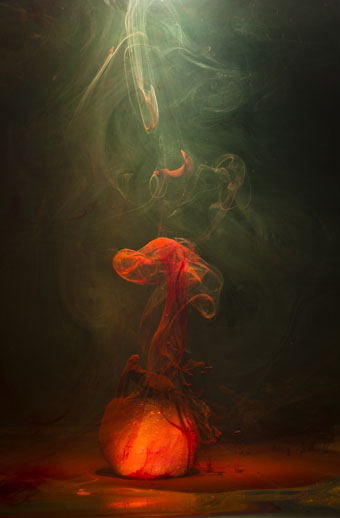
A suspended fluid photograph from Demersal, a series by Luka Klikovac.

• “Soon, Mr. Lachman was writing occult music. His song “(I’m Always Touched by Your) Presence, Dear,” which appeared on Blondie’s 1977 album Plastic Letters, was an example.” Gary Lachman: from Blondie to Swedenborg.

Neil Krug’s cover art for the new Scissor Sisters album, Magic Hour, channels the cloudless skies and photographic surrealism of Storm Thorgerson.

Implicate Explicate, a multiple 16mm film installation by Rose Kallal. Sound by Rose Kallal & Mark Pilkington using modular synthesizers.

Despite conservative queerdom’s best efforts to hide its “otherness” behind a velvet wall of “same as you” Tom and Hank and Jill and Janes, Mattilda and her like will not be ignored. As parades of neo-nuclear same sex families mug for the cameras on courthouse steps, queer body boys parade and flex impossibly taut muscles across our nation’s gym runways and circuit parties, and far, far too many proudly proclaim in knee-jerk defensiveness how “straight-acting” they are across the net, Sycamore blows raspberries at the forced mirage and holds up faded pictures of yesteryear boys and girls whose one claim to fame once was their difference.

Mattilda Bernstein Sycamore is interviewed at Lambda Literary

Paul Oestreicher, an Anglican priest, sets the cat squarely among the pigeons with the question (and answer) “Was Jesus gay? Probably.”

Andromeon, video by Alexander Tucker and Serena Korda for a new song by Alexander Tucker.

• Museums of Melancholy: Iain Sinclair on London’s memorials. An LRB essay from 2005.

FACT mix 325 is by Battles: from Boredoms to Cluster and The Alchemist.

The glass hills of Mars, “a region the size of Europe”.

Labyrinths and clues, an essay by Alan Wall.

The Alchemy of Emptiness.

Drop (1972) by Soft Machine | Drop (2002) by Hope Sandoval & The Warm Inventions | Airdrop (2006) by Kashiwa Daisuke.

David Chestnutt’s psychedelic fairy tales

pretend10.jpg

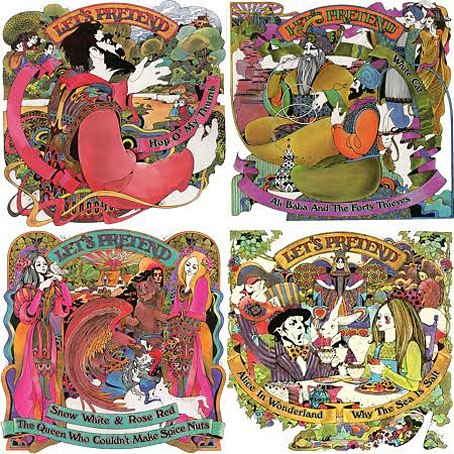
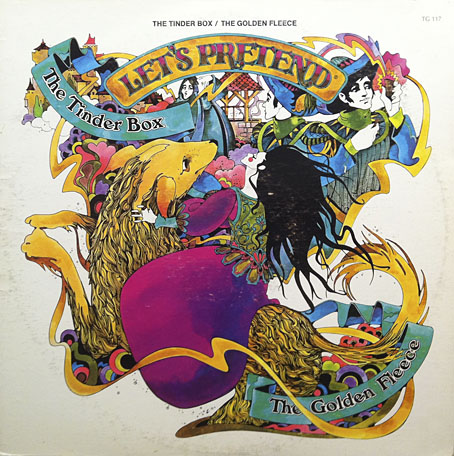
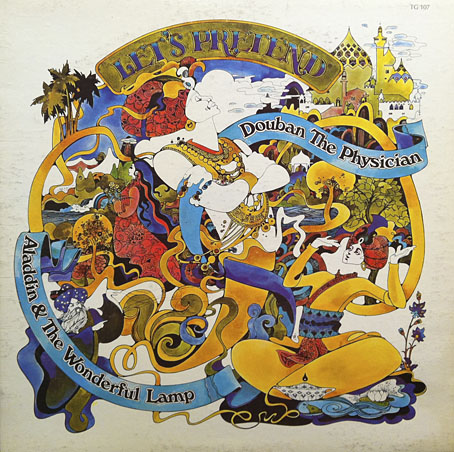
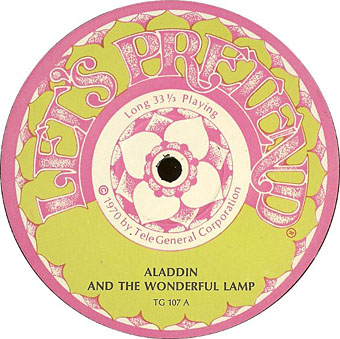
A post for Record Store Day. “Psychedelic” is stretching things here but it’s a word that always grabs the attention. Let’s Pretend was a series of fairy tale recordings released in the US in 1970 on the Stereo Dimension Records label. Each of the 25 recordings employs a radio show format, possibly because these were all radio recordings originally (there’s an older series of Let’s Pretend radio shows at the Internet Archive). Anyone desperate to experience one of them can listen to The Little Mermaid here. The sleeves are all illustrated by David Chestnutt in that post-Heinz Edelmann style that really ought to have a name of its own. Nice to see The Tinderbox turn up again, Chestnutt’s magical hound is a distinctly benevolent creature.

These sleeves were hoovered up from Discogs.com where some of them are only available in small images. If anyone finds a gallery of all 25 designs in decent quality then please leave a comment.

pretend09.jpg

pretend01.jpg

pretend02.jpg

Continue reading “David Chestnutt’s psychedelic fairy tales”

The Lumière Brothers at the Exposition Universelle

paris1900-1.jpg

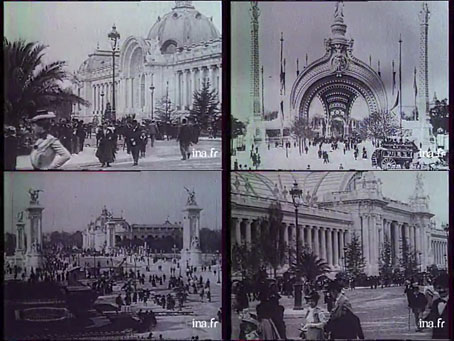
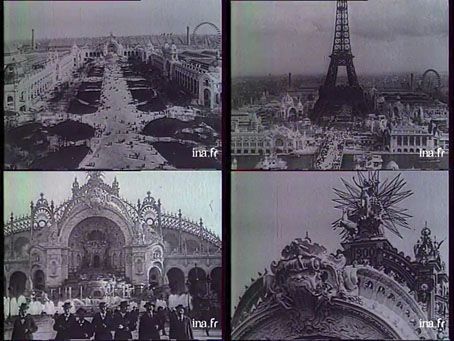
The films shot by the Edison company at the Paris Exposition Universelle of 1900 were featured here a couple of years ago. These screen grabs are from better quality footage made by Edison’s French rivals, Auguste and Louis Lumière, who had the advantage over the Americans in also having their films screened as one of the exposition attractions. The footage is nine minutes from Lumière, a French documentary compiled in 1966 by Marc Allégret, which is hosted here. The clip is still rough but not at all bad compared to the poor quality of online copies of the Edison footage, and it’s mostly projected at a speed so people don’t rush around like Keystone Cops. (On the downside, the audio track has the French speaking clock droning away in the left channel.) Great shots of the pavilions along the Seine, and the escalator. Whatever the quality, these views still strike me as miraculous for the brief impression they give of the exposition as a living event. Oscar Wilde enjoyed his last summer with these teeming crowds. He may be there somewhere among the top hats and parasols.

paris1900-2.jpg

Previously on { feuilleton }
Le Grand Globe Céleste, 1900
Tony Grubhofer’s Exposition Universelle sketches
The Cambodian Pavilion, Paris, 1900
Le Manoir a l’Envers
Suchard at the Exposition Universelle
Esquisses Décoratives by René Binet
Le Palais de l’Optique, 1900
Exposition Universelle films
Exposition jewellery
Exposition Universelle catalogue
Exposition Universelle publications
Exposition cornucopia
Return to the Exposition Universelle
The Palais Lumineux
Louis Bonnier’s exposition dreams
Exposition Universelle, 1900

The art of Léon Bonnat, 1833–1922

bonnat1.jpg

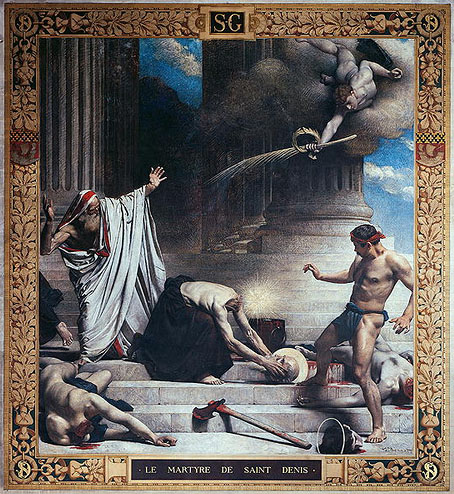
The Martyrdom of St Denis (1885).

Léon Bonnat’s depiction of St Denis reaching for his detached head might be included with St Lucy (always shown with her dish of eyeballs) and St Peter of Verona (seldom without an axe stuck in his skull) in a facetious list of Saints Do The Funniest Things. Bonnat’s gory painting can be found on a wall in the Panthéon in Paris, and is the kind of image I often keep in mind for those moments when someone wants to argue that violent imagery is a very recent thing. Academic painting at the end of the 19th century reached a pitch of photo-realism which demanded that acts of murder be shown with all the relevant blood splashes, hence St Denis and the characteristic excess of Georges Rochegrosse’s Andromaque, painted two years earlier. The 50 Watts Flickr pages have a large monochrome reproduction of Bonnat’s picture.

bonnat2.jpg

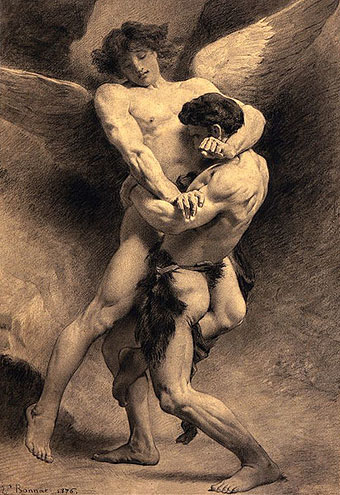
Jacob Wrestling with the Angel (1876).

It was this drawing of Jacob wrestling the angel that set me looking for more of Bonnart’s work. With the exception of a Tarzanesque painting of Samson fighting a lion there isn’t much else like this, a disappointment to those of us who can’t help but notice the Simeon Solomon-like homoerotic quality of the clinch.

Previously on { feuilleton }
Nirvana and The Conquerors