Weekend links 814

dameron.jpg

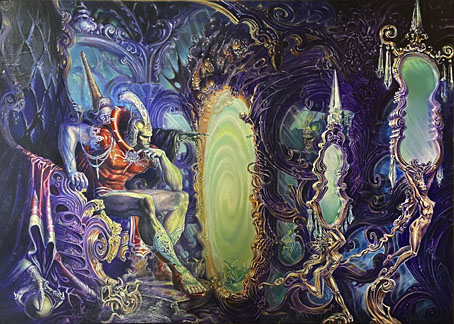
Kull of Atlantis—The Mirrors of Tuzun Thune by Ned Dameron for Kull (1985) by Robert E. Howard. Via.

Jeremy Allen reviews the latest reissue of The New Worlds Fair by Michael Moorcock and The Deep Fix, describing the album as “a fascinating and quixotic document from the time it was made, deserving to be taken seriously in its own right”.

• Among the new titles at Standard Ebooks, the home of free, high-quality, public-domain texts: Short Fiction, a small collection of early stories by Clark Ashton Smith.

• New music: Geometry of Murder: Extra Capsular Extraction Inversions by Earth x Black Noi$e; Live At Nonseq by WNDFRM.

The book is not just loaded with words or tongues. Its also loaded with genres, or more accurately, different modes of literature. And one of the modes I particularly enjoyed this time around is, appropriately, the Weird. In ways long noted on forlorn and unspeakable subreddits, there is a decidedly Lovecraftian dimension to Melville’s Whale, which the Master of Providence did read and enjoy months before writing his game-changing “Call of Cthulhu.” We begin the novel with a sick soul, who may or may not be named after an Old Testament outcast, wandering through a macabre and fetid New England whale-town, following grim portents that lead him on towards a cursed ship doomed to confront a monster who sleeps or at least feeds, and presumably dreams, at the bottom of the sea. And that’s just the first couple of chapters.

Erik Davis on the pleasures of re-reading Moby-Dick, in a piece which makes me want to read the novel again

• At the BFI: Phil Hoad on David Lynch’s efforts to keep making films in an industry resistant to his kind of art.

• Exploration Log 12: Adam Rowe on the best retro science fiction art collections.

• At Public Domain Review: The Nine Birds of Jacques de Fornazeris (1594).

Winners and finalists for the 2025 Ocean Art Contest.

• Mix of the week: A mix for The Wire by Hilary Woods.

The Whale (1977) by Electric Light Orchestra | Don’t Kill The Whale (1978) by Yes | School For Whales (1980) by Marc Barreca
Weekend links 813

bruenchenhein.jpg

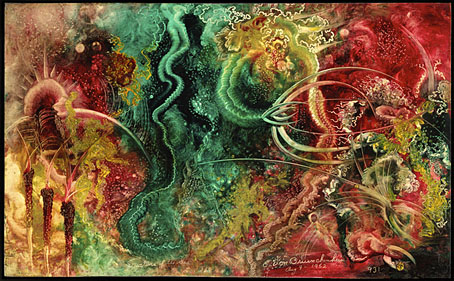
Dwellers of the Sea (1962) by Eugene Von Bruenchenhein.

• Among the new titles at Standard Ebooks, the home of free, high-quality, public-domain texts: Conan Stories by Robert E. Howard.

• At Colossal: “Uncanny personalities appear from nature in Malene Hartmann Rasmussen’s ceramics.”

• New music: Glory Black by Sunn O))); Through Lands Of Ghosts by Foster Neville; Sirenoscape by NIMF.

If we insist that art functions as a tool for promoting a limited set of political principles, what happens when an ideology that doesn’t share our values sweeps into power? Learning to engage with complexity is a necessary skill if we are ever to drag ourselves out of the puerile swamp of the culture wars. But if we continue to reduce art to moralistic soundbites, we will only succeed in stripping it of its capacity to transform us, which would be a huge loss. Art can help us to better understand ourselves, and the world we live in, by expressing those things that words cannot. It exposes us to a vast range of experiences, and asks us to sit with the fundamental ambivalences, moral complexities and conflicting emotions that are a part and parcel of being human.

Rosanna McLaughlin on attempts to make art of the past reflect the moral platitudes of the present

Strange Attractor is having a winter sale with 30% off all its available titles.

• At the BFI: Miriam Balanescu selects 10 great filmmaker biopics.

• Mix of the week: DreamScenes – January 2026 at Ambientblog.

• The Strange World of…Free Jazz & Improvised Music.

Free (1991) by Mazzy Star | The Free Design (1999) by Stereolab | Everything Is Free (2001) by Gillian Welch

Illustrating Hyperborea

hyperborea00.jpg

The Book of Hyperborea (1996). Cover art by Robert H. Knox.

“My Hyperborean tales, it seems to me, with their primordial, prehuman and sometimes premundane background and figures, are the closest to the Cthulhu Mythos, but most of them are written in a vein of grotesque humor that differentiates them vastly.” — Clark Ashton Smith

Since re-reading Clark Ashton Smith’s The Tale of Satampra Zeiros I’ve been revisiting more of Smith’s stories set in the lost world of Hyperborea. And having put together a post some years ago that gathered all the original illustrations for Smith’s Zothique cycle, I thought I’d try and do the same for another of his story series. As I noted in the earlier post, we’re fortunate today that it’s so easy to see illustrations that in the past would have been impossible to find unless you owned (or had access to) a huge collection of pulp magazines. Pulp illustrations aren’t always very good—in the case of the early issues of Weird Tales, they’re frequently amateurish—but those that illustrate new fiction for the first time are historically important if nothing else.

pennington1.jpg

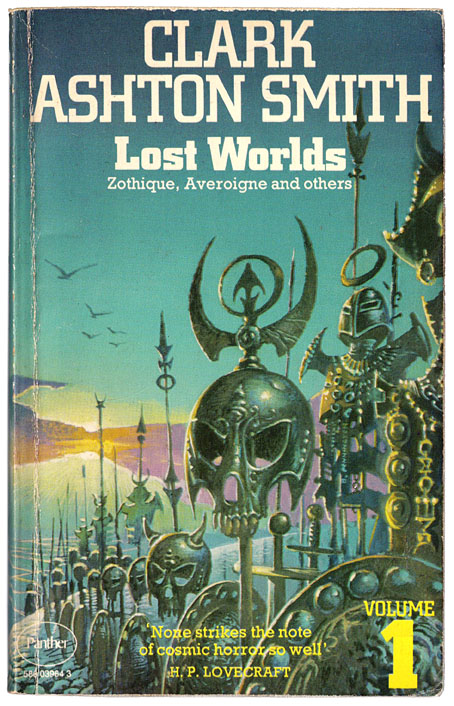
Lost Worlds: Volume 1 (1974). Cover art by Bruce Pennington. Lost Worlds was a single-volume collection published by Arkham House (USA) and Neville Spearman (UK). The Panther paperback covers by Bruce Pennington could easily be used on other books but these were the first Smith volumes I owned.  

The first Hyperborea stories were among Smith’s earliest prose fantasies, owing something to Lord Dunsany on the one hand (HP Lovecraft detected a Dunsanian quality), and the writers of antiquity on the other, the name “Hyperborea” (“Behind the North Wind”) being borrowed from the Greeks. The northern location is about the only feature of the continent that the Greek writers would recognise, Smith’s world being a temperate pre-Ice Age realm of mountains and verdant jungles. Dinosaurs and megafauna share the lands with human inhabitants for whom sorcery is a common practice. As with Zothique, the cycle was an influential one. Lin Carter in the introduction to his Ballantine collection, Hyperborea (1971), suggests that the name of the continent might have prompted Robert E. Howard to set his Conan stories in “the Hyborean Age”. This could be the case: Howard and Smith were writing for the same publications, and the first Conan story was published in Weird Tales shortly after The Tale of Satampra Zeiros; but Howard was also reading the Greeks as well. A more substantial influence may be found in Fritz Leiber’s Nehwon, a world in which aspects of Hyperborea and Zothique are combined. Sword and sorcery begins “behind the North Wind”, in other words, although there’s very little sword-play in Smith’s fiction, that was Leiber and Howard’s department.

pennington2.jpg

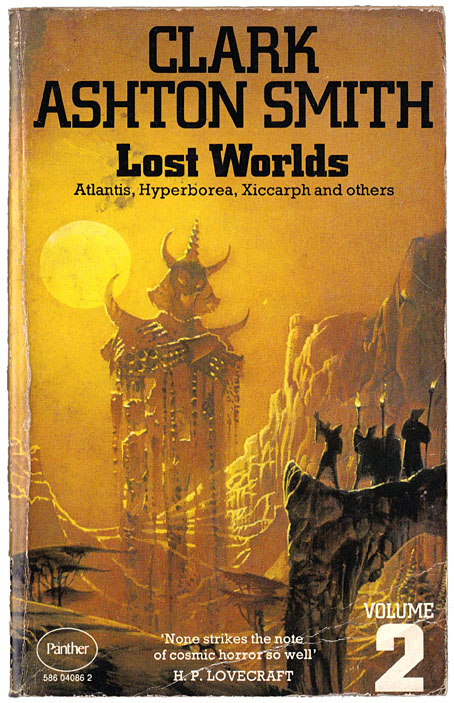
Lost Worlds: Volume 2 (1974). Cover art by Bruce Pennington.

The original Hyperborea illustrations are fewer than those for Zothique. As with the later cycle, several of the stories are unillustrated, while others were given lacklustre artwork. In the earlier post I followed the story order chosen by Lin Carter which attempted to contrive an internal chronology for the cycle. Carter did the same with his Hyperborea collection so I’ve followed his example once again. Later collections, like Will Murray’s Book of Hyperborea, tend to order the stories by publication date.

hyperborea01.jpg

The Seven Geases, Weird Tales, October 1934.

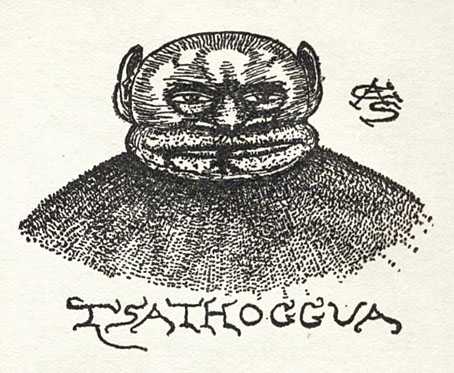
An illustration of Tsathoggua by Smith himself. The toad-god turns up in person in this story.

hyperborea02.jpg

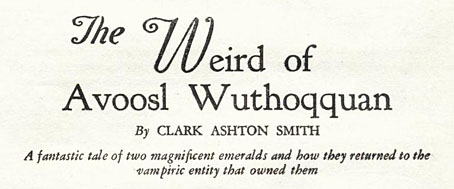
The Weird of Avoosl Wuthoqquan, Weird Tales, June 1932.

Continue reading “Illustrating Hyperborea”

Ray Harryhausen’s swords and sorceries

golden1.jpg

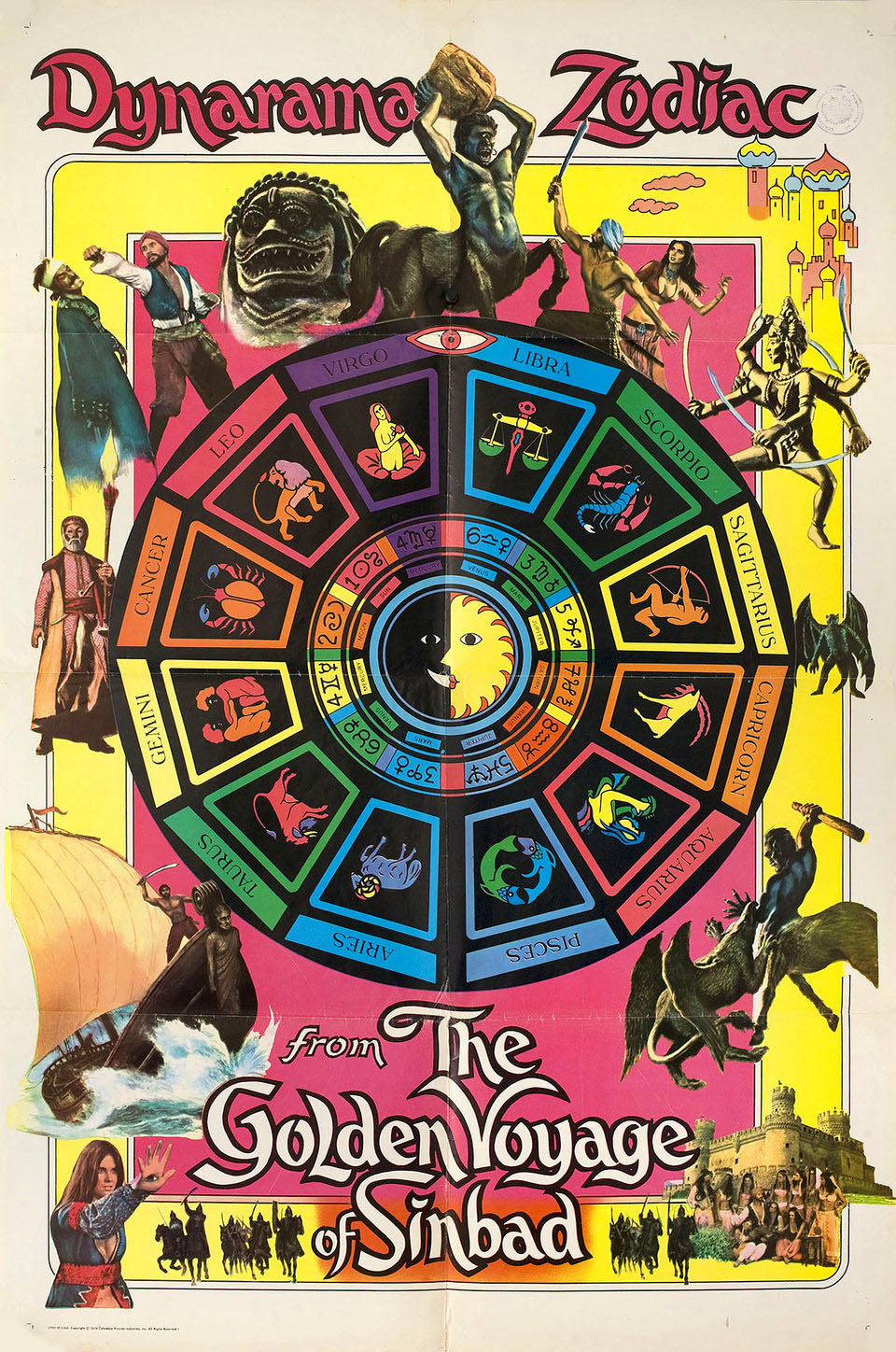
It was the 1970s: promoting Sinbad with a Zodiac poster for the blacklight brigade.

Last month I took advantage of the recent Indicator sale to buy blu-rays of a couple of favourite Ray Harryhausen films, together with Indicator’s reissued box of the three Harryhausen Sinbad features: The 7th Voyage of Sinbad (1958), The Golden Voyage of Sinbad (1973), and Sinbad and the Eye of the Tiger (1977). I’m very familiar with these films but hadn’t seen them for many years. Watching them again made me realise for the first time what perfect examples they are of sword-and-sorcery cinema even though you never see them classed as such. I’ve been reading sword-and-sorcery fiction for almost as long as I’ve been watching Ray Harryhausen films but this rather obvious insight hadn’t occurred to me before, no doubt because I’d always regarded the Sinbad cycle as Arabian Nights fantasies in the manner of The Thief of Bagdad. The 1940 version of the latter happened to be a Harryhausen favourite which prompted his decision to film an Arabian adventure following his monster-on-the-rampage pictures of the 1950s. He subsequently asked The Thief of Bagdad‘s composer, Miklós Rózsa, to score The Golden Voyage when Bernard Herrmann was unable to do so.

seventh.jpg

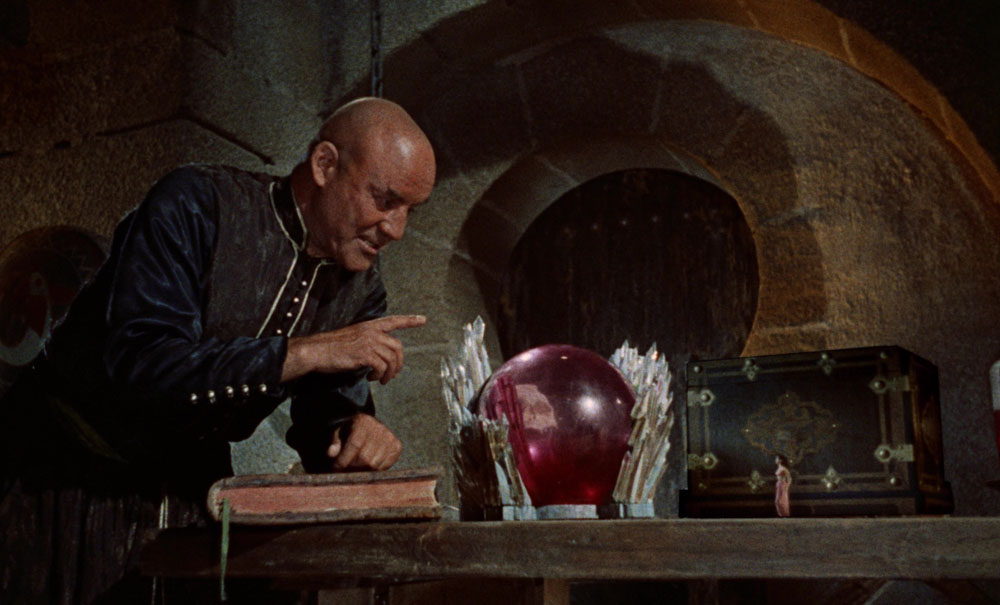
Sokurah (Torin Thatcher) with a shrunken Princess Parisa (Kathryn Grant).

The 7th Voyage is at least based on the original Sinbad tales but the second and third films have little to do with The Arabian Nights beyond Sinbad’s persona and a handful of cultural references. If you swapped the Arabian names for invented ones then you’d be even closer to the stories of Clark Ashton Smith and his colleagues at Weird Tales than the films already are. Smith’s sorcery-infused fiction is the key here even though his stories are light on sword-play. The sight of a shaven-headed Torin Thatcher as Sokurah, the duplicitous magician in The 7th Voyage, was so strongly reminiscent of one of Smith’s many sorcerers—he even looks a little like Virgil Finlay’s depiction of Dwerulas from The Garden of Adompha—that I couldn’t help but watch the films this time as though they were adaptations of Smith’s fantasies. In The 7th Voyage the similarity is most evident in the scene where Sokurah demonstrates his powers to the caliph by temporarily turning a handmaiden into a serpent-woman, and the later scenes in Sokurah’s underground fortress. Smith and his cohorts in the pulp magazines were of course refashioning elements from The Arabian Nights and from other legends so none of this should be surprising. The 7th Voyage may take some of its scenes from The Arabian Nights but the story establishes the template which the sequels follow, with Sinbad pitted against a magic-wielding adversary.

Continue reading “Ray Harryhausen’s swords and sorceries”

The Cthulhu Mythos in the pulps

mythos01.jpg

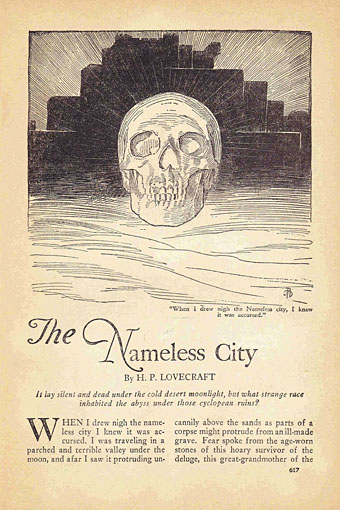
The Nameless City: First published in The Wolverine, November 1921. Reprinted in Weird Tales, November 1928. Illustration by Joseph Doolin.

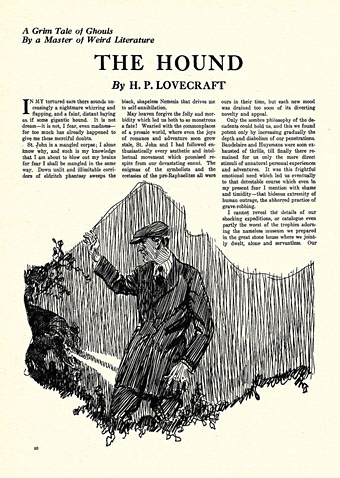
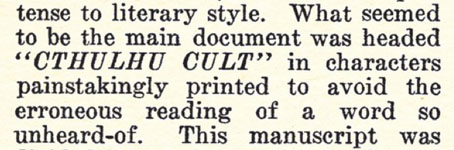
This would have been “The Cthulhu Mythos in Weird Tales” if some of HP Lovecraft’s more substantial stories hadn’t been published elsewhere. To prevent sprawl I’ve limited the list to Lovecraft’s own stories even though the Mythos takes in the work of contemporaries such as Clark Ashton Smith, Robert E. Howard, Frank Belknap Long, Zealia Bishop, August Derleth and others. I like seeing the first appearance in print of familiar tales, and I like seeing their accompanying illustrations even if the drawings are inferior pieces, which they often were for the first decade of Weird Tales. These are the short-story equivalent of first editions, and in the case of The Call of Cthulhu you get to see the first printing anywhere of that mysterious name.

mythos02.jpg

The Hound: Weird Tales, February 1924. Illustration by William Fred Heitman.

This issue is also notable for a story by Burton Peter Thom which shares a title with a Mythos-derived song by Metallica, The Thing That Should Not Be.

mythos03.jpg

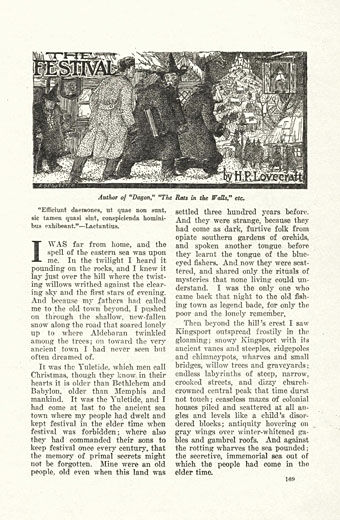
The Festival: Weird Tales, January 1925. Illustration by Andrew Brosnatch.

mythos22.jpg

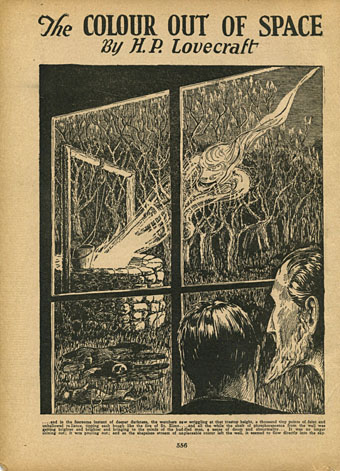
The Colour Out of Space: Amazing Stories, September 1927. Illustration by JM de Aragon.

Lovecraft didn’t think that Weird Tales would appreciate this one even though it’s more horror than science fiction so he sent it to Amazing Stories instead.

mythos04.jpg

mythos26.jpg

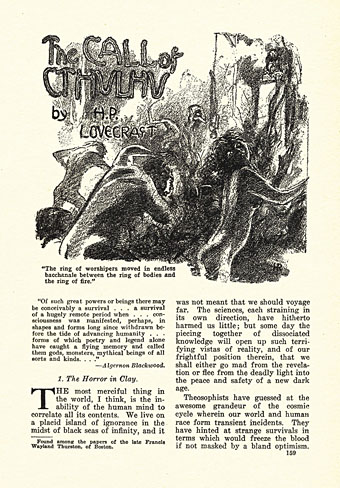
The Call of Cthulhu: Weird Tales, February 1928. Illustration by Hugh Rankin.

It’s doubtful that Rankin, Senf and co. would have been up to the task of depicting Great Cthulhu or the non-Euclidean nightmare of R’lyeh, but this hardly excuses editor Farnsworth Wright’s decision to give the cover to Elliott O’Donnell’s ridiculous ghost table.

Continue reading “The Cthulhu Mythos in the pulps”