An apology for Alan Turing

turing.jpg

Sometimes petitions work. A few weeks ago one such was launched by computer scientist John Graham-Cumming on the UK government website requesting a public apology for the terrible treatment accorded mathematician and wartime codebreaker Alan Turing in 1952. Turing was prosecuted after admitting a gay affair to police investigating another matter and given the choice of imprisonment or parole with chemical castration; in order to carry on working he took the latter choice but subsequent depression led to his suicide. The law used was the same which sent Oscar Wilde to prison in 1895, and Turing’s case was probably the worst treatment of a notable figure on the basis of sexuality since Wilde. During the Second World War Turing had saved countless lives by helping crack the Enigma code, and his early computer research led to the development of machines like the one on which you’re reading these words. In 1999 TIME Magazine put him in a list of the 100 Most Important People of the 20th Century.

Turing has always felt like a local hero to me even though he only lived in Manchester for a few years. The house where he died isn’t far from where I live, and he has a memorial statue (above) in Sackville Park in the city centre, midway between the gay village and the Institute of Science and Technology where he worked. The petition gained a lot of support—30,805 signatures—including endorsement from high-profile figures such as Richard Dawkins and Stephen Fry. I signed it although I was sceptical it would lead to anything; this government doesn’t have much of a record for paying attention to the wishes of its citizens. So colour me surprised now that PM Gordon Brown has issued an apology:

Thousands of people have come together to demand justice for Alan Turing and recognition of the appalling way he was treated. While Turing was dealt with under the law of the time and we can’t put the clock back, his treatment was of course utterly unfair and I am pleased to have the chance to say how deeply sorry I and we all are for what happened to him. Alan and the many thousands of other gay men who were convicted as he was convicted under homophobic laws were treated terribly. Over the years millions more lived in fear of conviction.

I am proud that those days are gone and that in the last 12 years this government has done so much to make life fairer and more equal for our LGBT community. This recognition of Alan’s status as one of Britain’s most famous victims of homophobia is another step towards equality and long overdue. (More.)

I take a consistently dim view of the present administration when it comes to its diminishing of our civil liberties and its involvement in other people’s wars. But when it comes to gay issues, Blair and Brown have been the best Prime Ministers since 1967, when another Labour government overturned the law which killed Wilde and Turing. The best, bar none. This announcement is another plus in that direction.

Previously on { feuilleton }
Stonewall forty years on
Over the rainbow
Forty years of freedom after centuries of injustice
L’Androgyne

seon.jpg

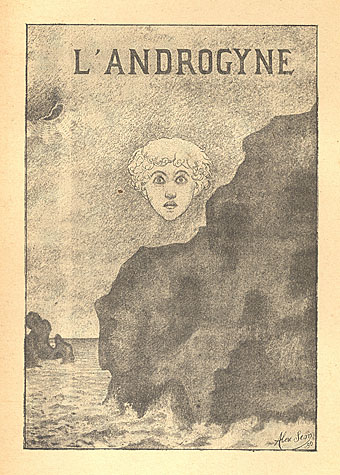
L’Androgyne by Alexandre Séon (1890).

Related to yesterday’s post, I’ve been re-reading various books this week for details of the most curious character associated with the French Symbolist movement, novelist and occultist Joséphin Péladan (1859–1918), also known as Sâr Peladan, a Babylonian title he bestowed upon himself as more befitting his adopted role as Rosicrucian mystic. Péladan’s writings and occult art theories spurred many of the painters who banded together as part of his Salon de la Rose+Croix, a kind of anti-salon intended to stand in opposition to what the Sâr saw as the drab realism of the Impressionists and the staid historicism of academic painters. One gets the impression reading about Péladan that he was probably a rather preposterous figure—his obsession with androgyny caused him to change his forename from Joseph to Joséphin yet he kept his length of bristling beard. But, like Oscar Wilde in London, his presence in the pool of fin de siècle art creates considerable ripples. Alexandre Séon, whose frontispiece above was created for Péladan’s semi-autobiographical essay, L’Androgyne, was particularly devoted to him, as was Carlos Schwabe. Séon’s picture depicts “the androgyne Samas, stupefied by the sexual enigma”, a character with whom Péladan fully identified as he describes his youth and its apparent state of androgynous grace.

mitchenko.jpg

One doesn’t need a Rosicrucian salon today for examples of creative androgyny, of course, all you have to do is go to Flickr where you’ll find creatures such as the boy above from Roman Mitchenko’s photostream. The photos there are at the fashion end of the spectrum; for more of an amateur or semi-professional perspective there are groups like the Androgyny pool, and the Mommy, I want to be androgynous! pool, the latter featuring many striking boyish girls and girlish boys.

Previously on { feuilleton }
Arthur Tress’s Hermaphrodite
Carlos Schwabe’s Fleurs du Mal
Czanara’s Hermaphrodite Angel

Stonewall forty years on

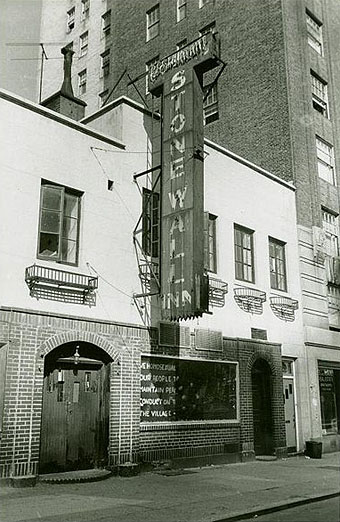
stonewall.jpg

It was forty years ago, on the night of the 27th and morning of the 28th of June, 1969, that patrons of the Stonewall Inn in Greenwich Village rioted after one police raid too many. You can read about it in detail on an unusually thorough (caveat lector) Wikipedia page. Violence, harassment and suspicion is something gay people still have to endure today but in the 1960s things were considerably worse and the riots which began that night marked the point at which gay people in America showed they weren’t going to be pushed around any more. The exact nature of the events is still being argued over but that doesn’t negate their symbolic value. Here in Britain Parliament had grudgingly (and with ridiculous provisos) decriminalised homosexual acts two years earlier but the Stonewall riots have proved a potent enough symbol to lend their name to Britain’s leading gay rights organisation.

Things have improved immeasurably since 1969 but the struggle for basic civil rights continues, whether for marriage equality in many western countries, or for freedom from persecution and execution elsewhere. Martin Luther King said “Let us realize the arc of the moral universe is long but it bends toward justice.” Likewise, Oscar Wilde, given two years’ hard labour under the law which wasn’t abolished until 1967, said upon his release, “Yes, we shall win in the end; but the road will be long and red with monstrous martyrdoms.” Most of the time it can feel like we’ve reached the end of Oscar’s road but that’s only true in a handful of countries. Until the map on this page can be turned a single colour, the end of the road for many people will remain out of sight. But the arc of the moral universe is long. And it bends towards justice.

• The Times: Church ‘out of touch’ as public supports equal rights for homosexuals

Previously on { feuilleton }
Over the rainbow
Forty years of freedom after centuries of injustice

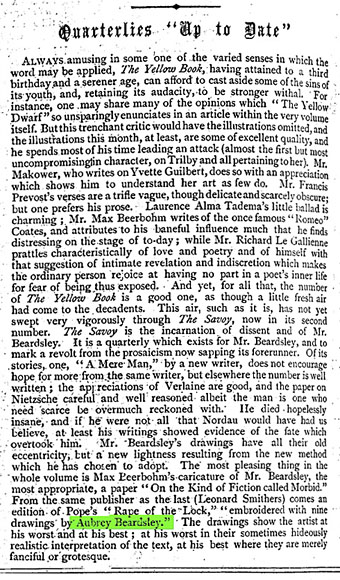
Merely fanciful or grotesque

graphic.jpg

Thus the judgement of a reviewer examining Aubrey Beardsley’s work in The Graphic for May 23, 1896. The work in question was Beardsley’s Rape of the Lock illustrations being unveiled for the first time in the second number of The Savoy, the magazine which Beardsley co-founded with Arthur Symons and Leonard Smithers as a rival to the staid Yellow Book, also reviewed in the same column. Beardsley’s illustrations for Pope are now considered some of his very finest works and it’s difficult from our perspective to find any grotesquery there at all. It may be a reference to The Cave of Spleen, a drawing which saw the brief return of Beardsley’s earlier foetus creatures and a work to which some of Harry Clarke’s style would seem to owe a debt. In which case the reviewer should have been grateful to be spared the giant phalluses of The Lysistrata which Aubrey was also drawing for Smithers at this time.

The column above is one of many mentions of Beardsley and company to be found at the British Library’s new online archive of 19th century British newspapers. What might be a treasure trove is compromised slightly for me by being a collection of newspapers only, rather than magazines. A magazine database would give us all of The Savoy and The Yellow Book, as well as other titles which featured the work of fin de siècle illustrators. Patience is the key here, with every passing year more of the past becomes easily accessible.

So now, given the quantity of references there’s likely to be, dare I search for Oscar Wilde?

Elsewhere on { feuilleton }
The Aubrey Beardsley archive

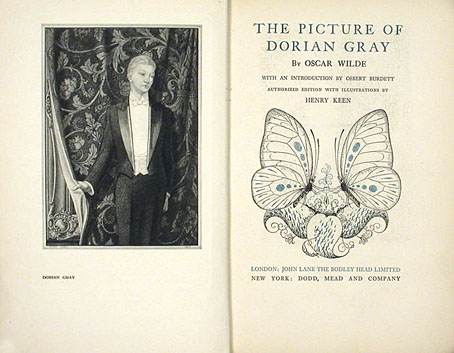
Henry Keen’s Dorian Gray

keen1.jpg

Returning to the golden boy again this week with an illustrated edition of Wilde’s novel from 1925. The publisher was Aubrey Beardsley’s old employer, John Lane, and the illustrator was Henry Keen, an artist of singular and dismaying obscurity. Perhaps some of my knowledgeable commenters can provide more information. Keen’s 12 plates look like lithographs but the book also featured ink embellishments and a splendid sunflower/butterfly design on the boards and slipcase.

Continue reading “Henry Keen’s Dorian Gray”