Two Brides

ansin.jpg

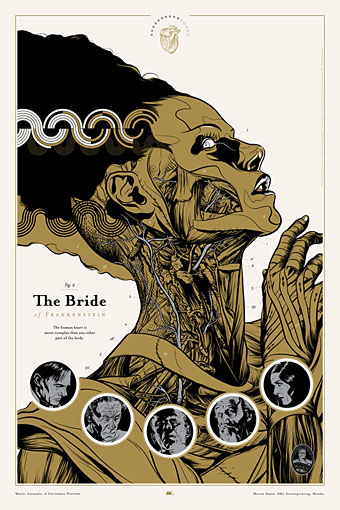
Ah, sweet serendipity… What are the odds, dear reader, of two blogospheric friends posting equally splendid pictures of everyone’s favourite hand-stitched and reanimated woman within days of each other? (It helps that Evan P and Monsieur Thombeau share a number of interests but let’s not spoil the moment.) The Gray’s-like dissection above is the work of illustrator Martin Ansin, while the painting below is by Michelle Mia Araujo, or Mia, as she prefers. Both artists have produced a quantity of other work which demands your attention. As for James Whale’s Bride of Frankenstein, it is, of course, one of the great cultural artefacts of the previous century; if you’ve never seen it there’s a Boris Karloff and Elsa Lanchester-shaped hole in your life which needs to be filled without delay.

mia.jpg

Previously on { feuilleton }
The Mask of Fu Manchu
Berni Wrightson’s Frankenstein

The Mask of Fu Manchu

fumanchu1.jpg

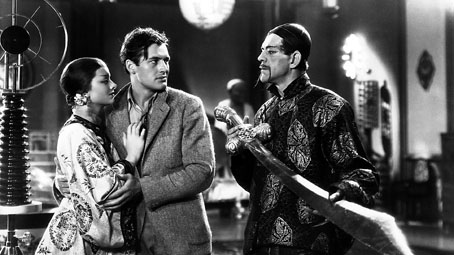
Myrna Loy, Charles Starrett and Boris Karloff.

Los Alamos ranch school where they later made the atom bomb and couldn’t wait to drop it on the yellow peril. The boys are sittin’ on logs and rocks eating some sort of food there’s a stream at the end of a slope. The counsellor was a southerner with a politician’s look about him. He told us stories by the camp fire culled from the racist garbage of the insidious Sax Rohmer. “East is evil, west is good.”

William Burroughs

More pulp, and yes, it’s still racist garbage but Charles Brabin’s 1932 film which stars Boris Karloff as Sax Rohmer’s Oriental super-villain has its pleasures if you look past the severely dated attitudes. Together with The Black Cat (1934), where Boris plays a Satan-worshipping Modernist architect (!), this is one of the best non-Frankenstein Karloff films of the 1930s, as I was reminded this weekend when re-watching it along with several Sherlock Holmes episodes.
fumanchu2.jpg

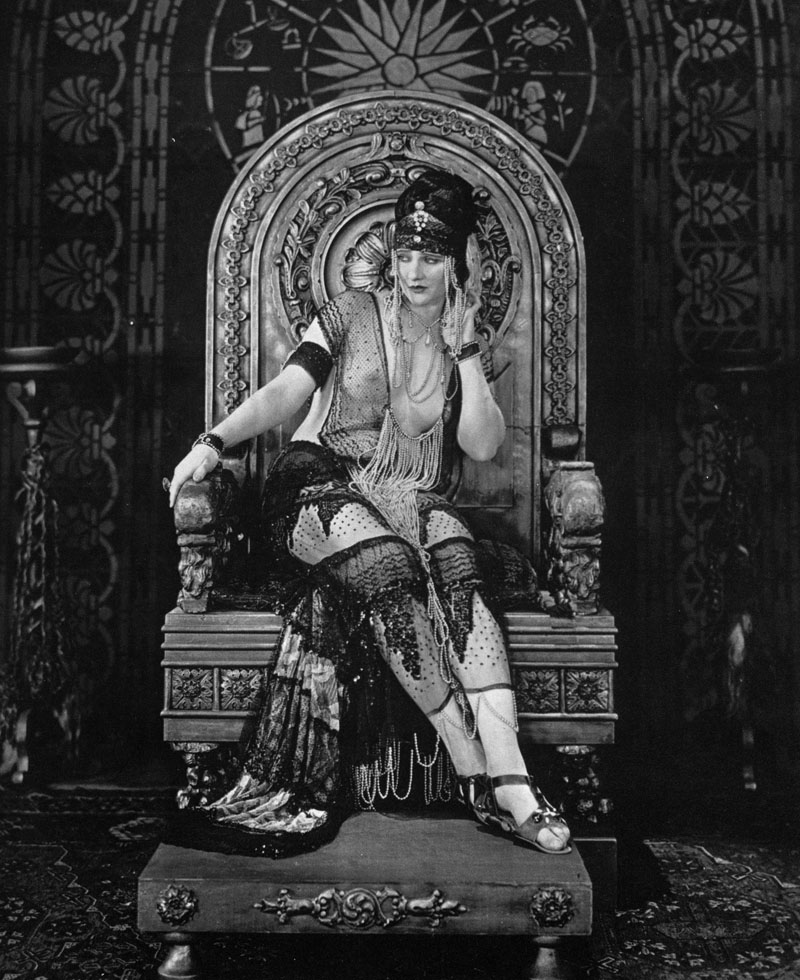
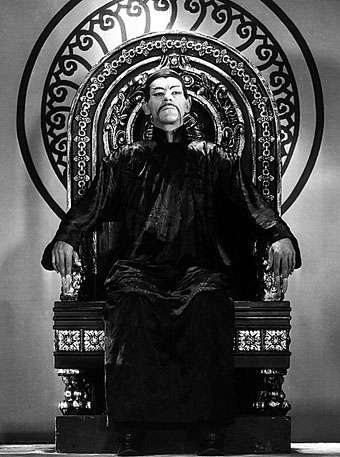
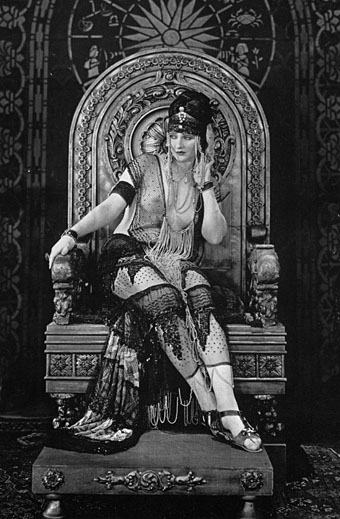
Christopher Lee is elegantly diabolical in the later Fu Manchu films but their cheap budgets force him to skulk around in dismal underground lairs. Karloff’s Doctor has a lavish Art Deco pad whose huge rooms are furnished with a noisy Van de Graaff generator and other scientific apparatus, plus a series of torture rooms where his guests may endure death by encroaching spikes (the “Slim Silver Fingers”), being lowered into an alligator pit, or driven mad by the incessant tolling of a giant bell. I happened to notice that the Doctor’s throne is quite possibly the same one (with a fresh coat of paint) as was used a decade earlier by a notoriously unclad Betty Blythe in The Queen of Sheba (1921), a lavish silent epic which is now unfortunately lost.
sheba.jpg

Betty Blythe as the Queen of Sheba.

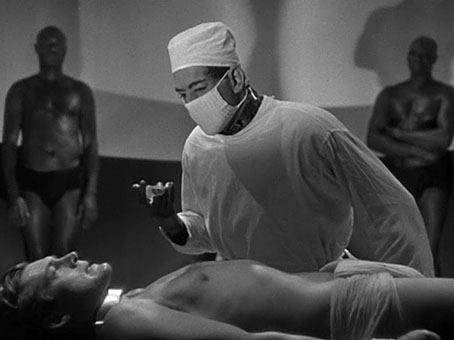
The flaunting of Ms. Blythe’s breasts were one of the many occurrences which led to Hollywood’s adoption of the Hays Code in the 1930s, although the Code’s full effects weren’t felt until later in the decade. The notable scene in The Mask of Fu Manchu where hunk Charles Starrett appears strapped to a table dressed in nothing but a skimpy loin cloth (having previously been thrashed by Fu’s lustful daughter) would have been toned down considerably had the film been made a few years later. All the more reason to watch it today, such scenes only add to the fun.
fumanchu3.jpg

The Doctor prepares to inject his captive with a serum which will turn the man into a compliant slave.

The Mask of Fu Manchu | A page about the original serial, the subsequent novel and its illustrators.

Previously on { feuilleton }
Wladyslaw Benda

Steampunk redux

steampunk2.jpg

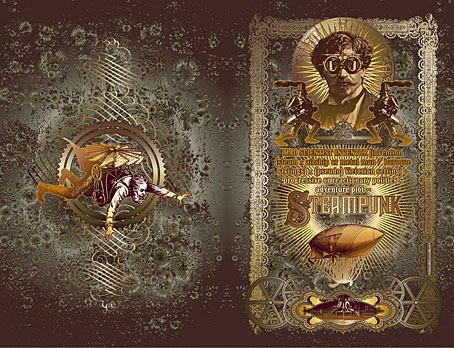
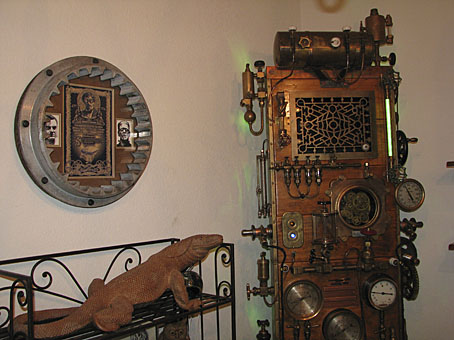
The Steampunk design I created last year for Modofly (based on a formula by writer Jeff VanderMeer) is given a new lease of life with this colour version. Modofly produce decorated Moleskin books with a range of designs from some very talented artists. Previous graphics were laser-etched onto the boards but they’re now able to print in full colour which is obviously to everyone’s advantage. This is available now in two different book formats. And while we’re on the subject, a reminder of Dana Mattock’s incredible Steampunk Frankenstein casemod at Flickr. His photos of my Steampunk print are now posted.

I’m planning more designs for Modofly and would have had some ready now had the past few months not been so hectic. In a similar mode (as it were), I’m also planning some T-shirt designs for Kingstrike. More about these later.

Previously on { feuilleton }
Steampunk framed
Steampunk Horror Shortcuts

Steampunk framed

sp1.jpg

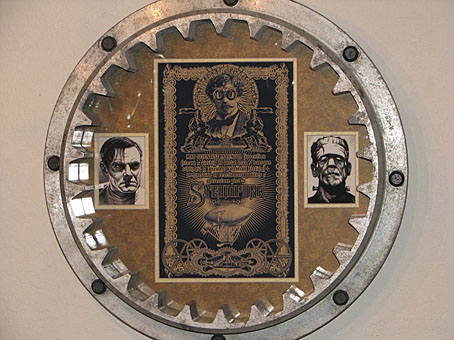
Dana Mattocks wrote to me a month or so ago asking if he could have a print of my Steampunk picture to go in a frame on the wall beside his jaw-dropping Steampunk Frankenstein case-mod. I immediately agreed after seeing his photos. A single picture doesn’t do justice to the amount of work and detailing that’s gone into this project which makes most other steampunk craftings look distinctly lacklustre. See his Flickr pictures for a better look at its wood-and-brass lusciousness. What I didn’t expect was that the frame would be an equally impressive heavy-duty item. And I’m especially pleased to see the picture in there along with Colin Clive and Boris Karloff from the first Universal Frankenstein films. Thanks Dana!

sp2.jpg

I’ve been working on an updated version of the Steampunk pic for something special which I’ll announce here shortly. Meanwhile, if anyone else has one of my pictures in an impressive frame, send me a photo and I’ll feature it here.

Previously on { feuilleton }
Steampunk Horror Shortcuts
Zeppelin vs. Pterodactyls

Berni Wrightson’s Frankenstein

frankenstein1.jpg

A recent conversation with Evan J Peterson touched on the subject of Mary Shelley’s Frankenstein. Evan is currently working on something based on the novel and—in the interests of disclosure—he wrote a very flattering piece about these pages recently. In addition to this, Peter Ackroyd’s latest book works his familiar intertextual games with the same story, placing the monster creator in London where he meets various significant literary types. Andrew Motion reviewed the latter this week and wasn’t impressed.

frankenstein2.jpg

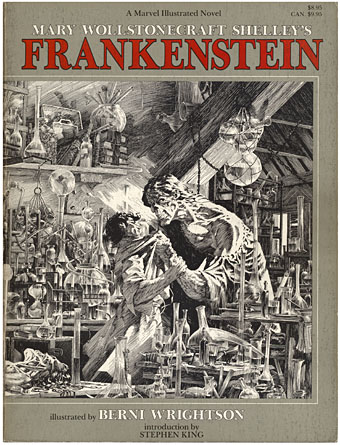
Which preamble brings us to Berni Wrightson’s treatment of the story and a work which was a major inspiration for my HP Lovecraft comics and illustrations. Wrightson’s illustrated edition of Shelley’s complete novel was published in 1983 with an introduction by Stephen King. I’d admired Wrightson’s technique for years but wasn’t always impressed by his subject matter which tended to revolve around the stock selection of favourite American horror characters—vampires, werewolves, zombies and so on—while much of his early art was indebted to the EC horror comics which never interested me at all. Jokey horror has always seemed to me a debased and neutered horror, horror-lite, and yes, that includes plush Cthulhus and the rest of that tat.

frankenstein3.jpg

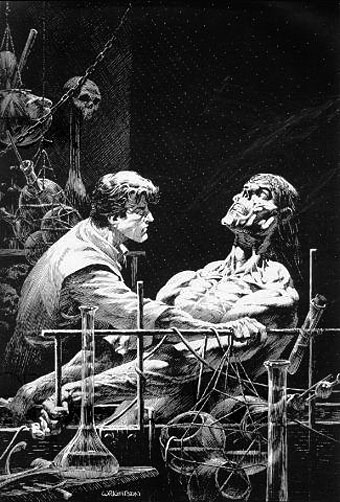
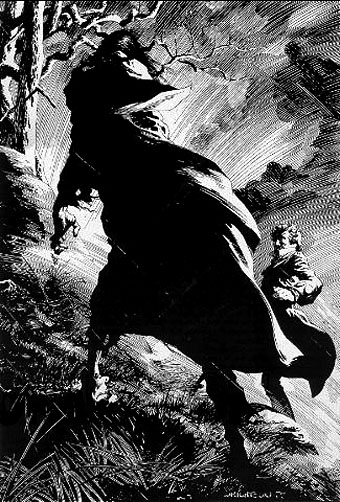
So the immediate attraction of the Frankenstein book was seeing Wrightson take the story back to its origins and treat it seriously. Frankenstein—creator, monster and myth—has been subject to as much degradation as Dracula over the past century which made Wrightson’s approach very welcome. Crucially, it also gave me the key to interpreting Lovecraft visually. It was very evident that his drawings owed a debt to a favourite illustrator of mine, Gustave Doré; two of the pieces were almost straight copies of Doré drawings from The Rime of the Ancient Mariner. In terms of overt influence, Wrightson’s book is dedicated to the great Roy G Krenkel, one of the finest fantasy illustrators of the early 20th century. I wasn’t aware of it at the time but Wrightson’s style here also owes much to American illustrator Franklin Booth (1874–1948), one of Krenkel’s own influences. If the monster in his drawings had a touch of the lumbering EC zombie about its features that was allowable given the other influences at work, and besides, his compositions are perfect. Once I started work on my Lovecraft drawings I quickly found an approach that suited my own obsessions with fine line and detail. But it was Wrightson’s example which pointed the way.

The only problem discussing this is that the copies available on various sites, including Wrightson’s own gallery pages, don’t do the drawings much justice at all. (There’s a large copy of one picture here.) Where the more detailed pieces are concerned you’ll have to try and find a copy of the book. This year is the 25th anniversary of the book’s publication so Dark Horse Comics will be publishing a hard cover edition in October 2008. In addition, Darkwoods Press have announced an “ultimate edition” which will reprint all the artwork (some drawings weren’t used) with quality reproduction. No further information about that, however, and given that they’ve having to source all of the original drawings it may be a while before it appears.

Elsewhere on { feuilleton }
The illustrators archive

Previously on { feuilleton }
Berni Wrightson in The Mist
The monstrous tome
Franklin Booth’s Flying Islands