Weekend links 800

goya.jpg

Plate 43 from Los Caprichos: The sleep of reason produces monsters (El sueño de la razon produce monstruos) (1799) by Francisco Goya.

• At Senses of Cinema: An interview with Jacques Rivette from 2001 in which the director passes judgment on a variety of feature films, old and new. Having read a couple of Cocteau-related books recently, I was pleased to see his comments about the importance of Cocteau’s example for his own film-making. Via MetaFilter.

• “Why is sleep, which literally occurs daily on a planetary scale, so often taken for granted, and not only by most people but even by scientists? Perhaps because its essence, its key property, is to be elusive, out of sight?” A long read by Vladyslav Vyazovskiy on the nature of sleep.

• “Often one cannot be sure if an object in a Welch picture is drawn from life or from other depictions of it, in sculpture, porcelain, woodwork or embroidery.” Alan Hollinghurst on the paintings and drawings of Denton Welch. (Previously.)

• At Colossal: Sinister skies set the scene for derelict buildings in Lee Madgwick’s surreal paintings.

• New music: The Mosaic Of Starlight Slips Back Like The Lid Of An Opening Eye by Paul Schütze.

• At Public Domain Review: Charles le Brun’s Human-Animal Hybrids (1806).

• Mix of the week: DreamScenes – October 2025 at Ambientblog.

• At the BFI: Anton Bitel chooses 10 great French horror films.

Winners of the 2025 Photomicrography Competition.

• RIP Diane Keaton.

Sleep (1981) by This Heat | Sleep (1995) by Paul Schütze | Sleep (2006) by DJ Olive

Weekend links 788

goya.jpg

The Witches’ Flight (1798) by Francisco Goya.

• At Wormwoodiana: Mark Valentine reviews the latest book from Tartarus, a biography of T. Lobsang Rampa by R.B. Russell. You don’t hear much about Rampa today but, as Mark says, old copies of his books have for many years been common sights on the Spiritualism/Occult shelves of British bookshops. Rampa wasn’t a Tibetan monk as he claimed in his first book, The Third Eye, but a very non-Tibetan Englishman, Cyril Henry Hoskin, whose stories about his early years evolved following press investigations into a claim of being possessed by the spirit of a Tibetan doctor named Tuesday Lobsang Rampa. Hoskin maintained the Rampa persona for the rest of his life, writing many more books about the mystic East, as well as accounts of his contact with the planet Venus and his psychic connection with his Siamese cat. The Rampa books were very popular in the 1960s—my mother had three or four of them—despite continual accusations that their author was a fraud.

• New music: The Hadronic Seeress And Other Wyrd Tales by The Wyrding Module; Master Builder by Xeeland; Resurrection Of The Foghorns by Everyday Dust.

• The twelfth installment of Smoky Man’s exploration of The Bumper Book of Magic has been posted (in Italian) at (quasi), and in English at Alan Moore World.

• Rivers of galaxies: Mark Neyrinck on the cosmic web and other metaphors that describe the largest structures in the Universe.

• “Curation becomes subservient to metrics.” Derek Walmsley on how Spotify distorts genre histories.

• At Spoon & Tamago: Erica Ward presents Tokyo as a living, breathing organism.

• At the BFI: Chloe Walker chooses 10 great films by one-time directors.

• At Unquiet Things: How Yuko Shimizu rewires ancient stories.

• Steven Heller’s font of the month is Jana Thork.

• RIP Ozzy Osbourne.

Web Weaver (1974) by Hawkwind | The Web (1985) by Cabaret Voltaire | Web (1992) by Brian Eno

Art on film: The Medusa Touch

medusa1.jpg

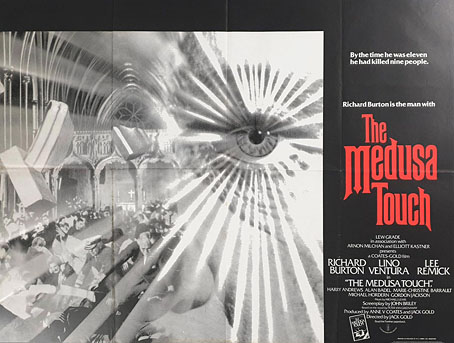
Continuing an occasional series about artworks in feature films. The Medusa Touch (1978) is the kind of film I usually dislike: a supernatural horror story with a preposterous premise—a man who causes disasters to occur with the power of his mind—which is also an ITC production directed by Jack Gold with a TV-friendly gloss, all overlit interiors and zoom-happy camera work. Richard Burton plays the man with a name you only find in horror novels, “John Morlar”, whose telekinetic gift is also a curse, the Medusa touch of the title, although his affliction is never quite described as such. It’s Burton who makes this one worth watching, he burns with a misanthropic intensity in every scene he appears in, delivering his lines with a conviction that suggests he identified rather too much with Morlar and his hatred for the world. The film unfolds as a police procedural, opening with the attempted murder of Morlar by an unknown assailant, then following the investigation that reveals the victim’s history. The police business is the weakest part of the film; being a British/French co-production means that the man leading the investigation, Inspector Brunel, is a Frenchman working in London as part of an exchange programme. Brunel’s dull character is further diminished by having him played by Lino Ventura with a dubbed voice, but it’s the inspector’s quest for clues to Morlar’s past that bring us eventually to the art.
medusa2.jpg

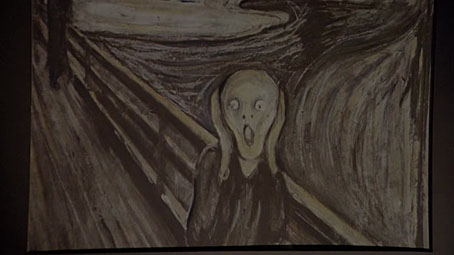
The first artwork, however, appears before all of this. The film opens in the street outside Morlar’s London home then cuts to the inside of his flat with this close view of a print of Edvard Munch’s The Scream. Munch’s most famous painting wasn’t quite the visual cliché in 1978 that it is today. Morlar’s history is recounted in a series of flashbacks which reveal him to have been a barrister whose distaste for the legal profession leads to his becoming a novelist with characters used as mouthpieces for his misanthropy. The art in his mansion flat is scrutinised by Brunel without being subjected to any discussion, leaving us to decide whether these works are the kinds of things that Morlar actually liked or exterior emblems related to his condition.
medusa3.jpg

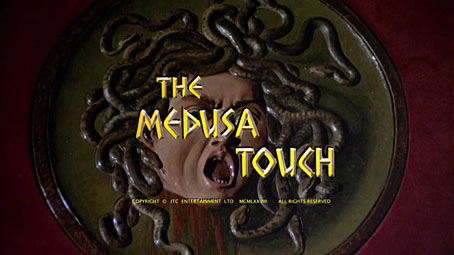
A relief based on Caravaggio’s Medusa (c.1597).

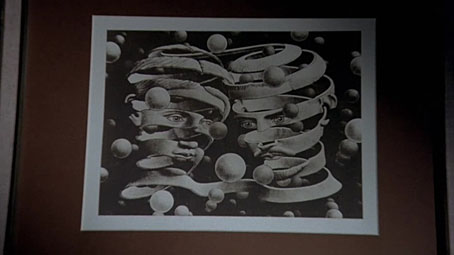
The head of Medusa pinned on Morlar’s wall suggests the latter, although the only introspective comments from Morlar come in the scenes with him and his psychiatrist, Dr Zonfeld (Lee Remick), which are mostly discussions of his calamity-filled life. Morlar and Zonfeld’s combative relationship may explain the next artwork which catches Brunel’s eye, a print of Bond of Union (1956) by MC Escher.
medusa4.jpg

The choice is an unusual one when the print was made to celebrate Escher’s marriage which was relatively happy, unlike Morlar’s disintegrated union which ends with him willing his wife to death in a car crash. Escher was very trendy in the 1970s, collections of his work were being published for the first time and his prints were everywhere. A better match for a story of this type might have been Eye (1946), an image with greater symbolic resonance that would also complement all the moments when Jack Gold’s camera zooms into Morlar’s basilisk glare.
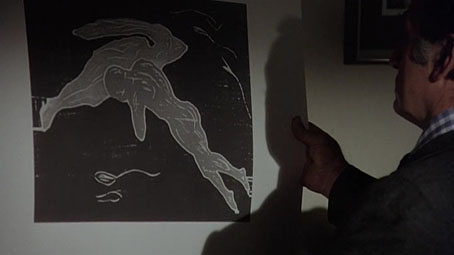
medusa5.jpg

munch.jpg

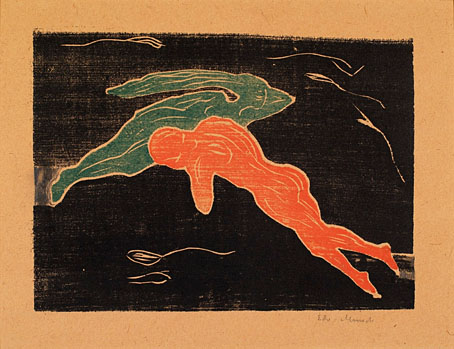
Encounter in Space (1899) by Edvard Munch.

After looking at the Escher, Brunel leafs through Morlar’s print collection, pulling out another Munch, and a very strange choice it is. This is an odd scene: the prints are all badly lit and none of them have much overt reference to either Morlar’s character or the story as a whole.

Continue reading “Art on film: The Medusa Touch”
