Wilfried Sätty: Artist of the occult

satty1.jpg

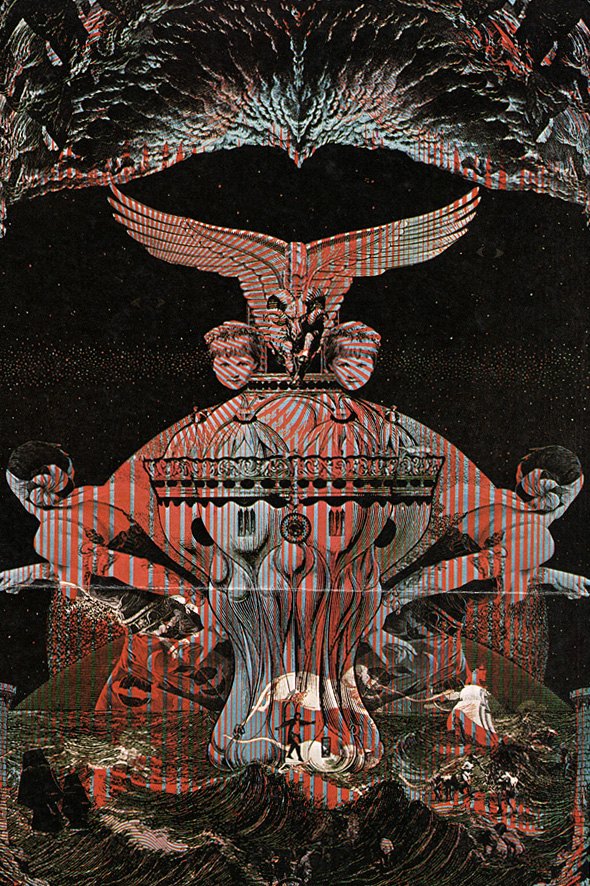
After last week’s post about Wilfried Sätty‘s illustrated Poe, I thought I’d follow it up with this 1970 interview from Man, Myth & Magic, a part-work publication which built weekly into a seven-volume “illustrated encyclopedia of the occult”. In the back of each issue there was a two-page feature, Frontiers of Belief, usually featuring more topical material, and issue 36 had Sätty as its subject. The interview captures him just after he’d been building his reputation as one of San Francisco’s psychedelic poster artists and just before the book collections of his collage work started to appear. The description of his working methods inevitably plays up the occult associations but helps to give a little insight into the artist. The first two pictures here are from the published article to which I added a couple of the album covers he produced in the 1970s. There’s also a poster for an exhibition with friend and fellow artist David Singer whose lettering adorned many of Sätty’s posters.

A note about Sätty’s name: he was known as Wilfried Podriech when he came to America but changed his name to Sätty thereafter. This surname is often reproduced without an umlaut over the “a” which I regard as an error. When Jay Babcock, Richard Pleuger and I visited David Singer to discuss Sätty’s work (and see some of Singer’s own) we were informed that Sätty’s adopted name was intended to be reminiscent of the Egyptian Pharaohonic name Seti. The umlaut over the “a” gives the pronunciation setty; without it would be satty.

*   *   *

ARTIST OF THE OCCULT by Robert W. Neubert

Alchemy can be a state of being according to Sätty, a German-born artist who now lives in San Francisco; and he believes that this concept can be extended to art. In his attempts to plumb the depths of the subconscious he makes use of his collection of occult works, including a 17th century alchemical text and a book of healing and magic published in 1648.

Blue and orange flames flicker from an ancient urn and throw dancing shadows about a dimly-lit subterranean chamber in San Francisco, California. Old, dark-hued tapestries hang from the walls and low ceiling, and occult art objects are crammed into every corner. Baroque harpsichord music filters through the incense-scented air.

Descending a wooden ladder into the nearly black chamber is a tall, lanky man with flowing brown hair, a dark blue Western-styled shirt, and grey flared slacks. He carries under his arm a mystical-looking montage he has recently created and run off on a lithograph press.

The montage is in poster form, and it is a haunting collection of Renaissance and medieval themes, incredible in its intensity, colour and creativity.
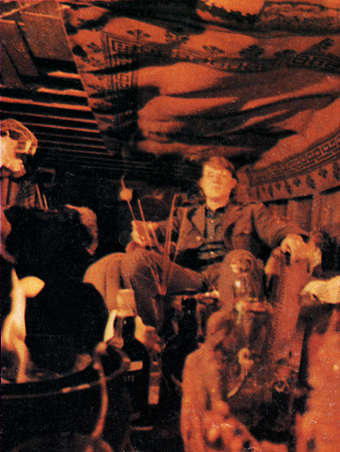
satty_photo.jpg

Sätty photographed for Man, Myth & Magic (1970).

The artist is Sätty, a German-born montage-maker with a dream—a dream of plumbing the depths of the subconscious by utilizing alchemy and mysticism in his work.

Alchemy is essential to his creativity, he says. But the 31-year-old artist’s definition of alchemy has a broader meaning than the classic textbook definition of transmuting base metals into gold. He is one of the first non-commercial poster makers, and his work far transcends the psychedelic art used to advertise San Francisco rock and roll dances.

“Alchemy can be a state of being,” he says. “There is such a thing as visual or intellectual or artistic alchemy. The undeveloped mind may be considered akin to lead, the fully-realized mind as gold. And the same is true of art. Much of contemporary art is lead.”
Continue reading “Wilfried Sätty: Artist of the occult”

Illustrating Poe #4: Wilfried Sätty

satty_poe01

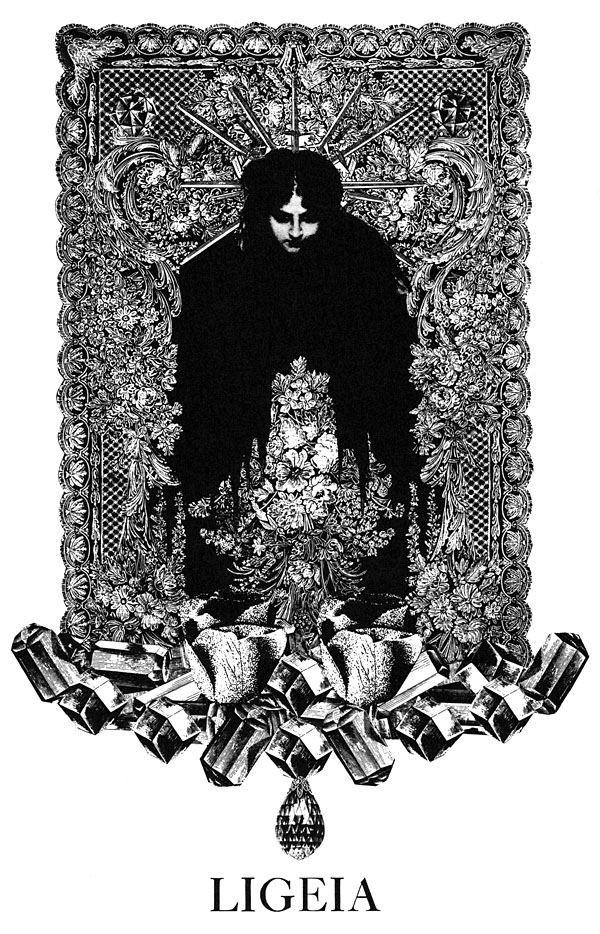
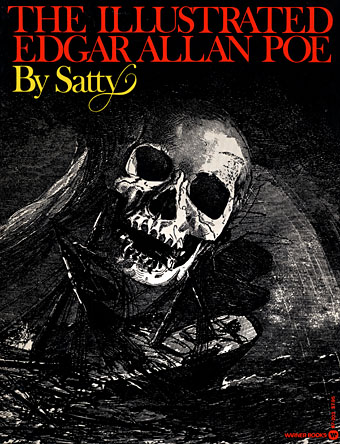
Here it is, the book that began my fascination with the collage art of Wilfried Sätty (1939–1982), a German artist and psychedelic poster designer resident in San Francisco during the 1960s and 1970s. Warner Books published his Poe collection in 1976 and for some reason omit the umlaut from his name even though it’s present in Thomas Albright’s introductory note. I bought my copy in 1979 at a time when I was writing a lot of unsuccessful “experimental” fiction, and the sight of these tremendous collages inspired a surge of writing activity which disregarded Poe’s stories altogether. I’d seen enough of Max Ernst’s engraving collages to know that Sätty was following Ernst’s example but something about Sätty’s work struck me in a manner I couldn’t articulate other than by trying to set down the thoughts they inspired. Personal obsessions aside, I’ve since come to regard this book as the only illustrated Poe which can approach Harry Clarke’s inimitable volume.

satty_poe02

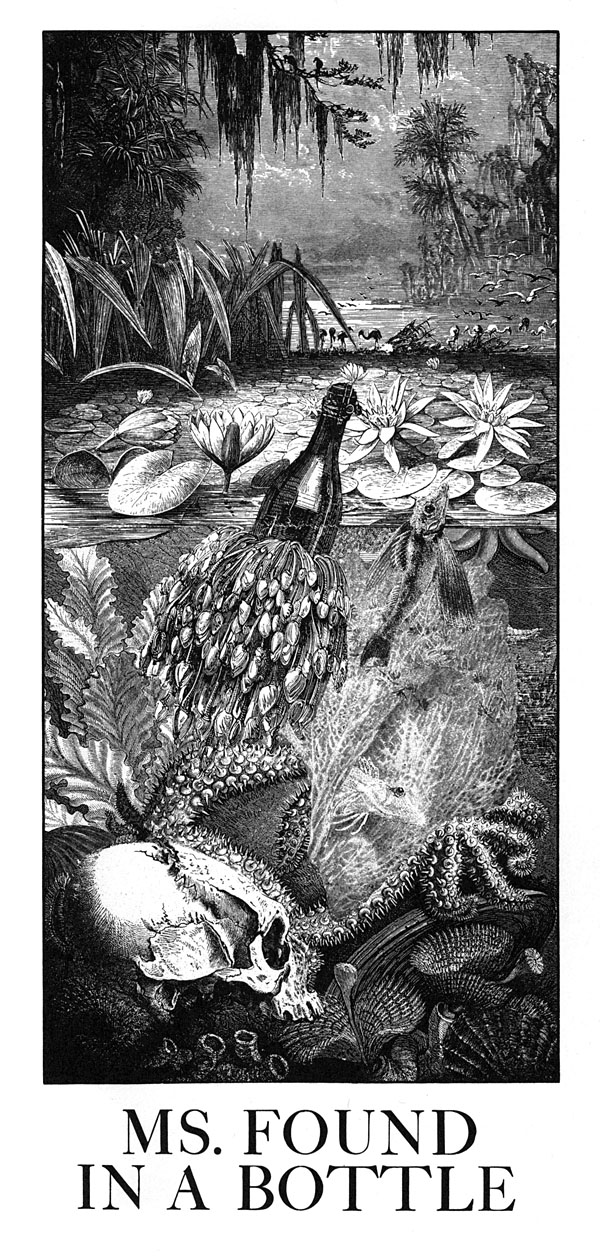
I’m fortunate to own two copies of this edition otherwise I wouldn’t have attempted to scan any pages when doing so involves bending the spine rather badly. The book is profusely illustrated, with many full-page or double-spread illustrations most of which I haven’t tried to reproduce. What you have here are the title pages from nearly all the pieces and a couple of additional illustrations. Sätty’s Poe is still the easiest of his books to find secondhand if you browse the dealer pages at AbeBooks. For more of his incredible work there’s this page at Ephemera Assemblyman, and for details of the artist’s life and career there’s my 2005 essay in Strange Attractor Journal Two.

• Sätty’s illustrations for The Annotated Dracula (1975) at Flickr.

satty_poe03

Continue reading “Illustrating Poe #4: Wilfried Sätty”

Horror! 333 Films to Scare You to Death

horror.jpg

Arriving in the post this week was this 350-page guide to horror cinema, a Carlton Books reprint of the 2006 Andre Deutsch volume to which I contributed some 30-plus reviews and essays on Dracula, Lovecraft and occult cinema. This new printing is slightly expanded although the production is a lot less lavish than the earlier book which was a hardback with colour photos throughout. I suppose this one goes by the TV chair whereas the previous edition deserved a place on the bookshelf. I didn’t have a lot of time earlier this year to help with the updating but I did manage to write reviews of The Mist and Cloverfield, two recent horror outings I enjoyed a great deal. Despite the proliferation of online reviews there’s still a place for handy guides such as this, and I’d say that even if I wasn’t a contributor. Kim Newman is a contributing editor at Sight & Sound magazine, and both he and James Marriott have produced their own excellent guides to horror cinema. When sites like IMDB are weighed down with an opinionated rabble, an intelligent and informed counterweight is essential.

Previously on { feuilleton }
Berni Wrightson in The Mist
Stamps of horror
Horror comics
Hail, horrors! hail, infernal world!

Weekend links 1

penguin_red

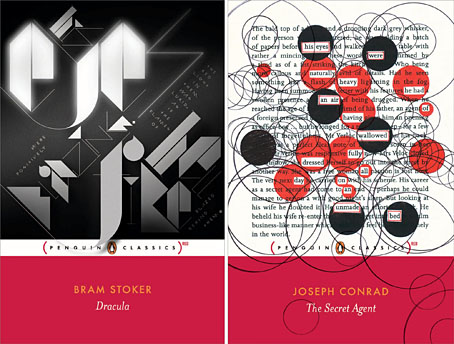
• Two covers from a new range of Penguin reprints for the AIDS awareness fund (RED), all of which are based around quotes from the books in question. Non-Format‘s stylised extract concerns the blazing red of the Count’s eyes while Coralie Bickford-Smith plays some Tom Phillips games with the text of The Secret Agent. The random circles no doubt relate to those which the doomed Stevie Verloc occupies his time in drawing. More at Caustic Cover Critic.

Artspeak? It’s complicated. Jon Canter at The Guardian makes a blazingly obvious point which few in the art world would ever admit: that the specious pronouncements of many galleries and contemporary artists are the worst kind of bullshit.

• I helped judge the Ballardian/Savoy Microfiction competition whose winners were announced last week.

• Designer Jonathan Barnbrook enjoys Neu! and Wendy Carlos.

Nuit Blanche, a short film by Spy Films.

Elsewhere on { feuilleton }
The book covers archive