
Horror in the shadows
| Algernon Blackwood profiled.
Tag: Algernon Blackwood
Wanna see something really scary?
 Xeni Jardin and Boing Boing readers reminisce today about the childhood traumas inspired by Sesame Street characters. Wimps, say I, although in fairness I was too old to be frightened of Muppetry by the time that stuff appeared on British TV screens.
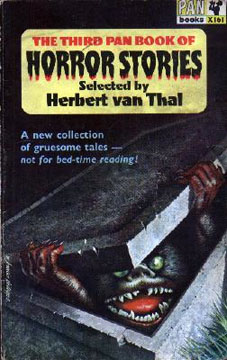
Scariest thing in the Coulthart household, easily out-classing anything on children’s television (Doctor Who monsters included), was the cover of the third Pan Book of Horror Stories. My parents had a small collection of paperbacks from the early Sixties which included some horror and occult fiction. My sister and I found this book one day while rooting in an old suitcase and were both mortified by it. I seem to remember there being dares to go and look at it again and also have vague recollections of at least one nightmare occurring as a result. A shame there isn’t a larger scan available since I’m curious to know who the artist was.
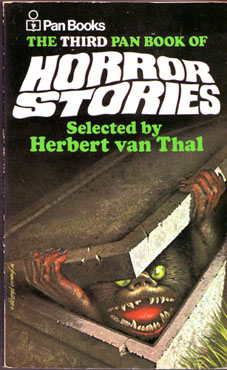 A few years later I was reading the Pan series myself although I never went back to this particular one. Herbert van Thal’s selections got off to a good start, reprinting old horror classics with newer fiction, but soon degenerated into detailed and repetitive tales of dismemberment and blood-letting, the kind of stuff that makes you think “cool” when you’re a teenage boy but which is otherwise worthless. Most of the writers in the later books are unheard of elsewhere which makes me suspect they were probably hacks earning a quick couple of quid writing under pseudonyms. The strangest thing about volume three now is looking at the contents list and seeing that we had stories by William Hope Hodgson and Algernon Blackwood in the house all that time and I never knew it.
Update: The cover artist was W Francis Phillips.
Elsewhere on { feuilleton }
• The book covers archive
Previously on { feuilleton }
• Druillet meets Hodgson
• A playlist for Halloween
• Ghost Box
• Le horreur cosmique
Ghost Box
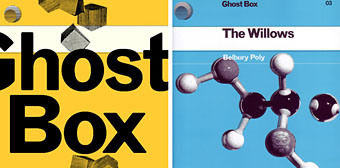
Q: What do you get when you cross analogue synthesizers, samples from obscure public information films, the graphic design of Pelican Books, Arthur Machen, HP Lovecraft, Algernon Blackwood, CS Lewis, Hammer horror, the Wicker Man and the music from Oliver Postgate’s animated films for children?
A: the CD releases by artists on the Ghost Box label. Ghost Box describe themselves as “an independent music label for artists that find inspiration in library music albums, folklore, vintage electronics, and the school music room” which, if you’re familiar with the reference points, is exactly what you get. A rather wonderful blend it is too, some of the tracks on Belbury Poly’s The Willows (named after Algernon Blackwood’s stunning horror tale) are how I expected Stereolab to sound until I heard them and was rather disappointed.
Favourite of the Ghost Box releases I’ve heard to date is (perhaps inevitably) Ourobourindra by Eric Zann (the “artist” here is named after Lovecraft’s haunted musician from The Music of Erich Zann). The website description—”Eric Zann’s radios, oscillators and recordings conjure eldritch, echoing spaces and invoke the voices of the dead that whisper within them”—again is a pretty accurate summation of this atmospheric and sinister audio collage. “Sinister” is a term that can be applied to much of this music and the Ghost Box founders, Julian House and Jim Jupp, declare in a Wire feature this month that matters spectral are of particular concern, hence the label name. Ourobourindra works especially well in this regard, sounding like the product of someone working through a trauma caused by viewing the seance scene from Dracula AD 1972 at too young an age. This is one I’ll be playing on Halloween.
Ghost Box music can be purchased online here.
Elsewhere on { feuilleton }
• The album covers archive
Previously on { feuilleton }
• Penguin book covers
• The music of Igor Wakhévitch
• The music of the Wicker Man
• The Absolute Elsewhere