Voo-doo: Hoochie Coochie and the Creative Spirit

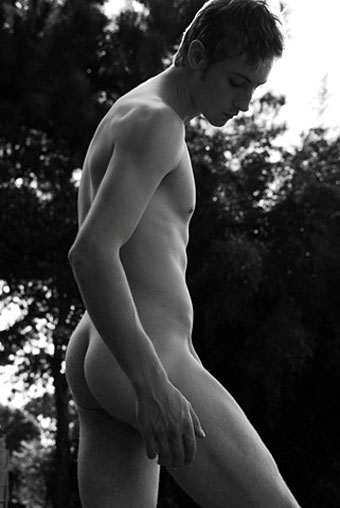
voodoo.jpg

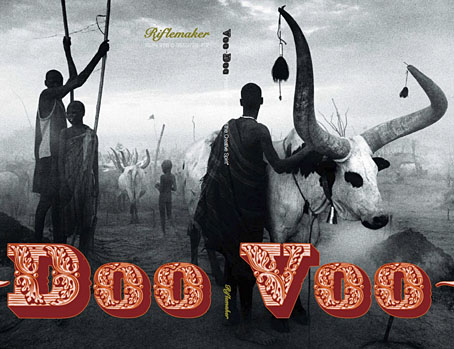
Better late than never mentioning this exhibition which has been running at Riflemaker, 79 Beak Street, London, since mid-January.

The exhibition features those artists, writers and musicians who acknowledge the need to reach a heightened or ‘altered state’ in order to create their work. We look at the mystery of the creative act; not the inexplicable ‘spark’, aka inspiration, but the fire; the non-doing before the doing, the summoning up of elemental spirits from within, or without, during the preparation of some visual or musical work, some theory or idea. This welling-up or ‘possession’, this ‘fever in the heart of man’, this spirit, this spell, might sometimes be referred to as Voodoo.

Among the very varied selection of work the chief attraction for me would be the rare opportunity to see one of Mati Klarwein‘s major paintings, Crucifixion. I referred to this large and detailed picture last year as I was fortunate to be able to use it for the packaging of Jon Hassell’s Maarifa Street CD. And while we’re on the subject of Mr Hassell (who had a track entitled Voodoo Wind on his second album) he has a new CD out on ECM, Last Night the Moon Came Dropping Its Clothes in the Street.

Voo-doo runs until April 4, 2009.

Elsewhere on { feuilleton }
The fantastic art archive

Previously on { feuilleton }
The art of Mati Klarwein, 1932–2002
Exuma: Obeah men and the voodoo groove
Voodoo Macbeth

Le Sacre du Printemps

roerich.jpg

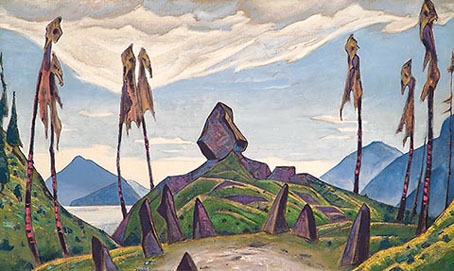
Backdrop for the League of Composers’ production, Philadelphia, 1930.

Something for the vernal equinox. The painting is a stage design by artist, writer and theatre designer Nicholas Roerich (1874–1947) for an American production of Stravinsky’s Rite of Spring. Roerich designed the costumes and decor for the riotous Paris performance of 1913 and the Roerich Museum has a selection of designs for this and subsequent performances. Stravinsky’s fiercely primitive ballet has long been a favourite musical work of mine so it’s especially satisfying when one enthusiasm bleeds into another. I’ve noted before HP Lovecraft’s praise for Roerich’s paintings of whom he wrote in 1937:

There is something in his handling of perspective and atmosphere which to me suggests other dimensions and alien orders of being—or at least, the gateways leading to such. Those fantastic carven stones in lonely upland deserts—those ominous, almost sentient, lines of jagged pinnacles—and above all, those curious cubical edifices clinging to precipitous slopes and edging upward to forbidden needle-like peaks!

Roerich is also mentioned in At the Mountains of Madness and some of his designs for the Rite—which are, after all, backdrops for a ritual sacrifice—might easily serve as a scene of Cthulhoid invocation. Writer Mike Jay has a fascinating piece about the artist which proposes that he should perhaps be given more credit for the origin of the Rite of Spring. He’s not the first to note that it was the stage designer who nurtured a lifelong passion for mysticism and esoteric ritual, not the composer.

Finally, some slightly more contemporary music: Can performing Vernal Equinox for the BBC in 1975.

Previously on { feuilleton }
HP Lovecraft’s favourite artists

Einar Nerman

nerman1.jpg

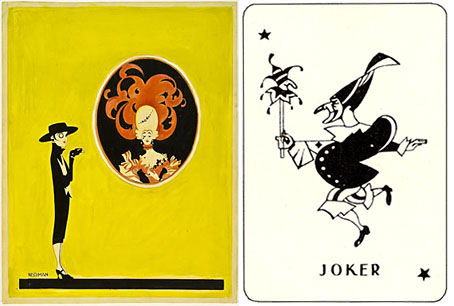
left: No title or date; right: Joker from a playing card set (1924).

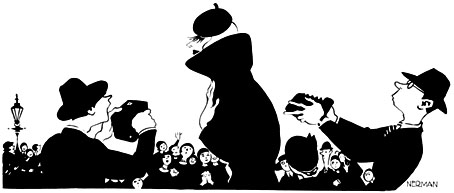
A recent post by Silent-Porn-Star draws my attention to Swedish illustrator and cartoonist Einar Nerman (1888–1983) whose work I don’t recall having come across before. There isn’t much available to see online unfortunately, a shame as SPS’s posting of a 1926 cigarette ad shows a distinct Beardsley influence. Nerman seems known chiefly today for his caricatures of Greta Garbo, one of which was used on a commemorative postage stamp in 2005.

nerman2.jpg

Greta Garbo.

Elsewhere on { feuilleton }
The illustrators archive

Previously on { feuilleton }
Oscar Wilde playing cards
Surrealist cartomancy