Directed by Saul Bass

bass1.jpg

Phase IV (1974).

It’s been a thrill recently poring over the Saul Bass monograph, Saul Bass: A Life in Film & Design by Jennifer Bass & Pat Kirkham, a large volume that weighs a ton and is as revelatory about the career of a great designer (and his wife and frequent collaborator, Elaine Bass) as you’d hope. One pleasure was getting to read about Bass’s film work from his own viewpoint for once. The curious science-fiction film he made in 1974, Phase IV, is well-known enough to have a cult reputation but too often his long involvement with Hollywood is passed over as a footnote to the careers of the directors for whom he worked. In addition to his celebrated title sequences, Bass was also a visual consultant responsible for the planning and filming of what used to be called “special sequences” within films, the most notorious of which is the endlessly argued-over shower scene in Hitchcock’s Psycho (1960). (See this authoritative post by Pat Kirkham on Bass’s special sequences, and the disputed history of those few seconds of black-and-white film.)

bass3.jpg

Phase IV (1974).

All of which sent me to YouTube looking for some of the shorter films that Bass directed from the mid-60s on. The monograph explores these and Phase IV in some detail, for the latter showing pages of sketches for unfilmed sequences. I’m not sure these would have improved a film which I find flawed and occasionally ludicrous but it’s good to see what the director had in mind. The film on DVD has no extras at all but a trailer can be found on YouTube that shows off some of the startling imagery, and also includes a few shots that were cut by distributors foolishly eager to try and sell it as a horror film. It’s ironic that a man who gained world recognition for his poster designs wasn’t allowed to design the poster for his own film.

bass2.jpg

Quest (1984).

Of the short works there’s Why Man Creates (1968) here and here, an examination of the creative impulse that’s been so popular with art teachers over the years that it’s probably been seen by a lot more people than his marauding ants. Both this and The Solar Film (1980), a documentary about solar energy, utilise Bass’s hand-drawn animation. The latter is also of note for its final shot of a baby walking into a sunset, a still of which was turned by Bass into an album cover for Stomu Yamashta in 1984. Also that year, Saul and Elaine produced their strangest work, Quest, a half-hour piece of science fiction based on a Ray Bradbury short story whose quest theme is overly-familiar from a dramatic point-of-view but which typically yields a wealth of memorable visuals. In Phase IV there was a nod to Dalí with the dead man’s hand filled with burrowing ants; in Quest we find imagery borrowed from Magritte (a floating castle-topped mountain) and MC Escher (his Cubic Space Division). The copy on YouTube is rough quality but it’s certainly worth a watch. I’m amused to discover how much Saul & Elaine were prog-rock heads (not that there’s anything wrong with that…): Phase IV has Stomu Yamash’ta and David Vorhaus from White Noise on its soundtrack, The Solar Film features a dubious cover version of Tubular Bells, while the score for Quest is mostly original music (with some borrowings from Holst) that sounds much of the time like Tangerine Dream when they were leaning on their Mellotrons.

Previously on { feuilleton }
Saul Bass album covers
Pablo Ferro on YouTube

Erotic bookplates by Franz von Bayros

bayros05.jpg

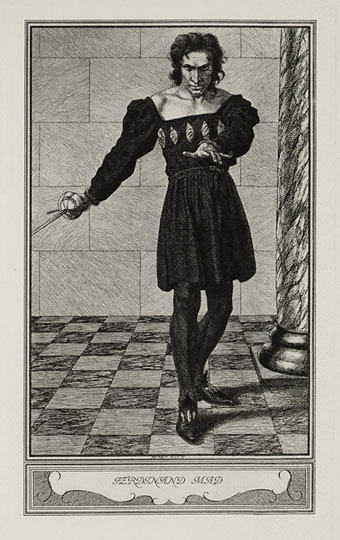
Tuesday’s bookplate post included a rather mild example by Franz von Bayros (1866–1924), the greatest pornographic artist of his generation. Quite by accident I found a substantial collection of his work earlier this week that includes more bookplates.

Von Bayros is far better known today than he would have been during his lifetime when his explicit rococo prints and drawings were available only to collectors. Erotic couplings of any variety quickly become repetitive so the Von Bayros approach was to make a feature of the decor and design, creating elaborate frames and decorative embellishments where the tiniest details emphasise the theme. Alan Moore once described this process to me as “fractal porn”, something you can see at work in these bookplates which are part of a substantial cache at Zeno.org. This is the best collection of Von Bayros art I’ve seen anywhere, quality copies for the most part, in with what appear to be complete sets from each of his illustrated editions. Whenever I look at this artist’s work I think it’s a shame he wasn’t gay. But then as Osgood says at the end of Some Like It Hot: “Nobody’s perfect!”

bayros02.jpg

bayros03.jpg

Continue reading “Erotic bookplates by Franz von Bayros”

German bookplates

exlibris08.jpg

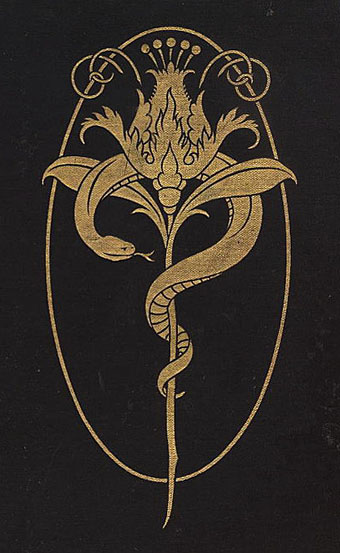
A selection from Das Moderne Deutsche Gebrauchs-Exlibris (1922) edited by Richard Braungart, an overview of the practioners of the bookplate form in Germany and Austria during the first decades of the 20th century. Some of the German and Austrian art magazines featured here over the past couple of years included bookplate designs, and Braungart’s collection includes many artists from those magazines: Melchior Lechter, Hugo Höppener (aka Fidus), Julius Diez, Heinrich Vogeler, Marcus Behmer, Franz von Bayros, Koloman Moser, Carl Otto Czeschka, Ephraim Moses Lilien, Franz Stassen and others. 400 examples in all.

exlibris01.jpg

exlibris02.jpg

Continue reading “German bookplates”

Jarek Piotrowski’s Soft Machine

piotrowski1.jpg

Jarek Piotrowski is a Polish-born Canadian artist whose exhibition of hand-cut PVC mats at Galerie8, London, borrows a title and inspiration from William Burroughs’ The Soft Machine. From the usual slab of gallery-speak:

Drawing on the subversive William S. Burroughs novel The Soft Machine (1961), Piotrowski’s work explores themes of the human body under siege, repetitive rituals and institutions of control. Through an immersive installation of paintings, cut-outs, experimental music and live performance, structure and order are broken down and unanswered fundamental questions of human nature confronted.

These creations no doubt look better in situ than in photos. The close-up below makes me think of Brion Gysin’s meshed calligraphy and the slots in his Dreamachines. Piotrowski talked to Dazed Digital about the Burroughs influence:

I don’t necessarily have a favourite part of the book, I like it as a gesture in itself completely rather than a particular part. I think of it more as an entity, but I do particularly like the phrase, ‘two assholes and a mandrake’ – it is a beautiful picture that I find quite intriguing.

Soft Machine runs to March 11th, 2012.

piotrowski2.jpg

Elsewhere on { feuilleton }
The William Burroughs archive