Palladini’s Aquarian Tarot

palladini01.jpg

For the past two months I’ve been busy drawing a new set of Tarot designs. More about these later, but sporadic research has naturally led to me to look at a few earlier sets, although my Trumps have mostly been following Pamela Colman Smith’s illustrations for the Waite deck. Tarot designs have really proliferated in the past few years (Is there a Lego Tarot? Yes, of course there is), so much so that many previous designs which would once have been notable are now swamped by mediocre decks.

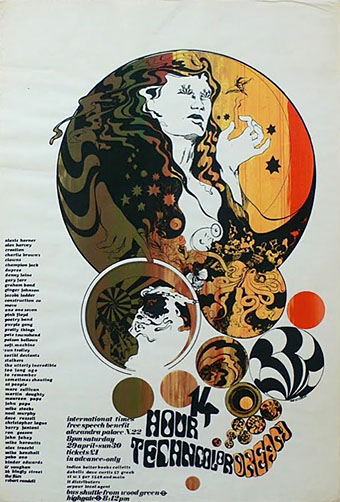
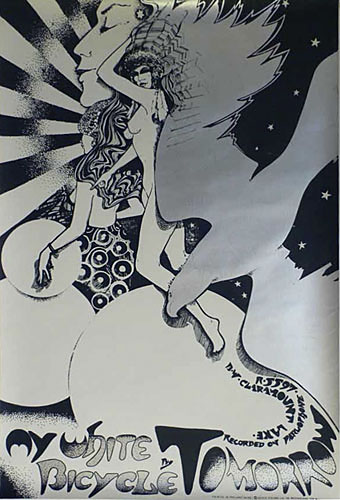
David Palladini’s Aquarian Tarot first appeared in 1970 when the occult revival was getting into its stride. Palladini had contributed to the Linweave Tarot in 1967 along with three other artists, something you can read more about at the excellent Sweet Jane’s Pop Boutique. I’m sure I must have seen the Aquarian Tarot in the past but probably dismissed it for being too modish and not occult enough; for a long time Aleister Crowley’s Thoth deck was the only one I’d look at. Palladini’s art is a lot more familiar now that his fabulous poster for Nosferatu the Vampyre looks down on me every day, and I’ve grown to enjoy his combination of Art Nouveau and Deco motifs so much that I wouldn’t mind a pack of these cards. The Aeclectic site reviews the deck, and has a few more examples of the designs. They also review the New Palladini Tarot which the artist produced in 1996. Given the choice I’d still go for the earlier set.

palladini02.jpg

Continue reading “Palladini’s Aquarian Tarot”

George Barbier’s Nijinsky

barbier05.jpg

An inevitable one this, given the amount of times that George Barbier’s work has been featured here. Designs on the Dances of Vaslav Nijinsky was a series of prints published in 1913 when the dancer was at the height of his celebrity. All of Nijinsky’s major roles are represented although this isn’t quite the complete set. There did used to be a Japanese site with several galleries of Barbier’s early prints but this has now disappeared.

barbier04.jpg

Schéhérazade.

barbier02.jpg

Prélude à l’après-midi d’un faune.

barbier01.jpg

Schéhérazade.

barbier10.jpg

L’oiseau de feu.

Continue reading “George Barbier’s Nijinsky”

The Rite of Spring and The Red Shoes

redshoes1.jpg

The Red Shoes: Moira Shearer and Léonide Massine.

Emeric is often too easily accused of basing the principal male character of The Red Shoes on Serge Diaghilev, to which he replies: “There is something of Diaghilev, something of Alex Korda, something of Michael, and quite a little bit of me.”

Michael Powell, A Life in Movies (1986)

Despite Emeric Pressburger’s qualificatory comments, there’s a lot more of the Ballets Russes in Powell and Pressburger’s film of The Red Shoes (1948) than first meets the eye. Or so I discovered, since I’d known about the film via my ballet-obsessed mother for years before I’d even heard of Diaghilev or Stravinsky. The most obvious connection is the presence of Léonide Massine who took the leading male roles in Diaghilev’s company following the departure of Nijinsky. He also choreographed Parade, the ballet which featured an Erik Satie score and designs by Picasso. The fraught relationship between Diaghilev and Nijinsky forms the heart of The Red Shoes: Anton Walbrook’s impresario, Boris Lermontov, is the Diaghilev figure while the brilliant dancer who obsesses him, and for whom he creates the ballet of The Red Shoes, is Moira Shearer as Victoria Page. That the dancer happens to be a woman is a detail which makes the film “secretly gay”, as Tony Rayns once put it. Diaghilev and Nijinsky were lovers, and fell out when Nijinsky married; in The Red Shoes Lermontov demands that Vicky choose between a life of art or a life of marriage to composer Julian Craster (Marius Goring). She chooses love but ends up drawn back to art, with tragic consequences that mirror the Hans Christian Andersen story. That story, of course, ends with a young woman dancing herself to death after donning the fatal shoes, a dénouement that’s unavoidably reminiscent of The Rite of Spring.

redshoes2.jpg

Anton Walbrook as Lermontov.

Lermontov: Why do you want to dance?

Vicky: Why do you want to live?

Other parallels may be found if you look for them, notably the figure of Julian Craster who comes to Lermontov as a young and unknown composer just as Stravinsky did with Diaghilev. Craster’s music isn’t as radical as Stravinsky but The Red Shoes was already giving the audience of 1948 enough unapologetic Art with a capital “A” without dosing them with twelve-tone serialism. The film aims for the same combination of the arts as that achieved by Diaghilev, especially in the long and increasingly fantastic ballet sequence. This was another of Powell’s shots at what he called “a composed film” in which dramaturgy and music work to create something unique. The Red Shoes is a film that’s deadly serious about the importance of art, a rare thing in a medium which is so often at the mercy of Philistines. In the past I’ve tended to favour other Powell and Pressburger films, probably because I’ve taken The Red Shoes for granted for so long. But the more I watch The Red Shoes the more it seems their greatest film, even without this wonderful train of associations. The recent restoration is out now on Blu-ray, and it looks astonishing for a film that’s over sixty years old.

Seeing as this week has been all about The Rite of Spring, here’s a few more centenary links:

Stravinsky’s The Rite of Spring, Visualized in a Computer Animation for its 100th Anniversary
• George Benjamin on How Stravinsky’s Rite of Spring has shaped 100 years of music
Strange Flowers visits the Théâtre des Champs-Elysées

Previously on { feuilleton }
The Rite of Spring, 2001
The Rite of Spring, 1970
The Rite of Spring reconstructed

The Rite of Spring, 2001

preljocaj1.jpg

Now this one is fantastic… Angelin Preljoçaj’s modern dance interpretation is wildly energetic, and, after a century of the music becoming increasingly familiar, manages to return some of the shock value to the ballet. Preljoçaj dispenses with symbolism and brings the sexual nature of the material to the fore, with recurrent instances of coercion that will no doubt prove intolerable for some viewers. All one can say to that is that this is a ballet which has always been about primitive erotic rituals which culminate in a chosen sacrifice being forced to dance herself to death. (The third part of the ballet—Jeu du rapt—was bluntly translated on a recording I used to own as “Game of Rape”.) For the finale of Preljoçaj’s version the dancer (uncredited, I’m afraid) performs naked. The televised performance benefits a great deal by having a score courtesy of Daniel Barenboim and the Chicago Symphony Orchestra thundering away in stereo. It’s a thrilling piece which shows that a century on The Rite of Spring has lost none of its power when carefully staged. Kudos to Ubuweb for turning up the goods once again.

preljocaj2.jpg

Previously on { feuilleton }
The Rite of Spring, 1970
The Rite of Spring reconstructed

The Rite of Spring, 1970

bejart1.jpg

Another film of the ballet that’s useful as a comparison to the later reconstruction. Maurice Béjart’s Ballet du XXe Siècle show how the music might be interpreted if the original ballet is pretty much discarded. The choreography is by Béjart himself, and for me creates a mixed impression. Women are wholly absent from the first half despite the ballet being about the spring rituals between groups of young men and women. In place of Nijinsky’s stamping crowd there’s a great deal of hopping around which runs the risk of looking more comical than pagan. The second half works better when the company creates a shifting arrangement of Busby Berkeley-like groupings. In place of the ceremonial sacrifice at the end we have some erotic mime which was no doubt advanced for 1970 but which packs less of a punch than the strange and terrible finale of the Joffrey performance. Where the original ballet still seems fresh, the 1970 version now appears rather dated. The whole thing is available for viewing at Ubuweb.

bejart2.jpg

Previously on { feuilleton }
The Rite of Spring reconstructed