The art of Robert W. Richards

richards1.jpg

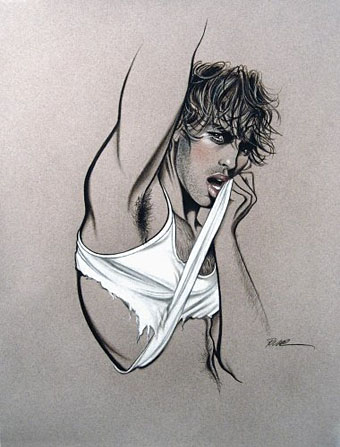
The latest interview at the essential BUTT magazine is Danny Calvi talking to ex-fashion illustrator and erotica artist Robert W. Richards about his life and work. I’d seen some of Richards’ drawings before but this is the first time I’ve seen him interviewed; one of the many commendable things about BUTT is the way they seek out people such as this to talk to, people who’ve been producing gay art for years but who the glossy, celebrity-obsessed mags will seldom mention. My only complaint is that some of their interviews aren’t longer.

richards2.jpg

As can be seen from the examples here, Richards’ career in the fashion world helped hone a technique and a command of line that’s very accomplished. When you’re this good it’s easy to stick to doing strictly commercial work, and avoid anything overtly explicit, gay or straight. Richards doesn’t seem to have been too worried about maintaining a sex-free reputation. BUTT has more examples of his drawings, as does Juxtapoz. There’s also a book, Allure, published by Bruno Gmünder. Stroke: From Under the Mattress to the Museum Wall, an exhibition of Richards’ art at the Leslie + Lohman Museum, New York, runs from March 28 to May 25, 2014.

Elsewhere on { feuilleton }
The gay artists archive

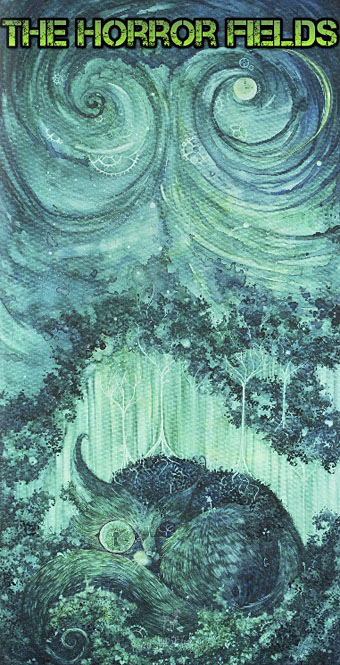
The Horror Fields

horror.jpg

Cover art: In the Palm of the Absinthe Woods by Aria/ShePaintsWithBlood.

Last year I was asked to contribute a piece of fiction to a rural horror special of Morpheus Tales. In time for the Spring Equinox, The Horror Fields, edited by Matt Leyshon, is now unleashed. Inside there’s my short story, Figures in a Landscape, plus contributions from Rosalie Parker, Don Webb, Edward Pearce, Murphy Edwards & Brian Rosenberger, James Everington, Richard Farren Barber, Ian Hunter, Justin Aryiku, and Rhys Hughes.

Two editions are available at Lulu: digest-sized, and A4 size; both editions are discounted until the end of the month. There should also be a Kindle edition soon so when I have details I’ll mention them here. I’d recommend reading this in a field at night but here in the northern hemisphere it’s still a little too cold for that.

Previously on { feuilleton }
Robin Redbreast by John Bowen
Red Shift by Alan Garner
Children of the Stones
Penda’s Fen by David Rudkin

A triangular book about alchemy

alchemy1.jpg

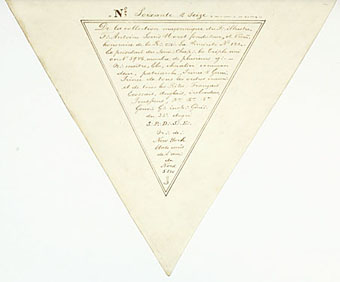
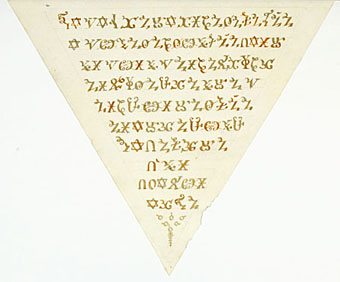
Triangular buildings aren’t so very unusual, triangular books, on the other hand, are less common. This example is from the Manly Palmer Hall collection of alchemical manuscripts at the Internet Archive, not only a triangular book but one where most of the pages are written in a symbolic alphabet. A reviewer supplies the following details (which may not be accurate so the usual caveats apply):

“No. Soixante & Seize” de la collection maconnique du F… Ex Dono Sapientissimi Comitis St. Germain Qui Orben Terrarum Per Cucurrit ca. 1775. Hogart MS 209.

This manuscript bought from Frank Hollings, a London antiquary, after 1933 (he apparently was unaware of the Hauser St. Germain manuscript) came from the occult library of Mme. Barbe, who had it from the bibliographer Stanislaus de Guaita, who in turn bought it at the auction of the library of Jules Favre. It is a copy made from one of the magical texts in the possession of St. Germain by the owner’s permission. A number of such copies were executed for the members of his Masonic lodge in Paris, and the following manuscript, as different in style as it is, may be one of the copies too. It is unclear in both cases whether the Comte St. Germain wrote the magical formulae or owned a copy of an ancient text. This manuscript was made for Antoine Louis Moret, a French emigre to America active in Masonry and in politics.

Does the 76 on the cover refer to the year the book was made, or does it have some other significance? One of the meanings assigned to the number 76 in the Sepher Sephiroth is “Secret, put away; a hiding place”, so the latter is a possibility. See the entire volume here.

alchemy2.jpg

alchemy3.jpg

alchemy4.jpg

Continue reading “A triangular book about alchemy”

Tresham’s Trinities

lodge.jpg

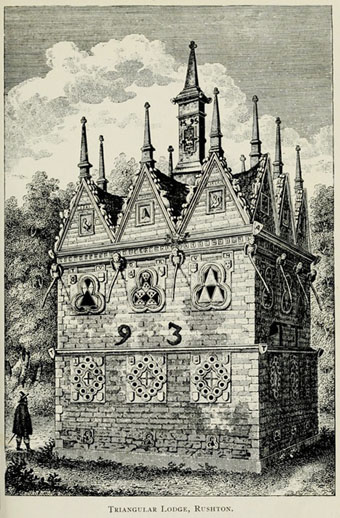
Memorials of Old Northamptonshire (1903), a book edited by Alice Dryden, includes an entire chapter by M. Jourdain about Thomas Tresham’s Triangular Lodge. Descriptions of the building usually skate over the Catholic symbolism encoded in its structure but Jourdain goes into some detail describing the many inscriptions and numerological details. The engraved illustration is rather good as well, although it makes the lodge appear a more squat than it should be. The chapter also contains a description of further symbolism at Tresham’s Lyveden manor. Read it here.

Previously on { feuilleton }
The Triangular Lodge again
The Triangular Lodge

The Triangular Lodge again

temples.jpg

Artwork & photography by Abbie Stephens, Zoë Maxwell. Design by Thomas Caslin.

Passing through a record shop the day after looking at photos of the Winchester Mystery House I couldn’t help but notice this sleeve for the debut album by British band Temples. Yesterday I described Sarah Winchester’s house as a folly, which it is, but it was also her home. The ideal folly is an ostensibly purposeless structure, although many of the ones scattered around the UK do serve some kind of decorative function, often as fake ruins intended to be seen from a distance.

Thomas Tresham’s mysterious Triangular Lodge near Rushton, Northants, has always been a favourite, a small triangular building constructed in the 16th century, and encoded all over with references to the number 3. Tresham was a Catholic at a time when the faith was persecuted in England so the lodge is an expression of his devotion to the Holy Trinity. Given the unusual appearance of the building you’d think it might have appeared on an album cover before now. Temples are from Kettering in Northants so they can claim some local attachment to the place. The cover picture has something of a Hipgnosis look to it, which is no bad thing, and there’s also some Hipgnosis-style collaging at work; those trees in the background have been copied then flipped over. One benefit of the current vinyl resurgence is that sleeve designs like this aren’t spoiled by being only seen at CD size. Some of Temples’ songs can be heard on their SoundCloud page, while Pinterest has more views of the Triangular Lodge.

Elsewhere on { feuilleton }
The album covers archive

Previously on { feuilleton }
The Triangular Lodge