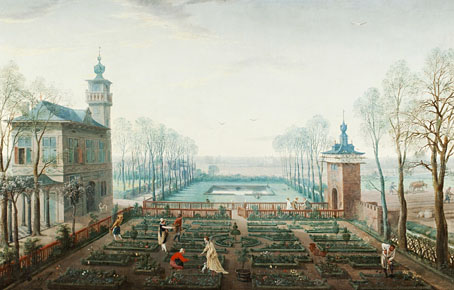
April, Works in a Garden (1614) by Jan Wildens.
The cruellest month in paintings. Snowy scenes abound for this time of year but I’ve avoided those.
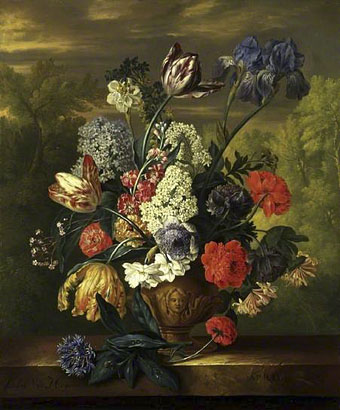
Twelve Months of Flowers: April (no date) by Jacob van Huysum.
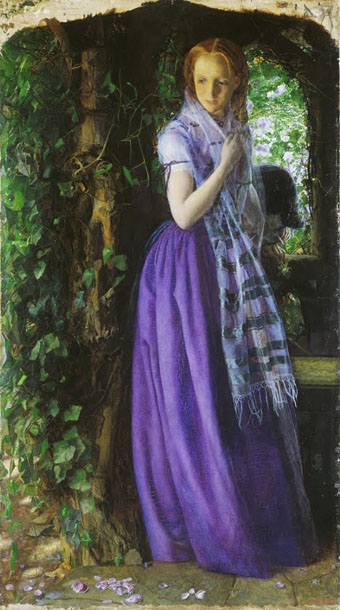
April Love (c. 1855) by Arthur Hughes.
A journal by artist and designer John Coulthart.

April, Works in a Garden (1614) by Jan Wildens.
The cruellest month in paintings. Snowy scenes abound for this time of year but I’ve avoided those.
Twelve Months of Flowers: April (no date) by Jacob van Huysum.
April Love (c. 1855) by Arthur Hughes.
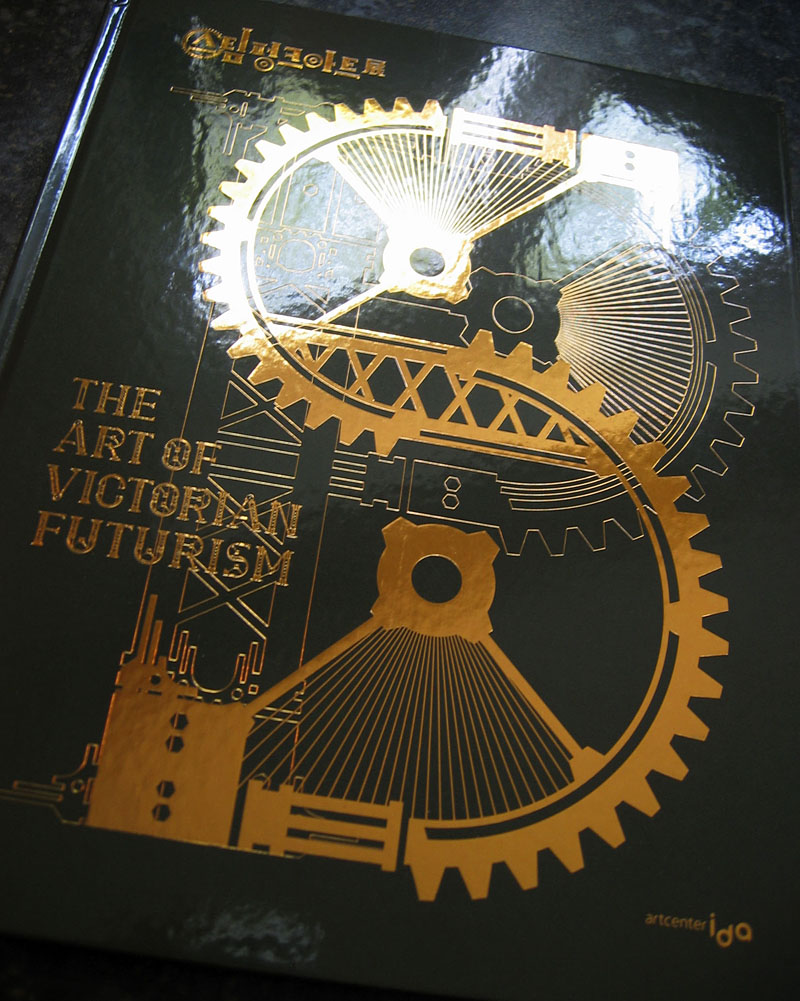
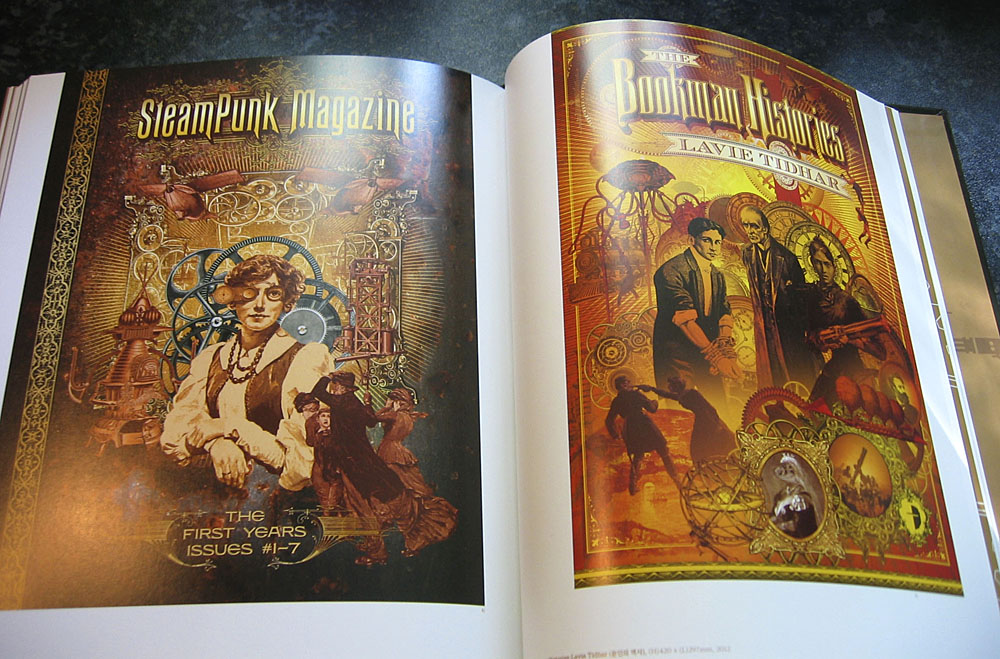
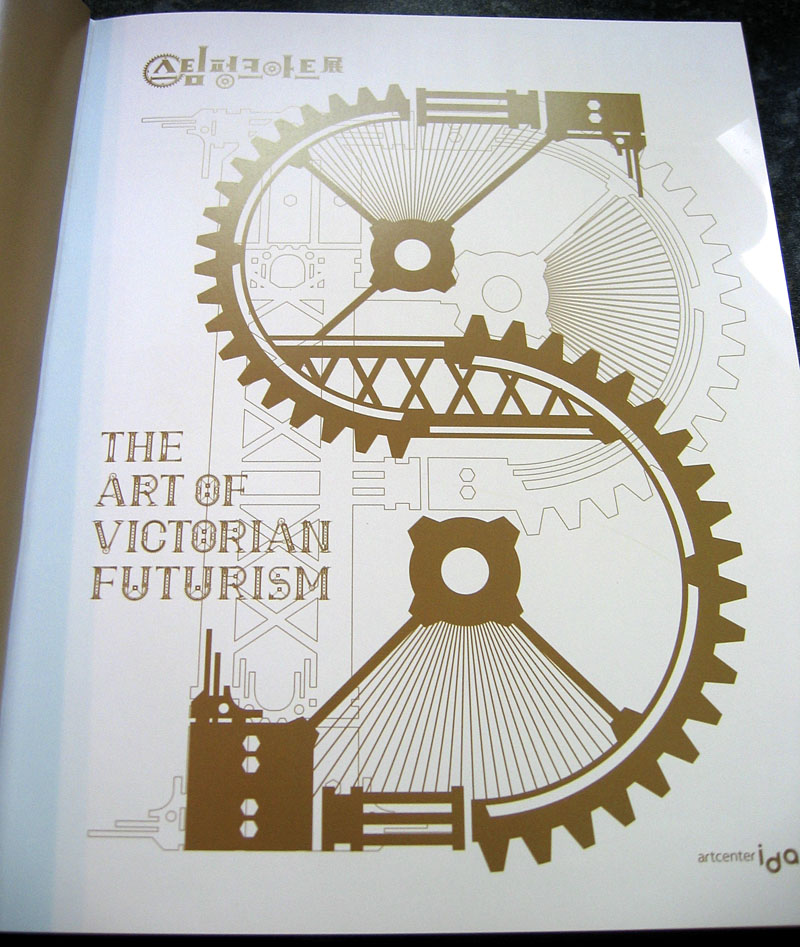
Another month, another exhibition catalogue. Steampunk: The Art of Victorian Futurism is still running at Artcenter IDA in Seoul with a selection of my book covers on display among a great variety of mechanical sculptures, costumes and other creations. The catalogue is a suitably lavish affair, so much so that it puts to shame many of the bandwagon-jumping coffee-table books that have been appearing recently. Excellent printing with lots of gold-ink embellishment, and all the exhibits are given substantial space. I especially like the mechanical type designs, and can now credit them to designers Se Byeol Moon and Han Woong Yoon. Korean TV news has run a couple of reports about the exhibition, the best of which may be seen here. The exhibition itself continues until May 18th.

Previously on { feuilleton }
• Steampunk: The Art of Victorian Futurism
• Steampunk Calendar
• Words and pictures
• Nathanial Krill at the Time Node
• Fiendish Schemes
• Ghosts in Gaslight, Monsters in Steam
• Steampunk Revolution
• The Bookman Histories
• Aether Cola
• Crafting steampunk illustrations
• SteamPunk Magazine
• Morlocks, airships and curious cabinets
• The Steampunk Bible
• Steampunk Reloaded
• Steampunk overloaded!
• More Steampunk and the Crawling Chaos
• Steampunk Redux
• Steampunk framed
• Steampunk Horror Shortcuts
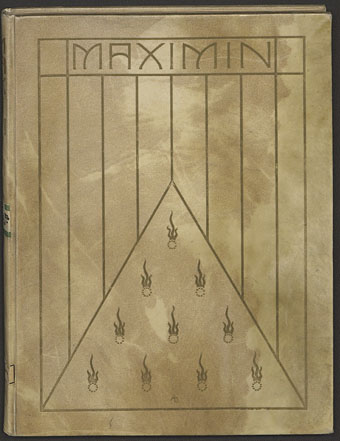
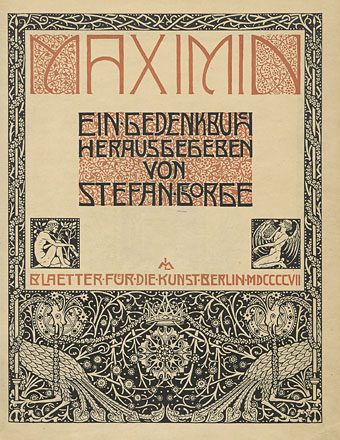
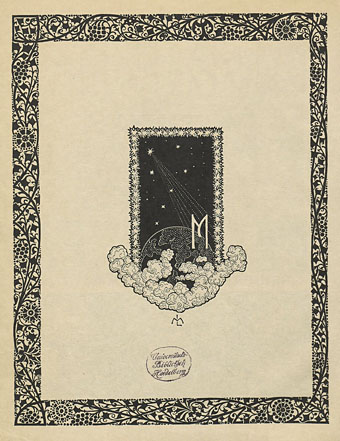
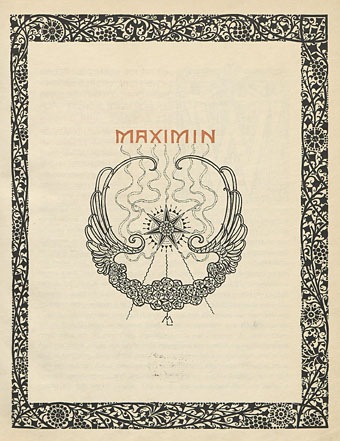
This is a strange and beautiful book, a loving paean to a dead boy-poet from another poet, Stefan George (1868–1933), published in 1907. The “Maximin” of the title was Maximilian Kronberger (1888–1904) who was around 14 when he met George; the older man was 34 at the time. George was apparently smitten by the boy, and devastated when he died from meningitis two years later. Maximin: ein Gedenkbuch (A Memorial Book) is the result, a collection of mournful poems, beautifully designed and illustrated by Melchior Lechter in that rectilinear Art Nouveau style which the artist made his own. The memory of the dead Maximin became for George a quasi-religious obsession which makes Maximin the bible of the homosocial cult that George subsequently encouraged.
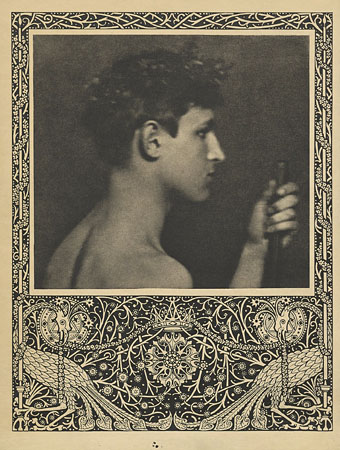
What’s most surprising about all this behaviour is that it did nothing at all to harm his reputation, even among the Nazis who later revered his poetry. George was a contemporary of Oscar Wilde but the pair were poles apart in character, George’s chilly, high-minded aestheticism preserving him from the brickbats aimed at Wilde and others. Nonetheless, the inherent camp that results from the combination of such a remote attitude combined with flagrant boy-worship secured for George a place alongside Wilde in Philip Core’s essential Camp: The Lie that Tells the Truth (1984):
Strangely enough his overtly (if classically) homosexual verses, his preference for beautiful youth, and his severe black-clad dignity, all became immensely popular in the land of brüderschaft (brothers’ love). The camp Classicism of his ‘academy’ of the spirit, in surroundings of neo-Classical kitsch, hit just the right middle ground between Edwardian sentimentality and Hitlerian Imperialism.
Maximin: ein Gedenkbuch may be browsed or downloaded at the University of Heidelberg. There’s a more academic examination of George’s homoerotics here. Further page samples follow.

Discovered via the latest issue of The Wire magazine in a feature about compilation albums, The Rock Machine Turns You On (1968) was the first budget sampler album. Given the success of this release I’m sure I must have seen it over the years but that cover wasn’t familiar at all. I have to assume that the “Hey, pop kids!” title would have been enough of a turn-off to ensure the fingers kept flipping through the sleeves. Priorities change with the passing of time, however, and my attention was caught by the cover art alone, another example of the engraving-collage style whose evolution I’ve been tracing over the past few years. The only design credit on the sleeve is for the back cover photo by Wadham Artists. The front cover is credited online to Milton Glaser, some of whose album covers have already featured here. He was working for Columbia/CBS in the late 60s so it’s a possibility. If anyone out there has a copy of the vinyl then maybe they can tell me if that’s an artist credit in the lower right of the picture. A CD reissue in 1996 only copied the album credits.
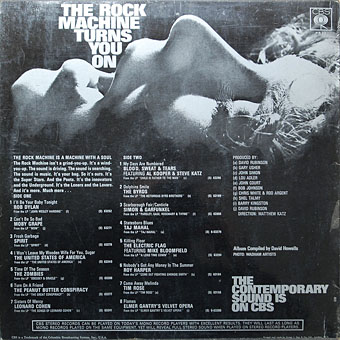
As to the music, it’s a pretty good compilation, lots of familiar names together with a track from cult favourites of mine The United States of America whose one and only self-titled album had been released that year. One of the few negatives about the superb United States of America album is the cover design which isn’t bad but does nothing to reflect the extraordinary musical invention within. It’s a shame that whoever designed The Rock Machine… couldn’t have worked on that sleeve as well.
Update: Rick Poynor writes to say that this cover appears in Milton Glaser: Pop, so the Glaser attribution is accurate.
Elsewhere on { feuilleton }
• The album covers archive
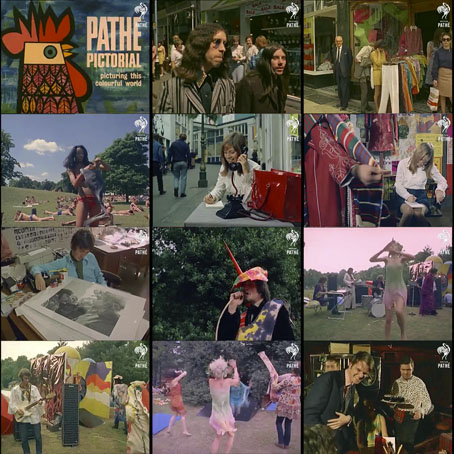
My thanks to Jay for turning up this gem from the huge British Pathé archive which recently landed at YouTube. British Pathé provided short newsreel films for UK cinemas up until 1970. The flaws of these films have always been immediately apparent, chiefly an irritating editorial attitude manifested by patronising voiceovers and sequences staged for the camera. On the plus side, everything was being shot for cinema screens so 35mm film was used which means the footage always looks better than the TV news of the time.
Swinging Britain is an 8-minute jaunt from the Portobello Road and Carnaby Street, to the offices of Intro magazine (launched that year), Mary Quant’s boutique, a “happening” in a park, and various nightclubs (not the UFO, unfortunately). Most footage along these lines tends to concentrate exclusively on London but this one also includes scenes in Manchester and Newcastle. The voiceover is as sceptical as you’d expect, leavened with a few qualifying remarks: “It’s good business for Britain!” The event in the park was one of a number of happenings and art events staged by Keith Albarn (Damon’s dad). The Pathé archive has another film showing the interior of Albarn’s Fun City environment at Margate, Kent. Of more general interest is this film of one of the popular beat groups of the period, four young men who call themselves The Pink Floyd.
See also:
• Woburn Love-In (1967)
• Light Fantastic (1968)
• Out Takes / Cuts From Cp 662 – Reel 1 Of 3 – Swinging Britain (1967)
• Out Takes / Cuts From Cp 662 – Reel 2 Of 3 – Swinging Britain (1967)
• Out Takes / Cuts From Cp 662 – Reel 3 Of 3 – Swinging Britain (1967)
• Out Takes / Cuts From Cp 719 – Fun Palace, Air Cushion And Balloon Race (1968)
Previously on { feuilleton }
• San Francisco by Anthony Stern
• Smashing Time