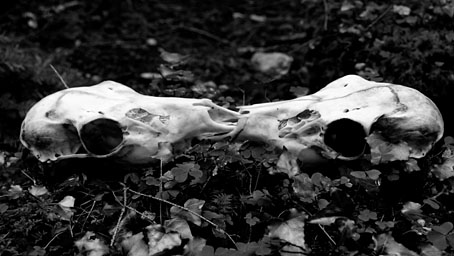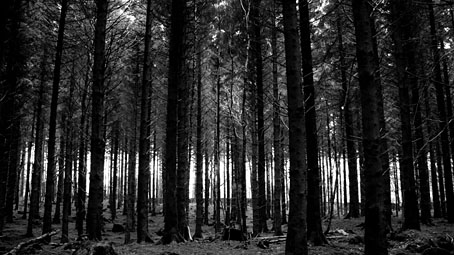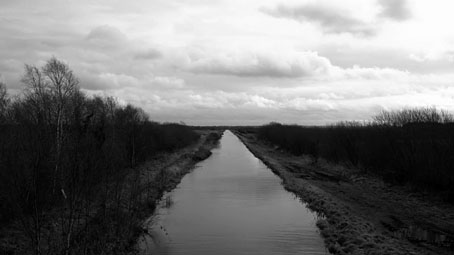
Dave Colohan was in touch recently to tell me he enjoyed the posts here (thanks, Dave) and also to point the way to Newlyborn, a short film he’s made. This is a moody piece that suits the season, black-and-white shots of South Longford, Ireland, accompanying Niamh Beirne’s narration. The music is minimal but Dave Colohan has a growing discography of music production by himself and in collaboration with others. I’d come across Taskerlands before—immediately notable because their name is a reference to The Stone Tape—and have had Raising Holy Sparks recommended to me, but there’s more there to explore. The No Longer Reel Vimeo channel has three videos for Raising Holy Sparks.
The Devil’s Cabaret

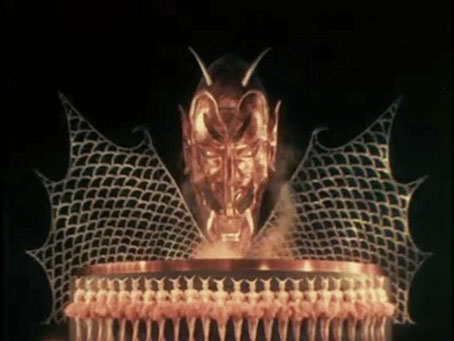
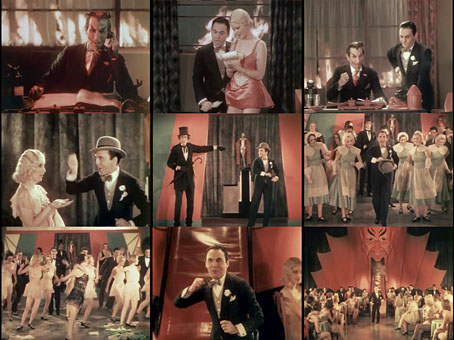
Halloween approaches so here’s a frivolous piece of Hollywood Diablerie. The Devil’s Cabaret (1930) was one of several short films made to showcase dance sequences shot for The March of Time, an MGM musical abandoned by the studio halfway through production. The footage from the earlier film is a short ballet sequence featuring a company of horned ballerinas dancing around an enormous, leering Devil’s head. Dimitri Tiomkin composed the music. All the footage was shot using an early Technicolor process so the film is subtitled “A Colortone Novelty”.

The framing narrative is a sequence of short sketches that offend many of the principles the Hays Code was brought in to protect a few years later. An uncredited Charles Middleton (Ming the Merciless in the Flash Gordon films) is a CEO-like Satan urging his Vice President Howie Burns (geddit?) to counter Heaven’s successes by bringing more souls to Hades (the word “Hell” only gets used at the end but after 1934 it was banned from use altogether). Burns does this by interrupting a religious meeting on Earth with a jazzy dance sequence that turns into a strip show; everyone in the audience rushes to join the damned. Once in Hades the newcomers are treated to the March of Time ballet. Elsewhere there’s some laboured humour, references to the Wall Street Crash and Prohibition, and a fair amount of salacious dialogue. Films such as these are always a good reminder of how risqué Hollywood could be before everyone adopted the production code. (Thanks to Gabe for the tip!)
• The Devil’s Cabaret: part one | part two
Previously on { feuilleton }
• Chocolate devils
• Harry Lachman’s Inferno
Wildeana 13
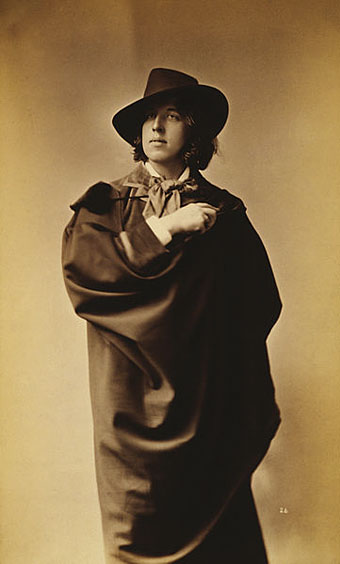
Oscar Wilde, no. 26 (1882). One of a series of photo portraits taken by Napoleon Sarony when Wilde was in New York.
Every day is an anniversary for something. Among other things, October 16th 2014 is the 160th anniversary of the day that Oscar Wilde was brought to Earth in a spaceship—see Velvet Goldmine for details—so in honour of that moment here’s a few more Wildean links.
• One item of news I missed last month was Al Pacino’s announcement that he’ll be bringing his production of Wilde’s Salomé to the London stage in 2016. Good to hear that his enthusiasm was sparked by the excellent Steven Berkoff production, and this detail is especially noteworthy: “There will be make-up, sets, costumes… and decadence. It will be a whole different thing to what we did in America.”
• Turkish censors still have problems with Anglophone novels that publishers attempt to present in Turkish translations—the work of William Burroughs caused a fuss a couple of years ago—but last month an uncensored edition of The Picture of Dorian Gray was published there for the first time.
• Oscar Wilde’s grandson Merlin Holland: “We’ve got as close as we can to hearing him speak” Holland has co-written The Trials of Oscar Wilde, a dramatisation of Wilde’s court appearances which opens at Trafalgar Studios, London, this week.
• The extraordinary story of Oscar Wilde’s holiday in Worthing in 1894. James Connaughton interviews Antony Edmonds about his new book, Oscar Wilde’s Scandalous Summer: The 1894 Worthing Holiday and the Aftermath.
• The beau of Reading jail: was prisoner 1122 Oscar Wilde’s lover? (The answer to any newspaper headline ending with a question mark is invariably “No”.)
Elsewhere on { feuilleton }
• The Oscar Wilde archive
Ivan Bilibin’s Russian Wonder Tales

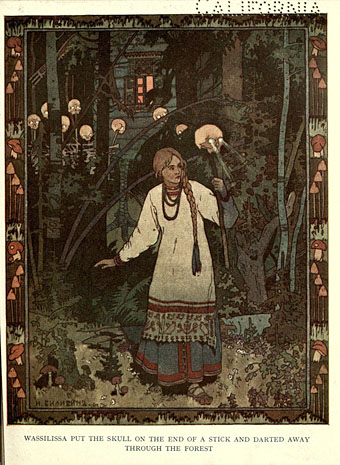
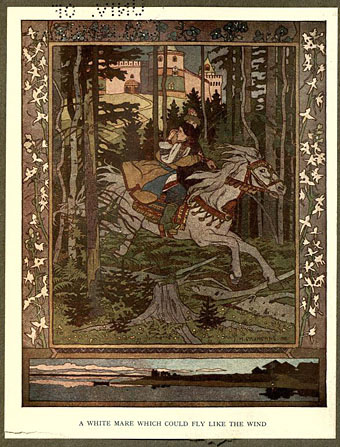
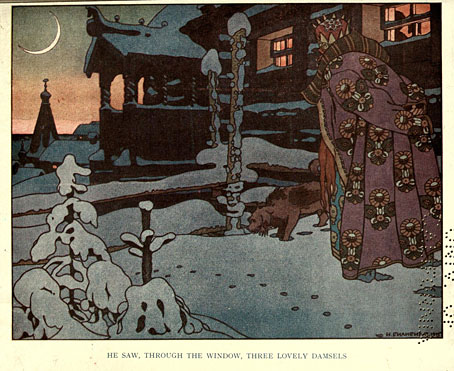
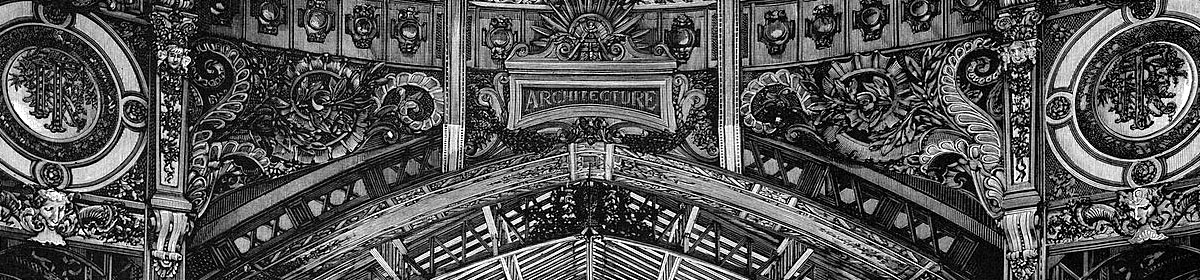
Halloween approaches so a picture of Wassilissa the Beautiful carrying a skull on a stick suits the season, as do the psilocybin-like mushrooms in the border. This edition of Russian Wonder Tales (1917) was a retelling of Russian folk tales by Post Wheeler for a British readership. Ivan Bilibin’s illustrations date from some twenty years earlier, however, and their colours are compromised by age and printing, but you at least get to see them with their stories in English. Among the pictures below there’s a nice portrait of the ever-bizarre Baba Yaga scooting through the forest.


Here and There, a film by Andrzej Pawlowski
I only realised earlier today that the post about The Saragossa Manuscript provides continuity with last week’s examples of Polish cinema; unintentional but it shows where my head is at just now.
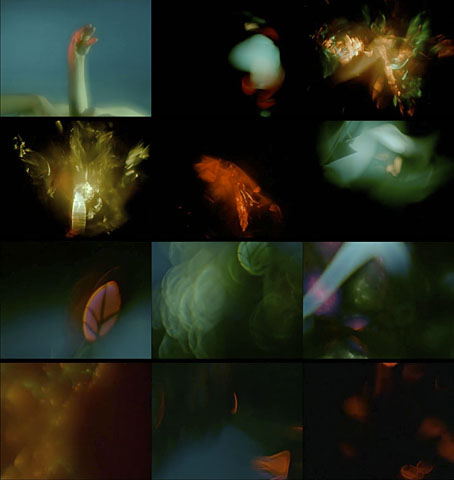
Here’s another example, and another abstract filmmaker I hadn’t come across before. Andrzej Pawlowski (1925–1986) was also a painter, and his films take a painterly approach to their manipulation of light and colour. Here and There is a short from 1957 that would have been labelled psychedelic if it had been made ten years later. The gorgeous visuals seem at odds with the score by Adam Walacinski, a typical piece of mid-century dissonance that now seems less avant-garde than merely unsuitable. One challenge of abstract cinema is to find music (if music is required) that doesn’t seem to have been chosen at random. Here and There would work just as well with many other six-minute pieces as its score.
Elsewhere on { feuilleton }
• The abstract cinema archive