Noxious administrations

nixon.jpg

President Nixon by Gerald Scarfe (1972).

“Nixon was a professional politician, and I despised everything he stood for—but if he were running for president this year against the evil Bush-Cheney gang, I would happily vote for him.” Hunter S Thompson, Fear and Loathing, Campaign 2004.

Hunter S Thompson wasn’t the only Nixon critic to regret the passing of his old enemy with the advent of the current regime. Watergate reporter Carl Bernstein was saying pretty much the same thing in 2004; two years on, his opprobrium is a lot more severe.

Carl Bernstein: Bush Administration Has Done ‘Far Greater Damage’ Than Nixon

Editor & Publisher
Published: January 24, 2007 4:00 PM ET updated Thursday

NEW YORK In an online chat at washingtonpost.com on Wednesday afternoon, Carl Bernstein, the famed Watergate reporter at that paper and now writing articles for Vanity Fair, took several hard shots at the current Bush administration—almost every time he was asked about the Nixon era. It came just as news of the death of former Watergate ringleader E. Howard Hunt was circulating widely.

After a long explanation of how the American system “worked,” eventually, with Watergate, Bernstein said:

“In the case George W. Bush, the American system has obviously failed—tragically—about which we can talk more in a minute. But imagine the difference in our worldview today, had the institutions—particularly of government—done their job to ensure that a mendacious and dangerous president (as has since been proven many times over, beyond mere assertion) be restrained in a war that has killed thousands of American soldiers, brought turmoil to the lives of millions, and constrained the goodwill towards the United States in much of the world.”

Later, asked if the Nixon administration was unique in hiring disreputable characters, he replied: “Until the Bush-43 administration, I had believed that the Nixon presidency was sui generis in modern American history in terms of your question…

“In terms of small-bore (but dangerous) characters like Howard Hunt and Gordon Liddy with their schemes, I doubt that any presidency approaches the criminality of the Nixon White House. But the Watergate conspiracy—to undermine the constitution and use illegal methods to hurt Nixon’s political opponents and even undermine the electoral system—was supervised by those at the very top.

“In the current administration we have seen from the President down—especially Vice President Cheney, Attorney General Gonzales, Condoleeza Rice, Donald Rumsfeld—a willingness to ignore the great constitutional history of the United States—to suspend, really, many of the constitutional guarantees that have made us a nation apart, with real freedoms unknown elsewhere, unrestricted by short-term political objectives of our leaders.

“Then there are the Geneva conventions: Who would have dreamed that, in our lifetime, our leaders would permit their flagrant abuse, would authorize torture, ‘renditions’ to foreign-torture chambers, suspension of habeus corpus, illegal surveillance of our own citizens….

“But perhaps worst, has been the lying and mendacity of the president and his men and women—in the reasons they cited for going to war, their conduct of the war, their attempts to smear their political opponents.

“Nixon and his men lied and abused the constitution to horrible effect, but they were stopped.

“The Bush Administration—especially its top officials named above and others familiar to most Americans—was not stopped, and has done far greater damage. As a (Republican) bumper-sticker of the day proclaimed, ‘Nobody died at Watergate.’ If only we could say that about the era of George W. Bush, and that our elected representatives in Congress and our judiciary had been courageous enough to do their duty and hold the President and his aides accountable.”

Bernstein was also asked about the CIA leak case and the leaking of Valerie Plame’s name, which he called “a truly Nixonian event, a happenstance not atypical of the take-no-prisoners politics of the Bush presidency. But it pales in comparison to the larger questions of the Constitution, of life and death, of the Geneva conventions, of the expectation that our leaders—from Condoleeza Rice to Dick Cheney, to the attorney(s) general to Paul Wolfowitz and on down and up the line speak truthfully to the American people and the Congress. They have consistently failed to do so.”

The World in 2030

2030.jpg

The incomparable Culture Archive presents an embarrassment of riches in scanned form; if only there were more sites as good as this. Easier for you to go and look for yourself than waste time reading a poor description of the place.

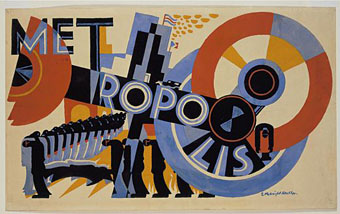
Random browsing turned up pages from the Earl of Birkenhead’s study of the state of the world a century from 1930. But it’s not the Earl’s prognostications that concern us here, rather the book’s airbrush illustrations by E McKnight Kauffer, an artist and designer better known for his Art Deco poster designs like Metropolis (1926) below.

kauffer.jpg

Previously on { feuilleton }
Metropolis posters
Frank Lloyd Wright’s future city

Wladyslaw Benda

benda1.jpg

The American Magazine, May 1933.

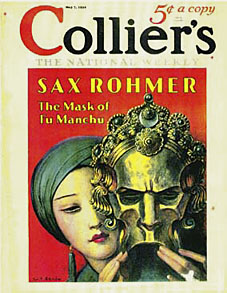
An atypical piece by Wladyslaw Theodor Benda (1873–1948), a Pole who moved to the US to work for the magazines. His illustrations are rarely this splendid but he gained a later reputation as a mask-maker, a talent that would have helped with his cover depicting the Mask of Fu Manchu for Collier’s.

benda2.jpg

Collier’s, May 7th 1932.

This page has a great succession of images showing how Benda’s original mask design managed to survive reinterpretation by subsequent Rohmer illustrators—what you might call a case of visual Chinese whispers.

Elsewhere on { feuilleton }
The illustrators archive

Previously on { feuilleton }
Vintage magazine art II
Vintage magazine art

Juice from A Clockwork Orange

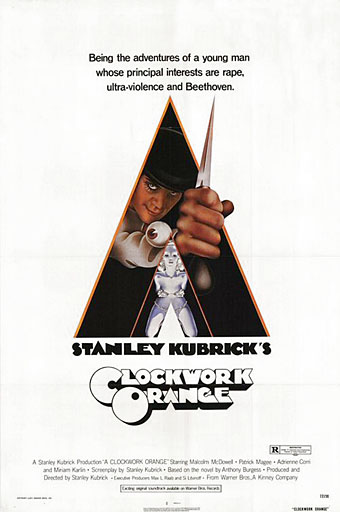
clockwork_poster.jpg

Philip Castle’s poster design. Castle also created the artwork for Full Metal Jacket.

Searching through old magazines whilst researching the epic Barney Bubbles post turned up this, a short reaction by Anthony Burgess to the success of Stanley Kubrick’s Clockwork Orange. Burgess became increasingly ambivalent about the attention brought about by Kubrick’s adaptation, not least because of the way it dominated the rest of his career; some of that ambivalence is already in evidence here.

Juice from A Clockwork Orange
by Anthony Burgess

Rolling Stone, June 8th, 1972

WHEN IT WAS first proposed about eight years ago, that a film be made of A Clockwork Orange, it was the Rolling Stones who were intended to appear in it, with Mick Jagger playing the role that Malcolm McDowell eventually filled. Indeed, it was somebody with the physical appearance and mercurial temperament of Jagger that I had in mind when writing the book, although pop groups as we know them had not yet come on the scene. The book was written in 1961, when England was full of skiffle. If I’d thought of giving Alex, the hero, a surname at all (Kubrick gives him two, one of them mine), Jagger would have been as good a name as any: it means “hunter,” a person who goes on jags, a person who doesn’t keep in line, a person who inflicts jagged rips on the face of society. I did use the name eventually, but it was in a very different novel—Tremor of Intent—and meant solely a hunter, and a rather holy one.

I’ve no doubt that a lot of people will want to read the story because they’ve seen the movie—far more than the other way around—and I can say at once that the story and the movie are very like each other. Indeed, I can think of only one other film which keeps as painfully close to the book it’s based on—Polanski’s Rosemary’s Baby. The plot of the film is that of the book, and so is the language, although naturally there’s both more language and more plot in the book than in the film. The language used by Alex, my delinquent hero, is called Nadsat—the Russian suffix used in making words like fourteen, fifteen, sixteen—and a lot of the terms he employs are derived from Russian. As these words are filtered through an English-speaking mind, they take on meanings and associations unknown to Russians. Thus, Alex uses the word horrorshow to designate anything good—the Russian root for good is horosh—and “fine, splendid, all right then” is the neuter form we ought really to spell as chorosho (the ch is guttural, as in Bach). But good to Alex is tied up with performing horrors, and when he is made what the State calls good it is through the witnessing of violent films—genuine horror shows. The Russian golova—meaning head—is domesticated into gulliver, which reminds the reader he is taking in a piece of social satire, like Gulliver’s Travels. The fact that Russian doesn’t distinguish between foot and leg (noga for both) and arm and hand (ruka) serves—by suggesting a mechanical doll—to emphasise the clockwork-view of life that Alex has: first he is self-geared to be bad, next he is state-geared to be good.

Continue reading “Juice from A Clockwork Orange”

Edward Whittemore

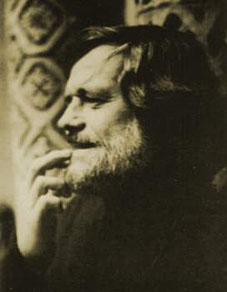
whittemore.jpg

A decade after his death, with all his books back in print, Edward Whittemore remains pretty much off the literary radar.

Whittemore was an ex-CIA agent who made the people, history and landscapes of the Middle East the subject matter of a series of remarkable novels. His books aren’t always fantasy (although they were often marketed as such) yet they contain fantastical elements; they’re frequently comic yet contain moments of pure horror; they’re witty, sexy, incredibly inventive and quite unique. They also provide another example of genre readers and writers nurturing the memory and reputation of an author the wider literary world has never heard of. Michael Moorcock and Jeff VanderMeer have both spoken highly of Whittemore in recent years and with the republication of his books in 2002 he now has access to a new generation of readers.

Anne Sydenham’s Whittemore site, Jerusalem Dreaming, has just moved to a new location and is an excellent source of information about the man and his work.